Showing posts with label Chinese Restaurants. Show all posts

Wednesday, March 25, 2009

Guoyuan Hunanese Food

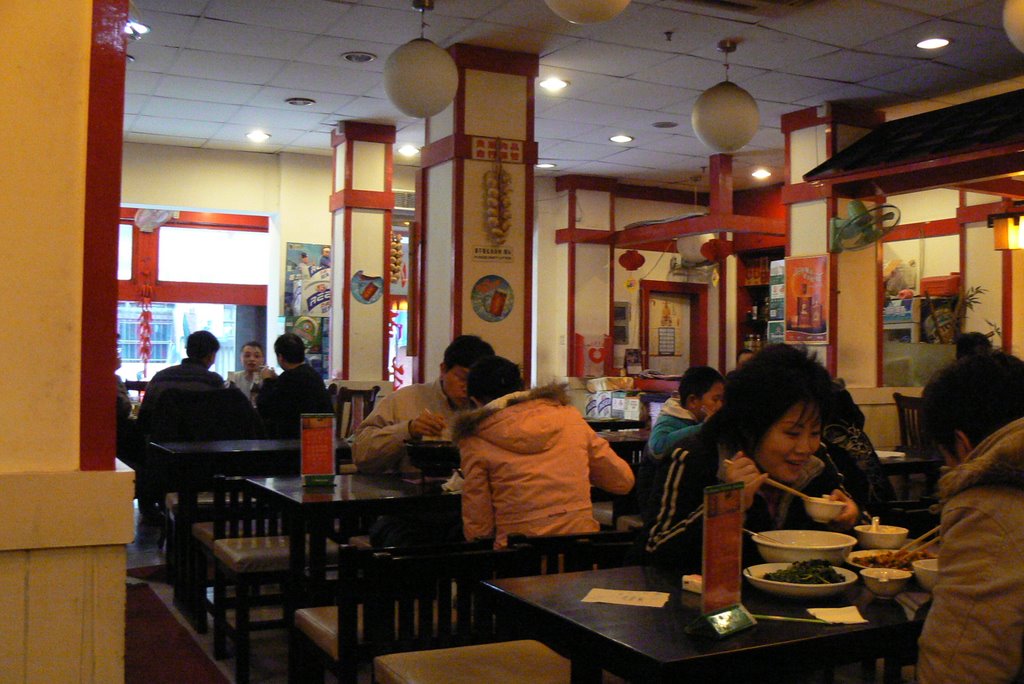
Guoyuan is a small Hunanese Restaurant, near the Hongkou football stadium. While in most regards it looks the part of a standard local restaurant, it stands out in one regard: there will almost always be a line out the front door, day or night.

It's actually a favorite restaurant of mine, and a restaurant that's very convenient for me. I don't go as often as I might like, and I'd like to take a moment to blame my friends – while it's near two subway stations, it's still not a very central location for most people. And the people I do know in the area, for the most part, can't take the spiciness. As opposed to the sweetness and even blandness of Shanghainese Foods, Hunan Food is spicy, and Guoyuan plays the part. As an extreme example, here's a plate of bamboo, covered in peppers, along with garlic, ginger, and other spices. Not to be macho, but most Shanghai residents, local or foreigners, just couldn't handle it!


The restaurant is entirely Chinese-language, and while the service is friendly, they're a bit rushed. A foreigner who doesn't speak the language and doesn't have a little familiarity with Hunan food might have a tough time. There is a list of the most popular dishes on the first page of the menu. One of the recommended dishes is found on almost everybody's table, and is really very attractive-looking, twin pepper fish head. I admit I'm not the #1 fan of fish head, so when I brought the camera I instead got fish soup. It's an interesting mélange of spices, including herbs that I usually see in a cup of tea!


How authentic is Guoyuan? There's obviously a few concessions to local tastes. For example, Shanghai people love cucumbers, and I'm guessing that spicy-oil cucumbers aren't a menu item at most restaurants in Hunan, although I quite enjoyed them:


But while I've never been to Hunan, or have any friends from Hunan, I assumed the restaurant was for the most part authentic, and I've also heard the chef is from Hunan. However when I went with a Sichuanese friend, she told me that while she enjoyed the restaurant very much, it wasn't at all what would be served in an authentic-style Hunanese restaurant in Sichuan, which borders Hunan. While obviously that could be a reflection on Sichuanese restaurants, she guessed that the restaurant adapted a lot of foods to local ingredients and tastes.

Anyway, the restaurant is on 520 Dongjiangwan Lu, a five or ten minute walk North of the Hongkou Football Stadium subway stations of both line #3 and line #8. Prices should amount to around 40-50 kuai per person, that's six or seven US dollars. The restaurant is open from 11-2 and then from 5-10, daily. There's no reservations taken, and there's usually a line, although the line isn't too bad except on weekend nights. While the restaurant is small, and patrons are often smoking, the décor inside is simple but classy.

Sunday, March 15, 2009

So Congee

I have a problem with So Congee. So Congee is a quite nice restaurant with a quite nice atmosphere and quite nice food, for a pretty decent price. I went with a friend who afterwards half-jokingly claimed she wanted to eat there every day. While I also like the place, really two things hold me back from giving raves. First is that congee is just, well, congee. Very simple, I've never made it myself but I imagine you just add some water to a bowl of rice, then boil it for a long time. It's great when you want something basic, in the US I'd get it with a few vegetables or meat for maybe two fifty. In China a plain version costs two or three kuai, somewhere between a quarter and fifty cents. Generally if people have it they'll have it for breakfast, which I tend to skip.

But really my main problem with the restaurant is that, my God, it's so slow. I find myself waiting half an hour or more, for food that I think of as being so elementary. I can get crazy impatient and actually asked if I could get a long-wait-discount, last time I went. It didn't work, but I didn't expect it to. Anyway, as long as I'm prepared to wait (something I have a hard time with), the atmosphere at So Congee is comfortable, and it's a good place to relax. The furniture is nothing amazing, but it's attractively lit, it's none to loud, the tables aren't stacked right against each other, and there's usually a cool soundtrack playing in the background – last time I went, it was early Billy Holiday.

The restaurant is kind of split in half, there's also a sister restaurant So Hot Pot, confusingly enough it operates in the exact same space even though they make it out to be two different restaurants. Most of the customers seem to be there for the hot pot. I've never tried that, I'm not a huge hot pot fan, and while I'm sure their rendition is decent, the place seems a little restrained atmosphere for what's usually a meal eaten with friends and a few bottles of beer. There's also a menu of Shanghai foods, snacks, and desserts. I usually order a snack or vegetable alongside my congee, they're generally fine but nothing amazing.


The congee is given in a large bowl with a large serving spoon, there's a base price of eight kuai per person, although I could see getting an extra portion if people are hungry. Other ingredients are mixed in, there's a whole lot of different types of mushrooms and seafood to choose from, along with some other meats and vegetables. Prices are maybe fifteen to thirty kuai, depending what's added in, but it varies. These ingredients are always very high-quality. The base congee is bland, as is to be expected, but is about as nice as congee can get. This congee had needle mushrooms and eel added:


So really it's very good food, and for only sixty nine kuai I felt like I had a nice meal for two at a nice restaurant. So despite my misgivings about the concept of an upscale congee restaurant, I recommend giving this place a try.

The menu is entirely translated into English, and there's numerous pictures, additionally I imagine some of the waiters speak English. It's located a little North of Jing'an Temple, on 98 Yanping Road, near Xinzha Road. I don't think reservations should be necessary, but it might be a good idea during peak times – the phone number is (21)6267-1781.

Wednesday, February 11, 2009

Xinjiang Style Restaurant

Xinjiang Style Restaurant is a very good Xinjiang Restaurant in the Hongkou area. On the Chinese food site Dianping.com, it's currently rated the #2 Xinjiang Restaurant, based on taste. This isn't my first update about a Xinjiang Restaurant, I've also mentioned the unfortunately-named Xinjiang Rather Go On Expedition A Restaurant, near Jing'an Temple. And much of what I could write for that restaurant applies to this one as well: Xinjiang Food is from the Muslim, Eastern-Turkish minorities of Northwestern China. It's Central Asian in character, with a Chinese influence, and makes an excellent break from eating standard Chinese fair. Xinjiang Restaurants are most known for their lamb kebabs, which are popular both with a meal, or a snack for people just passing by. And to my mind, the kebabs aren't as good at Xinjiang Style Restaurant. They're being cooked out front in the small picture up top, here's a closer look at them:


I wouldn't call them bad, they're actually pretty good and I order a few whenever I go. Rather, it's that there's solid chunks of seasoned lamb fat on those kebabs! It's probably something of a treat for those stuck in the freezing Xinjiang winters, but to me it's kind of gross. Anyway, past that, I prefer Xinjiang Style Restaurant's food to Xinjiang Rather Go On Expedition A Restaurant's. The two restaurants are comparable in quality, both of them occupy the range of being better than good but worse than amazing.

The environment can't be called upscale, but service is friendly and there's a unique atmosphere. Particularly in the early afternoon, Xinjiang Style Restaurant is almost entirely occupied by Uighur/Eastern Turkish people, many of whom seem to know each other well. Maybe they're of the same extended family, or maybe it's just a close-knit community, I haven't asked. Even if they have nothing else on their table, they'll generally have a large stack of Xinjiang-style bread, it's very dense but vaguely reminds me of naan. I can't say I'm a huge fan, but it's not expensive, neither.


I am a big mushroom fan, and these needle mushrooms are marinated in a really delicious vinegar-dominated sauce that reminds me of the mushrooms you'd find in an Italian deli:


The soups are fun, and while I couldn’t give a culinary history, they seem to be thoroughly Xinjiang-ized takes on Chinese soups. For instance, this Hot and Sour soup was swimming with peppers, lamb, and onions:


Looking underneath, it's all heated with a dry flame, that keeps the soup at a low boil while it's at the table. It's not at all uncommon to see in Shanghai, but I still like it very much.


I've never seen any foreigners at this restaurant, and there's no English spoken, but the menu has pictures included for the most part, and there should be no real difficulties. It also has English translations that make almost no sense. My favorite thing to get, if I'm going by myself, is a plate of Ding Ding Mian – chopped-up noodles with diced lamb and peppers. It may look like Chef Boyardee, but it's so delicious!


This restaurant is located on 98 Dongjiangwan Lu, it's about a 5 minute walk south from Subway Line #8's Hongkou Stadium Station, Exit #1, and in the shadow of the elevated subway line. A meal should cost somewhere between twenty and fifty kuai per person.

Saturday, December 20, 2008

Yuxin Sichuan Restaurant

Sichuanese food is well-regarded throughout China, and that includes in Shanghai, where people's tendency is towards bland-ish foods, with the strongest flavors coming from the sugar. Consequently, I think a lot of the Sichuanese Restaurants here get overly localized, and a number of friends from Sichuan or neighboring Chongqing confirm this – Hunanese Restaurants are a better bet, for those looking for a fix of spicy food.

Yuxin Sichuanese was introduced to me as the most authentic Sichuanese Restaurant in Shanghai. While I've never been to Sichuan and can't go into any detailed comparison, it definitely gets spicier than Shanghai's other Sichuanese restaurants, and some dishes have a pronounced ma flavor – it's a peppercorn with a numbing effect on the mouth. Here's one of the spicy dishes, covered in peppers:


It's rabbit, and it's quite good, although it's swimming in oil – which is perfectly authentic Sichuanese. However, I wonder how much the menu has been adjusted to suit local tastes. Really, only a substantial minority of the menu is marked as being spicy, and these sweet fried eels, while excellent, definitely strike me as belonging to Shanghai's cuisine, rather than anything out of Chengdu:


This is an easy restaurant to recommend. Two locations are downtown – one on 333 Chengdu Lu & Weihai Lu, plus a more convenient location on 399 Jiujiang Lu, directly south of the East Nanjing Lu Subway Station. There's also a Pudong Location, on the third floor of a mall on 796 Dongfang Lu. A meal comes to about 100 kuai per person. It's a good idea to make reservations on weekends or Holidays - 6361-1777 is the Jiujiang Lu restaurant's. There's English menus with lots of pictures, and it's a nice if crowded environment, with tables divided off from each other, a professional waiting staff, and tablecloths that start out sparkling white. I wish I had a better picture to demonstrate:

Wednesday, July 09, 2008

Two Macau-style Restaurants

A small update here, about two restaurants in the style of one of my favorite cities: Macau! Truth be told, Macau's food is one of the reasons I love it so much. There's excellent Cantonese-style food, there's excellent Portuguese-style food, but best of all there's a local, pan-Portuguese cuisine, mixing Chinese and Portuguese with Portuguese Colonial influences. The two restaurants mentioned here aren't quite up to the real thing, but they're both excellent restaurants.

The first is Macau Portuguese Restaurant, on Xikang Lu near Wuding Lu - putting it right around the corner from Thai House, my favorite restaurant in Shanghai. Stiff competition, and maybe Macau Portuguese loses out in comparison - they're both semi-casual, good-value restaurants. Macau Portuguese Restaurant is slightly more formal, but slightly cheaper. Here's what I had last time I visited:


That plus a salad bar plus a Lemon Iced tea cost 30 kuai, about $4, not bad at all! If I lived or worked nearby, I imagine I'd be going there all the time. The restaurant has weekend buffets, and on weekdays offers a large number of lunch specials. Menus are in English, and much of the staff speaks English - along with Pilipino, and there's a Pilipino menu. You can see from the picture above that my dish was extremely rich from a butter-sauce, which is endemic to the restaurant. I ordered pork and black fungus, ha ha have I gone too local-style? Anyway, here's the other lunch-set options that were available that day:


So if that restaurant is very good, I'd have to say that Lisboa Macau Restaurant is outstanding, and one of the best restaurants in Shanghai. However, that comes with the caveat that the environment is basically a step up from a cafeteria. Really, it's just a large uncarpeted room with a bunch of IKEA-esque tables and chairs. There's two branches, one in the Times Square Mall East of Huangpi Nan Lu Station, and one on the sixth floor of the Super Brands Mall, near Lujiazui Station.

Regardless, the food is what's important. While the food has a definite localized tilt to it, it's a restaurant where just ordering whatever sounds like it might be tasty nearly always pays off. It's the first good restaurant I "discovered" in Shanghai, back when I was still new to the city and killed time just wandering up and down Huaihai Lu. I've been a number of times, and I've never been disappointed. However, it's not one where I've taken a number of pictures, and here's a not-entirely appetizing look at the African Chicken, a specialty dish from Macau:


They also have danta available - while the origins are debated, they're a small egg-custard tart, very good, and very common throughout Shanghai. The danta at Lisboa Macau are excellent, particularly the creamier, egg-white version. I would call them the second-best danta I've had in Shanghai - I'll have more to say about danta soon.

Wednesday, May 07, 2008

Gongying Hundun - My Favorite Won-tons

Posting a couple of updates about my much-loved xiaolongbao has really got me started. While I'm generally negative about food in Shanghai, I think the snacks and street-side vendors are quite frequently great - and it's a lot more fun to talk about the food I like than the food I don't. This update will be about one of my favorite Shanghai snacks - what I call Gongying Hundun's won-tons. It actually doesn't have a name, "Gongying Hundun" is just taken from their sign, basically meaning "we serve won-tons."

Gongying Hundun is inconvenient unless you work near the American Center or have a weekday free - it's on 68 Yuyuan Lu, the far Eastern end of the street, across the street from a Kedi convenience store, and basically around the corner from Malone's. That's pretty central, but it's only open on weekdays from 11-1:30! Instead of a proper restaurant or even a proper stand, it operates out of the side of an old-fashioned apartment building. It would be easy to miss except that there's often a small line leading outside:


Much like xiaolongbao, while the basic concept of won-tons is extremely simple, there's a lot of small things to go wrong. But I don't think Gongying Hundun leaves any room to nit-pick - its hand-made Won-tons are consistently flawless, and the basic toppings are strongly flavored and match well. Perhaps part of the reason Gongying gets it right is the extremely basic menu - there's nothing available except for pork won-tons and Red Braised Pork - a Shanghai specialty. The pork looks great but I've never tried it. Here's a quick look at the menu, unfortunely there's no English anywhere:


The only variation is that you can add a boiled egg, and have it served in soup or have it served dry. You can also choose to add minced garlic, chili peppers, and hot oil - I load it up on all three! A bowl of won-tons is five kuai, and then you just tell the server what to add. I won't go into Chinese vocabulary. There's no English, but you order the won-tons right at the stand and a little pointing should be enough to convey intentions.


These won-tons aren't going to win any beauty contests, but they are oh-so-delicious:

Sunday, September 30, 2007

Xinjiang Rather Go On Expedition A Restaurant

This review covers a restaurant with a rather unlikely name, Xinjiang Rather Go on Expedition A Restaurant. I almost apologize for trotting out Engrish to be laughed at, but it's an accurate translation of the Chinese Name. I assume the restaurant's name makes more sense in Turkish, represented with Arabic characters. Xinjiang is a region in the Northwest of China, with a history and culture more related to Turkey and Central Asia than to China. It's tragic that in more than two years I've only mentioned Xinjiang in the context of the delicious food I get from Xinjiang restaurants.

But I don't really see any reason to stop talking about Xinjiang food, either. Xinjiang food is simple, but makes an excellent alternative to the normal dining scene in Shanghai, where the main alternative to Chinese food is overpriced, poorly-interpreted renditions of Western food. This particular Xinjiang restaurant is very popular with foreigners, who at night will invariably take up a table or two out front - pole position for seeing the restaurant's worker's kids, who turn the sidewalks into a sort of impromptu playground.

Most of the dishes I've tried at the restaurant are decent, but not extraordinary. These noodles are a little on meat and vegetables, and only a very light eater would make an entire meal of it.


But in a way that's fine with me, as the raison d'etre for the restaurant is the Lamb shish kebab, and ordering a few is a must. They're covered in hot pepper, enough to make it spicy rather than hot. They're large and go for a locally expensive thirty five cents apiece. While I'm no shish kebab expert, I consider these the best in town:


They're grilled outside, over a flame. A lot of them are sold to people walking by, rather than restaurant customers.


They also serve Sinkiang/Xinjiang Black Beer, which I've heard mentioned as the best Chinese beer. Personally I have to disagree. But it's definitely drinkable, and makes a nice alternative to the super-light lagers that dominate in China. I've only seen it in Xinjiang Restaurants, never in a store. There's also Sinkiang lager beers, they aren't as good though.


The restaurant is very near Jing'an Si, on Yuyuan Feeder road (a short street parallel and south of Yuyuan Road), and the corner of Wulumuqi Road. It has English menus. And, my pictures on this one were a little sparse, but this Japanese-language review has a bunch of very nice pictures.

Thursday, August 30, 2007

Lao Kele

Lao Kele is a restaurant that I heard about through the excellent Like a Local blog, which has tips on favorite restaurants in Shanghai and what to eat. The writer mentioned it as his favorite restaurant, putting out old-fashioned, authentic Chinese cooking. A strong enough recommendation that I had to try it.

While I basically agree that it's a very good restaurant, I'm going to have to take quick exception: the restaurant serves fried cheese sticks. No really. So on some level I just can't call it strictly Chinese cuisine. Rather, it's a Chinese take on Western cuisine, it reminded me a lot of the fusion noodle restaurants in the Bay Area, generally I'd see them in shopping malls and so forth. That's a pretty negative comparison, but here's a quick look at about a third of the menu, I could completely imagine seeing the exact same menu back in California. It's about 8 kuai to the dollar:


Similarly to a mall chain, Lao Kele also has a bright, clean, cafeteria-like interior:


But I don't want to pick on the restaurant, just point out the somewhat eerie resemblance. The food is most important, and here I think Lao Kele is excellent. There's a range of fried appetizers, including the cheese, which is served with Thousand Island Dressing as a dipping sauce! Much better was this fried squid:


The noodles are hand made and very high quality, much better than would be available at the California mall. There's a variety, spinach noodles and carrot noodles and egg noodles and so forth. The meat generally still has the bones attached to it, you spit them out while eating, I hate that. Anyway, here's egg noodle with chicken in spices, #316 on the take-out menu above:


I don't have a picture, but there's also very high-quality fruit juices and smoothies going for about a dollar. I've been three or four times, and everything I've ordered has been excellent. Except for the cheese sticks, but my expectations were low for that one anyway. The location is convenient, right near People's Park at Huanghe Lu and Fengyang Lu - so for me, I can take the #2 Subway there, and it's just a minute or two walk North from the #9 exit.

Monday, January 22, 2007

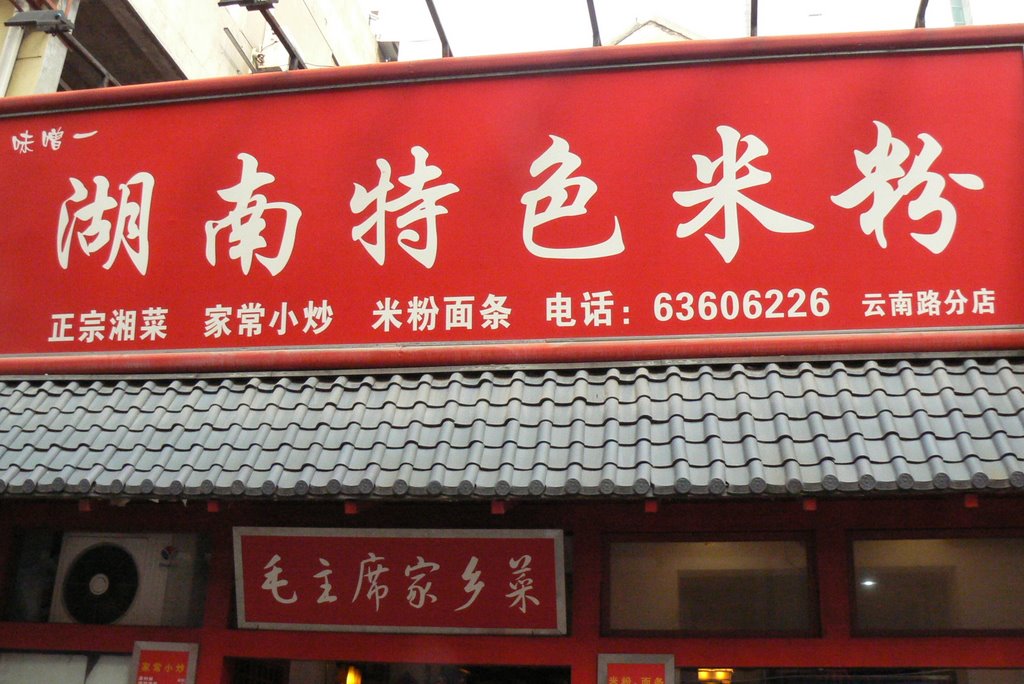
Chairman Mao Hometown-style Food

A quick update on a restaurant I frequent and enjoy: Chairman Mao's Hometown-style Food!


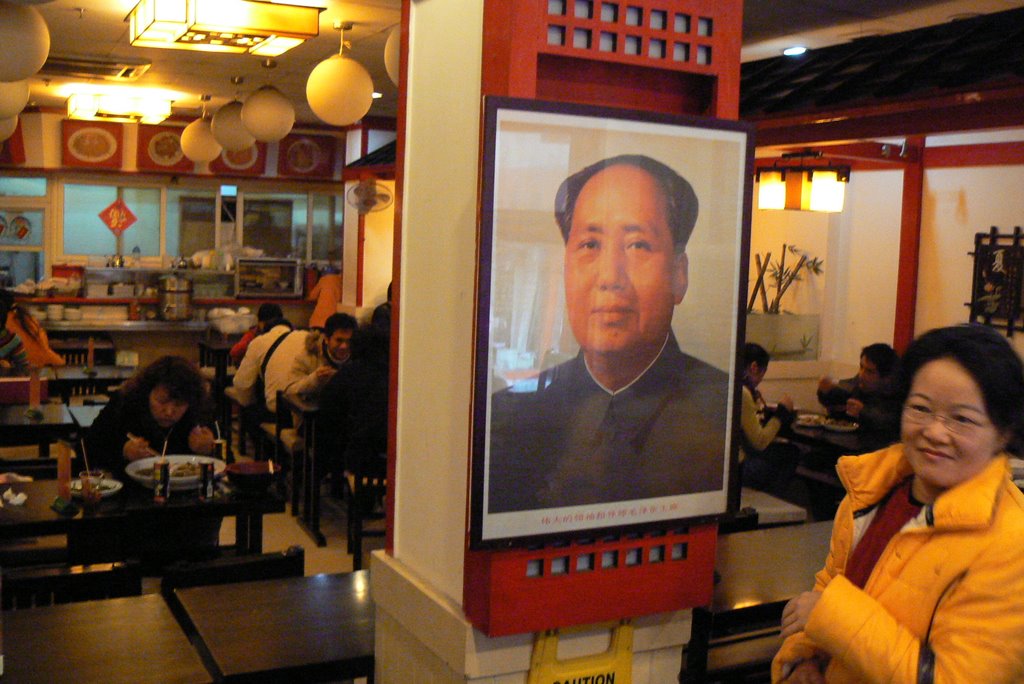
I've mentioned before that Mao Zedong's picture is a little rare to be seen in Shanghai, outside of paper money and products aimed at tourists. There are other places you can half-expect to see it though, and one of them is at Hunanese Restaurants - Mao Zedong was born and raised in Hunan province. While most restaurants don't specify Mao Zedong in the name, a fair number will have a prominent painting of Mao:


From what I understand, Mao Zedong repped the HN his entire life, speaking Hunan dialect (not Mandarin) and eating mostly Hunanese food. In that regards I bear a striking resemblance to Mao Zedong, as I tend to eat Hunanese food four or five times a week. I prefer the stronger flavors of Hunan food to Shanghai-style food. It's much like neighboring Sichuanese food, except Shanghai's Sichuanese food is generally over-adapted to Shanghai tastes.

This talk of different cuisines brings up a point: the difference between Chinese region's cuisines can be very substantial, with Northerners eating lots of noodles, and Cantonese eating anything that moves. Actually I went to the restaurant with a few people, one of them born and raised in the far North of China. I figured I'd just let her order, being Chinese she would have a better idea of what to get. But, she wasn't even familiar with 75% of what was on the menu!


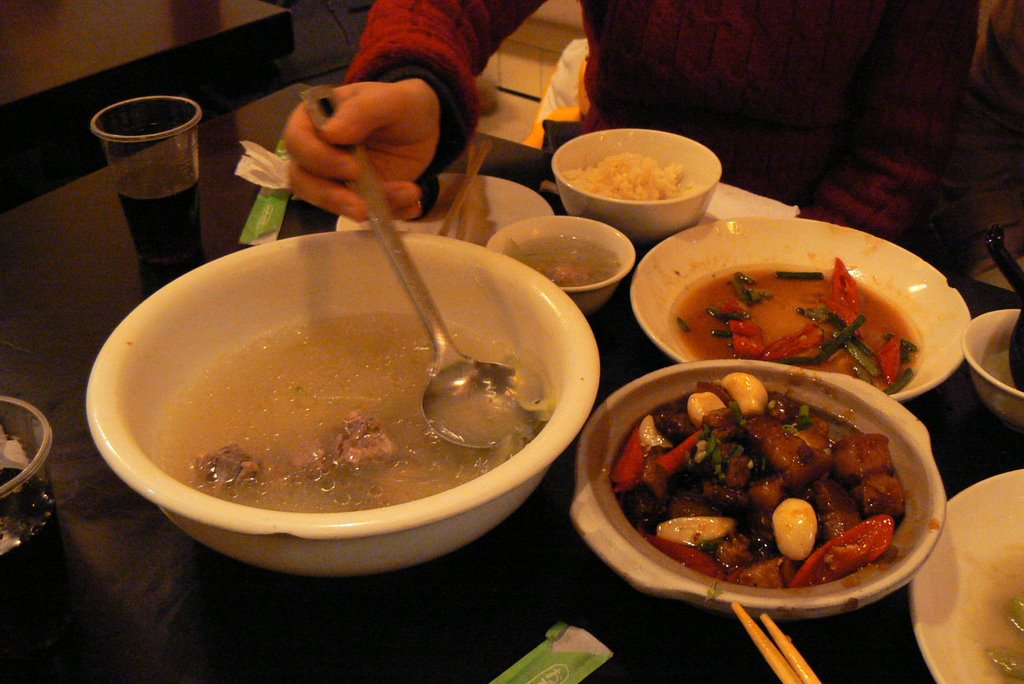
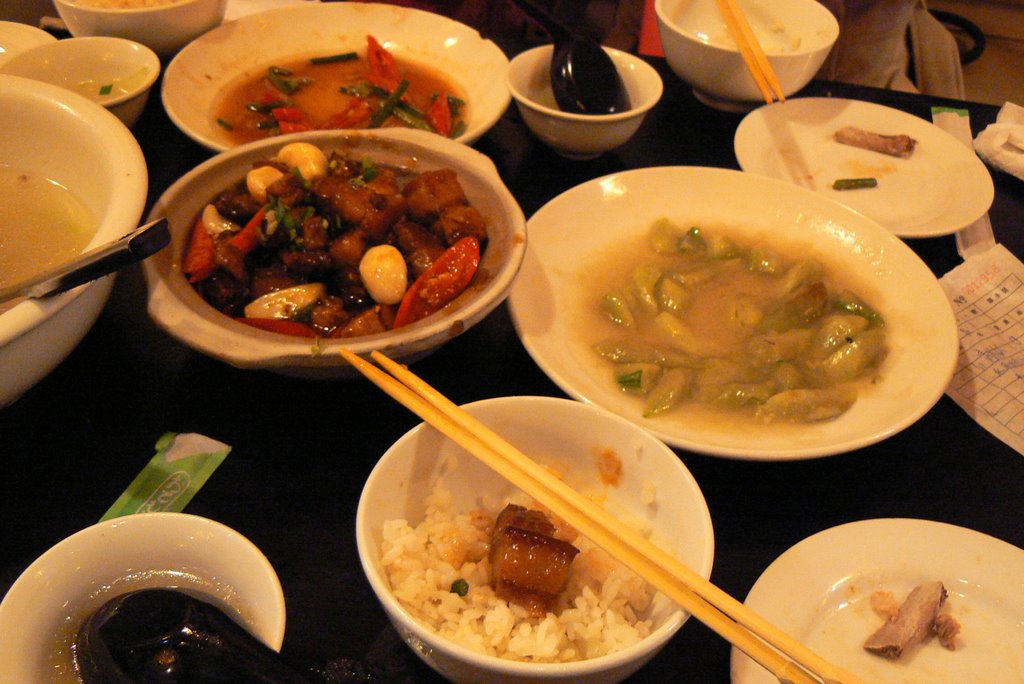
You can see from above, it's chicken soup, some garlic sprouts with pork, some really fatty meat - I was told it's good for your brain, and that it was Mao Zedong's favorite food, huh! Oh yeah, being winter time and all, they have dog dry hot pot, where the dog meat is roasted in a pan over a fire. I want to try it, but the people I'm with keep refusing.

From the picture below, definitely the thing I like least about Chinese food is that they often serve the bones intact with the meat. You're expected to put it all in your mouth and spit out the bones, it's a gross and slow process. That was true in Oakland as well, I would just not order those sorts of dishes, nobody complained. Now my "no small bones" policy is a bit of a pet peeve for the people I eat food with!


The restaurant isn't my favorite Hunanese place - actually there's a much better one immediate to my apartment. But I like the casual atmosphere, the food is pretty good (if a little inconsistent), and I usually end up spending less that $5. And most importantly, it's right near the busy People's Square, on Yunnan Lu near Fuzhou Lu - whereas the other area restaurants I know either aren't that good or aren't that cheap. Oh, and it has a mostly-translated English menu, if this update interests anybody enough to check it out.