Showing posts with label Tea. Show all posts

Sunday, January 25, 2009

Figaro Café

I'll keep this update quick, because Figaro Café is largely (if not entirely) foreigner-oriented, and raving on about it just doesn’t at all go along with the increasingly-ignored “Slums of Shaolin” motif. However, I'd like to give the place some quick ups. The main branch of the chain is near Xintiandi and the Huangpi Nan Lu Subway Station, on 160 Xingye Lu & Madang Lu. First of all, they serve coffee:


OK the horrible truth is I don't like coffee, and while sometimes I'll go to cafes in Shanghai, it's almost purely because I have time to kill and want a place to chill for a little while, reading and using wi-fi. Figaro charges 18 kuai for a normal-sized cup of coffee, or 22 kuai for a bizarrely large mug. Quality seems about average, to my undiscerning tastes.

The reason to go is that the place is the best spot for a foreign book nerd in Shanghai to be. Downstairs, it's a convenient place to pick up Shanghai's various free English-language magazines. Upstairs, there's a large number of bookshelves, where customers freely drop off used books, and pick up new books to take home and read, as part of an international club called Book Crossings. I'll guess there's somewhere around two hundred books available, mostly in English but some in Japanese and other languages.

These books do change, it's worth dropping by from time to time to see what's newly available. In all honesty the collection does have a serious tendency towards fluffy airplane novels, while my preference is towards serious literature and studious non-fictions. But there's almost always a few top-notch books available. I've had good experiences diving outside my normal genres – for instance, I thought the military history "Panzer Commander" was fascinating. Theoretically, the available books can be gleaned off the Book Crossing website – while that does give an idea of what's available, realistically, most people obviously don't register their activities with the site, and I'll admit I'm one of them.

The friendly manager also runs a number of book related club, either on a weekly or monthly basis – there's reading clubs and workgroups for authors. I don't do them, but I've seen them operate and maybe I'll join in, sometime in the future.

The number two café for booklovers? I'll give that title to Garden Books, on 325 Changle Lu & Shaanxi Lu, near the Shaanxi Nan Lu Subway station. Honestly, I've never had the coffee there, but it's a very nice bookstore with an attached café, I had their ice-cream once and thought it top-notch.

Update 2/17/09 - Oh man! Figaro Café lost their lease just yesterday, a bank is taking over the space. I heard the manager say she was looking for a new location nearby, and expects to open in about two months - I'll update this blog when it happens. There's a smaller branch with a smaller selection of books and a less interesting atmosphere, at 456 Nanjing Xi Lu. It's about a five or ten minute walk west of People Square.

Update 3/25/09 - Actually, the second branch at 456 Nanjing Xi Lu has also closed. The main branch is still set-up to re-open, I'll post the information when that happens.

Thursday, January 18, 2007

Jin Yuan Tea House

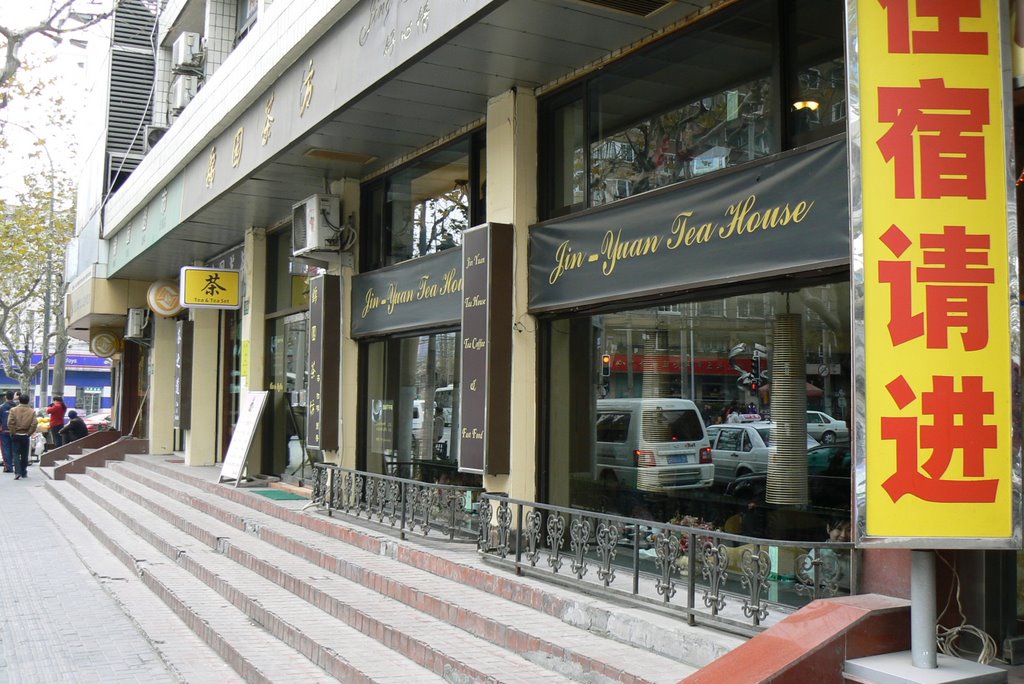
I'm headed back to Shanghai for this update, to the cozy confines of a teahouse near my apartment in the Jing'an Temple area. It's a two-story teahouse on the corner of Beijing Lu and Wanhangdu Lu. Recently I've been going a lot, it's a casual environment and a convenient place to meet people. With the couches and the cushioned chairs, it feels something like a communal living room.


This is flower tea, the red bits add a bitter flavor. It's probably my favorite of the teas I've had there. I also like how it comes with a special ceramic pot-holder, there's a candle underneath keeping the tea warm:


I'm no tea expert, but I drink my fair share, I'll splurge on the more expensive teas at times. Still I think the tea here is consistently some of the best I've had. It's a little on the expensive side, compared to the other places I've been - a pot goes for three to five dollars. Like other tea houses, the tea is served with the leaves or ingredients left intact. Then, the waitress either gives a mug of boiling hot water to add, or she'll come around periodicially to refill the water for you. I think it just depends how energetic the waitress is feeling at the moment. Actual tea (as in tea-leaf tea) comes in a less photogenic china pot, but here's another picture. It's some Ginger tea, the pot is stuffed full of fruits, ginger, and other unidentifiable things I assume are ingredients. In the background is a large thermos of hot water, along with a milk tea.


These photos were taken when there weren't many other customers around. It can get busy, and I'll admit the other customers can bug me sometimes. Mostly, I'm going to study lingo, maybe to enjoy the delicate flavors of flower&bitter-stuff tea, and the people around me will be puffing down on cigarettes! Yuck. It's busiest around meal times. They have food that strikes me as pretty average and more of an after-thought to the tea, but it gets a fair crowd coming in. When it's too busy, sometimes I'll retreat to the upstairs. It gives a nice view of a busy but unspectacular intersection:


Maybe talking about my frequent visits to a teahouse in Shanghai makes it sound like I've gone super local-style. But honestly, there's not all that many teahouses in Shanghai. On the other hand, the area has one cafe after another cafe, it's like being back in San Francisco!

Update 11/4/2008 - This place (along with many of the shops nearby) has been knocked down and re-located to the boring Pudong district.

Sunday, November 13, 2005

Not for all the Tea in China

Tea in Shanghai is not what it is in the US. I don't mean to say it's made from something weird, but that it occupies a different niche than what you'll get in Chinese restaurant back in the US. Most of those places in the US, they'll give a nice pot of tea, with some minced-up leaves that settle at the bottom of your glass. I believe that's a perfectly authentic Cantonese style of drinking tea. But it doesn't jibe with how it's done in Shanghai.

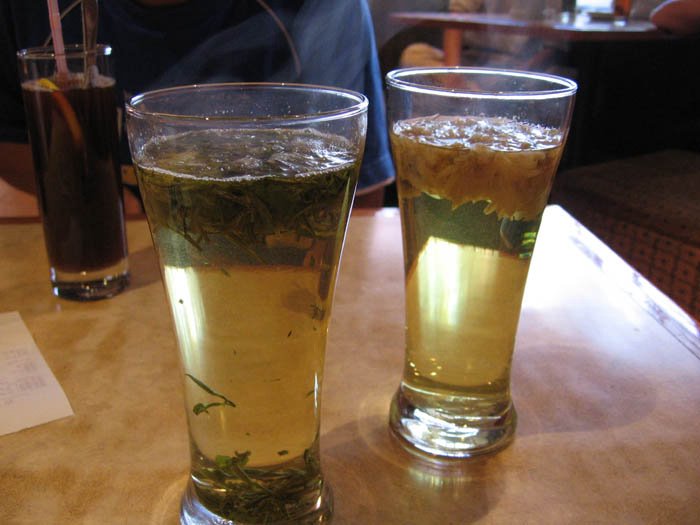
Here, if you go to a normal Chinese-style cafe, you'll be given a glass of incredibly hot water, with some leaves in it. These leaves float on the surface, flavoring the water. The idea is that as the water cools, the leaves will sink down to the bottom. With the higher-quality teas, they'll rise and fall a few times, before eventually sinking to the bottom. However in practice the leaves never all agree to head to the bottom of the glass. There's a certain art to drinking the tea without getting any in your mouth - an art I haven't quite mastered.


Note the two teas, which are probably the most popular ones in Shanghai: on the left is green tea, it was delicious if I recall. On the right is flower tea, it's a bunch of dried white jasmine flowers. Jasmine tea's taste isn't my favorite but it does look really cool. Once you've reached the bottom of the glass, somebody will re-fill it with more incredibly hot water.

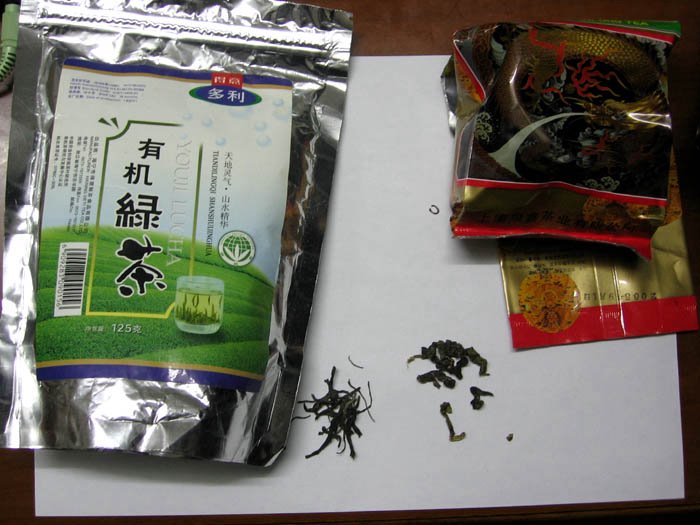
The tea starts out life a little uglier. Here is some tea in my apartment, right out of the bag. It's green tea on the left, and Oolong tea on the right. The leaves look like something from under the sofa, until they're soaked in water for a bit. Even a small grocery store or convenience store will have dozens of these dried teas for sale, and premium tea stores are pretty common.


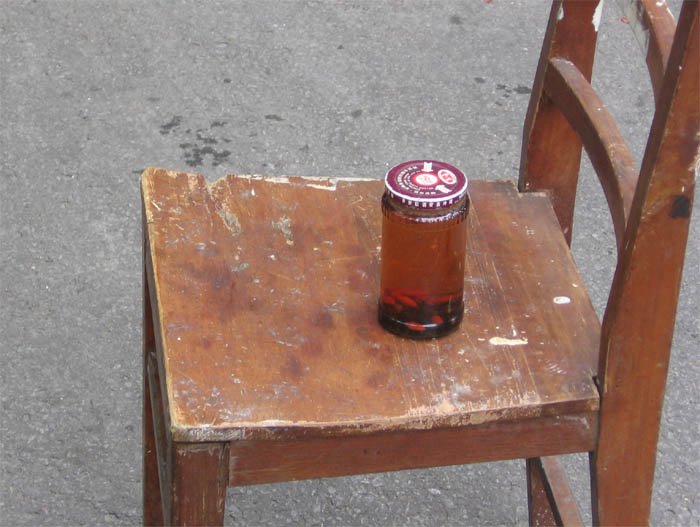
But of course tea is consumed in other ways, you can't get away from it! A large amount of people will carry around thermoses of tea. Partially the tea sun-dries and partially there's hot water easily available in a lot of places. Sometimes these thermoses have a little of this and a little of that, it's strangely artistic, although I have no idea how or why you'd want to mix up the various kinds of tea.

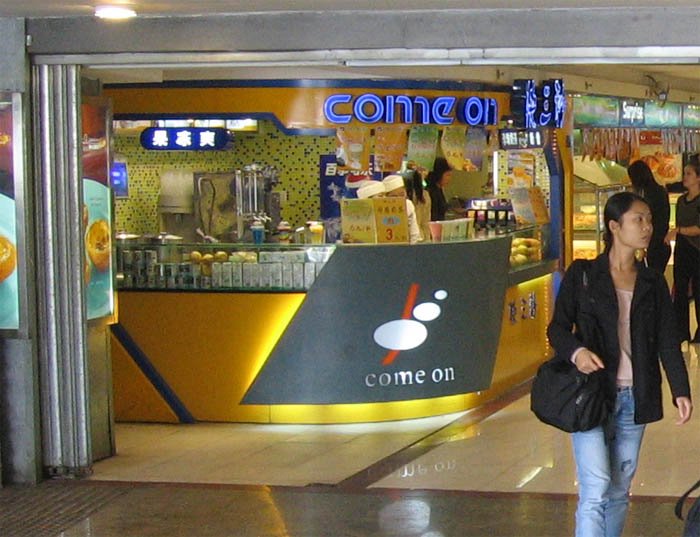
And of course pearl milk tea drinks (with sweetened milk mostly overwhelming the flavor of the tea) are found on nearly every block. They'll cost maybe a quarter or fifty cents, and are often served warm or even hot. You can also find iced tea at convenience stores, but they're all lightly sweetened, which I find repulsive.


Surprisingly, most local restaurants I go to will not have tea available. Instead, the liquid comes from ordering a light soup. If they do have any drinks, it'll be soy milk, or a juice, or a milk tea (with or without the pearls).

And you do see teabags around, I'll notice them in offices or situations where free leaves would be too messy. They're also available at the cafes you'll see in the more Westernized areas, which attract a certain kind of clientel: