Showing posts with label Other Parts of China. Show all posts

Tuesday, September 01, 2009

Visiting Sichuan: Emeishan and Chengdu

Far too long ago, I wrote an update about visiting the really-quite-impressive Buddha statues of Leshan and Jiajiang. Really, the Big Buddha of Leshan was the impetus for the trip - my sister was visiting China, saw a picture of the Buddha, and knew she wanted to see that. However I was also happy to have a look at Sichuan while there - I have a lot of friends from Chengdu and Sichuan, and they've really talked it up a lot, and Chengdu in particular has an excellent reputation.

I'll start with Emeishan, or Emei Mountain, which is one of the famous Buddhist Mountains of China, dotted with ancient temples, there's also tribes of monkeys to contend with. My sister, a former resident of India, was a lot less excited about that latter prospect than I was. But truth be told, I never even saw a monkey, I only heard them off in the distance. It's because I mostly ended up hiking around the lower reaches of the mountain, rather than doing the normal tourist thing and taking a two and a half hour trip to the top and then walking down. If it sounds like I missed out on scenic views, Sichuan's climate was pretty much on par for the course, and was too foggy to see all that much.

I almost planned for a multi-day hike and I'm glad I didn't. Generally the mountain views weren't much, and so for the most part what I saw was this:


It's a non-descript picture, but it was a non-descript environment, a whole lot of the trail looked like that. The main thing to notice is there's a whole bunch of concrete stairs going up and down, and most of the trail involved walking up and down concrete stairs, which really killed the legs. Hikes in China are all paved over like this, it's a lot less fun than being in California, where I got really into Bay Area Hiker last time I was around, and went on a number of amazing dirt paths through redwoods and so forth:


There were Buddhist temples, although they weren't of ancient construction and were of the cheesy tourist-oriented kind, something like smaller but better versions of Jing'an Temple. Many of them had restaurants serving simple Chinese-Buddhist-style (vegan) meals, I had one and it was pretty good. As corny as they could be, the temples were a colorful break from the hiking.


I ended my short trip in Chengdu, the capital of Sichuan. It's famous for the spicy food and for the beautiful women. However, my sister's vegetarian and we didn't get the chance to try the normal local eating options, and we looked around and I swear the women didn't really look much different than in Shanghai. Later I heard that women there are considered more beautiful mainly because they're whiter.

Perhaps my expectation were too high, but I just didn't think much of Chengdu. My favorite was Wenshu Temple, which had a lot of older locals just lazing about doing their thing. I also ran across a Tibetan area with a decent Tibetan restaurant. However for the most part it felt like a standard, poorly-constructed Chinese city, with the tourist sites being expensive and uninteresting. I'm told that it's a great city to live in and enjoy a laid-back atmosphere, but as a tourist just there for a couple days, I admit I didn't much care for it. Also, as a city of four million people without a subway or even elevated highways, the traffic at rush hour was about the worst I've ever seen in my life, and I've had a daily commute from Oakland to Palo Alto! I don't want to end on a sour note, so here's a picture of a nice old-style gateway:

Sunday, June 21, 2009

Visiting Sichuan: Leshan & Jiajiang

I've long wanted to visit Sichuan, if for no other reason than because I have a number of friends from the area, and they kept talking it up! I ended up making a very quick trip out, and while I wasn't entirely impressed I'll start out on a high note by talking about some carved Buddhas.

OK that maybe sound horribly boring, especially if you happen to not be me, but the Leshan seated Buddha gets a special pass for being two hundred fifty feet high - the largest Buddha in the world, ever since the Taliban blew up the standing Buddhas carved out of a cliff-side, not so long ago. It really is an impressive sight, especially as one can walk right up to and alongside the Buddha, which also happens to show the sense of scale. Those people on the far side look tiny!


One doesn't just walk around up top, there's also a thin path down, right alongside the Buddha. When I went it was pleasant except for a heavy fog (which is on par for Sichuan), but I've heard it can get horrifically crowded, and there were even Disneyland-style barriers set up, so the lines would have to snake left and right. I could just skip right past them. Anyway it's interesting to go down the cliff, there's all sorts of different views. The Buddha faces a river, and it's also possible to get a view from a boat or a nearby sand bar.


Leshan is a couple hours away from Chengdu, and it's a no-horse town where I get the idea you just have a look at the Buddha and then go on somewhere else. Jiajiang is much the same, only worse. Jiajiang's one claim to fame, for a tourist anyway, is the Thousand Buddha cliffs. That said, all the Buddhas are pretty impressive. Therels really hundreds, or perhaps even a literal thousand Buddas tucked away:


The site was probably a lot more impressive forty or fifty years ago, before the Cultural Revolution came to town. About half the Buddhas had their head knocked of, and I wouldn't be surprised if their were other Buddhas that were destroyed altogether:


Additionally, these Buddhas were really all there were to the area. OK, I don't want to complain too much. If the site was located in Shanghai, it would be a must-visit. On the other hand, Jiajiang itself is out of the way, and then from Jiajiang Bus Station it was a weird local bus ride, where after driving a few blocks, everybody got out of the bus and walked a couple blocks over and changed buses. I'd recommend a taxi, on the other hand it's probably impossible to catch a taxi from the cliffs, so it's best to hire one - no idea how much that should cost. Additionally, although Jiajiang tries to play up the whole cliffs area as a sprawling tourist area, really the cliffs is it. I have nothing more to say so I'll end this with a picture of a flower my sister took:

Wednesday, October 01, 2008

Wuyuan and Surroundings

Feeling adventurous after a small trip to Fujian Province, I decided to take the bus back, rather than a plane. That allowed me a chance to look over the countryside, and to make a small detour to Jiangxi Province, on the way back to Shanghai.

Don't do this.

Here's the bus I took, it was a bunch of lay-down cots rather than seats. The cots were a foot and a half shorter than me, meaning I had to sort of fold myself into the cot. Everybody around me was chain smoking. To top it off, it was an 18 hour bus ride. And, the driver dropped me off by the side of the dark highway at 2:30 in the morning, and told me (and a fellow traveler) that it was about a mile to Jingdezhen, a medium-sized no-horse town a few hours away from from my final destination of Wuyuan.


But that's an overly long introduction to Wuyuan. Basically, Wuyuan is an ugly city that acts as a transportation hub to the beautiful villages nearby. So the first order of business is getting out of Dodge and making it to somewhere else. With me, I went to Small Likeng:


As a small village, it made for an interesting contrast with the Hakka villages I had been to several days before. It felt more typically Chinese, not being a Hakka area and all. The countryside, with plenty of rivers and streams, was beautiful, if not quite up to the standards of Yongding. And the buildings were beautiful, well-preserved, and built right against the water. I did have a complaint about all the tourists:


It's not an elitist "I'm too cool to be in a touristed spot" attitude, although of course I do have that attitude. It's more that, Small Likeng is a small village with small sidewalks. With the large tour groups and busy crowds going by, I found myself waiting in line just to walk down the street!

But I don't want to exaggerate; even in Small Likeng, it was easy to get away from the crowds. Here's a couple quick pictures:


There were a number of other villages that weren't quite as impressive, but weren't as busy. They didn't all feel cut from the same mold, though, there were marked contrasts between them. It doesn't photograph well, but Sixi Yancun had a labyrinthine feeling of large featureless buildings, connected by thin irregular pathways:


Whereas Qinghua had a more country feel to it. Here's looking under Rainbow Bridge:


And nearby to central Qinghua City was a beautiful valley filled with older homes:


Similiarly to Yongding, there was an odd relation to the locals, and it felt like their normal lives had turned into a tourist attraction. I was also on the receiving end of this, as random morons would go up to me and yell "Hello!" constantly. Anyway, whether it's cultural imperialism or not, I thought it was interesting to see the villagers doing their thing, here's a few quick pictures:


From Wuyuan, it was a seven hour bus ride back to Shanghai - the proper kind of bus, with seats and rules against smoking.

Saturday, January 06, 2007

Jet Set Jeff Encounters the Terra-Cotta Warriors

In my last post, I found myself in the ancient city of Xi'an, ready to encounter what lay ahead: the clay statue remains of the ancient Qin Dynasty warriors!

As a very short history lesson, the Qin Dynasty united China 2200 years ago, and set about standardizing the written language, measurements, culture, and so forth. They also ruled heavy-handedly, and enacted a large number of expensive, fanciful public works - the secret Terra Cotta Warrior burial chamber, searches for immortality magic, and the unification of many smaller walls into the Great Wall were a few of them. Ultimately the dynasty only lasted twenty years, and the Terra Cotta Warrior Site never was uncovered. It was forgotten to history until its discovery in the 1970s, by farmers digging a well - the actual site lies in the rural suburbs of Xi'an city.


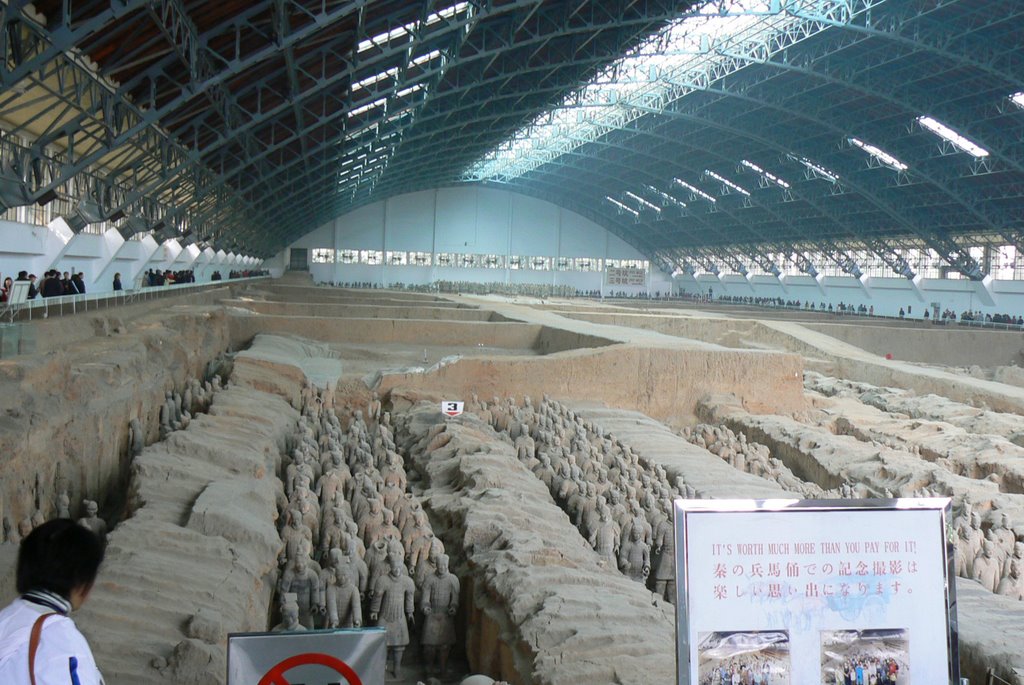
Again I'll talk about Imperial Chinese historical sites in terms of quantity: while the statues were memorable, individually made with a great skill, what most impresses in the scope of the project - the statues just go on and on, there's thousands of them. The first (and by far the largest) dig is located inside what seems like an airplane hangar:


You can see that that it's not only soldiers. Terra-Cotta Horses were also buried, they were carrying chariots that have long since decayed.


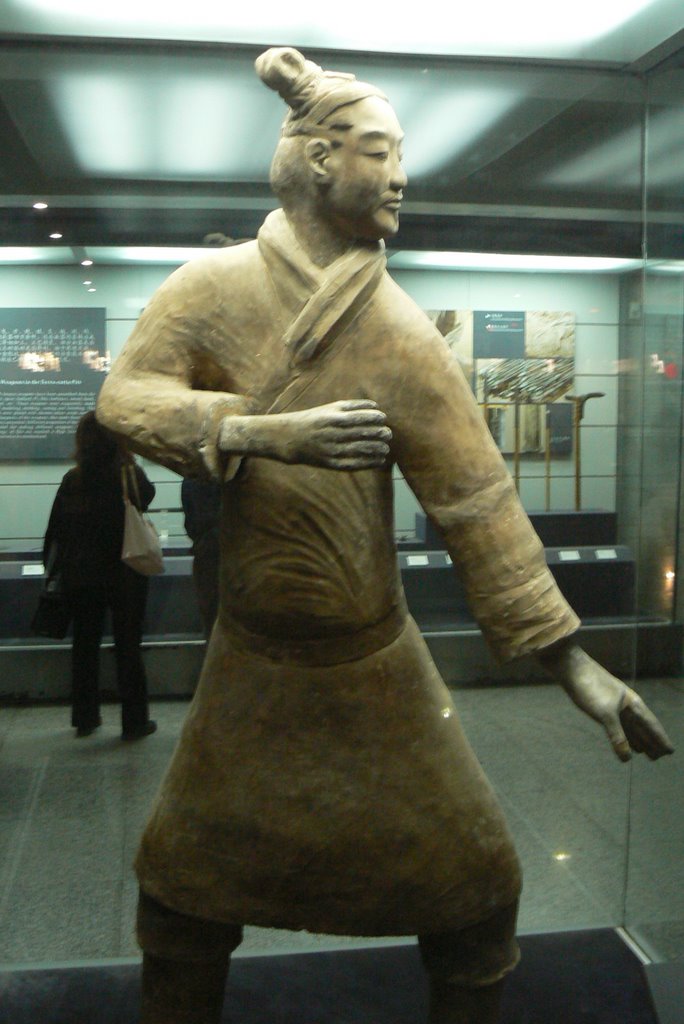
Behind the horses can be made out the outline of clay sculptures, still being assembled. As solid as the sculptures seem in the above picture, all the terra cotta warriors had been smashed to bits. Thousands of years ago the statues had been originally housed in wooden structures, the roofs have long since collapsed.


Bringing the statues back together looks like an amazingly painstaking process, and even now the large majority of the site is unexcavated - not only that, but there are other nearby Terra-Cotta sites that haven't even been touched yet! It's such a large job, with new sites still being discovered, that I don't expect the work to be finished in my lifetime.

Once outside the excavation sites, there's a huge industry of hawkers aggressively pushing small-scale Terra-Cotta Warriors, latching on parasitically, starting with high-ball prices and quickly dropping to prices so ridiculously cheap you almost wanted to get them as a whim. You can see them ahead...waiting...


Also! On the walk to the parking lot, there was a ridiculously lengthy procession of newly constructed one and two story buildings. They looked very plain, something like an office park or an off-market shopping center. They were all empty, except for people with tables out front, selling fruit and silly tourist junk. As the walk went on and on, it felt eerie, like walking through a ghost city. I'm not sure how they expect to full so many buildings in such a remote area, I imagine they hope future tourists will stay entirely in this complex, not even bothering with the trip to Xi'an proper.

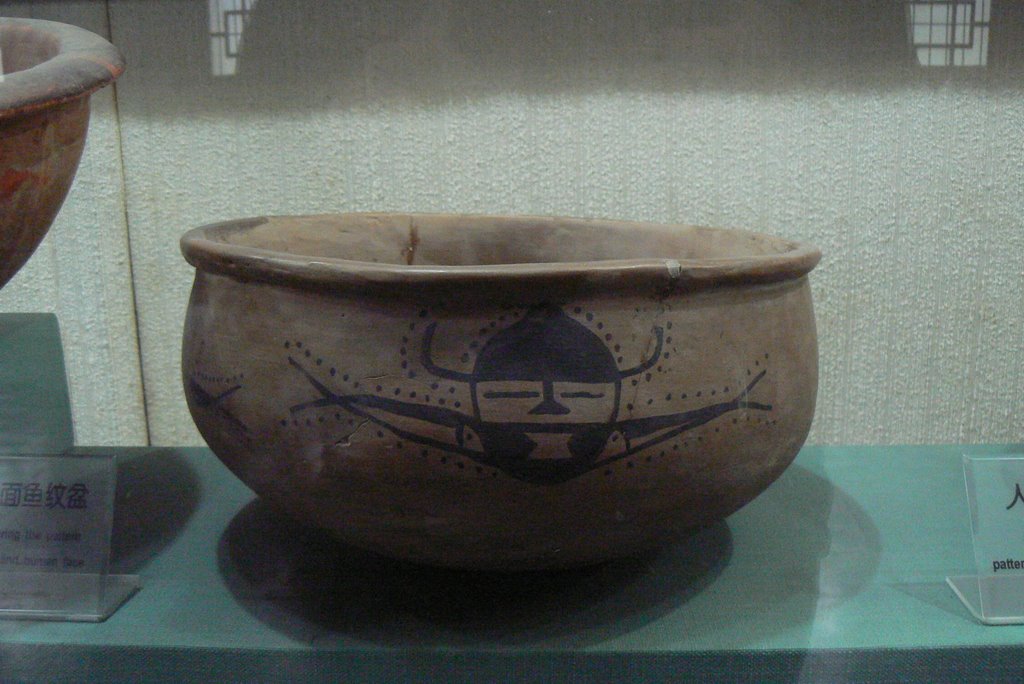
I also visited another excavation site, Banpo Neolithic Village. It's ancient, nearly six thousand years old, and naturally there's a lot less to see: a few clay pieces, burial sites, foundations of houses, etc. To my inexpert eye there seems to be some connection to a more modern China, but how they fit in exactly is unclear. As with the Terra-Cotta Warriors site, the excavation is still in process, they're less than half finished.

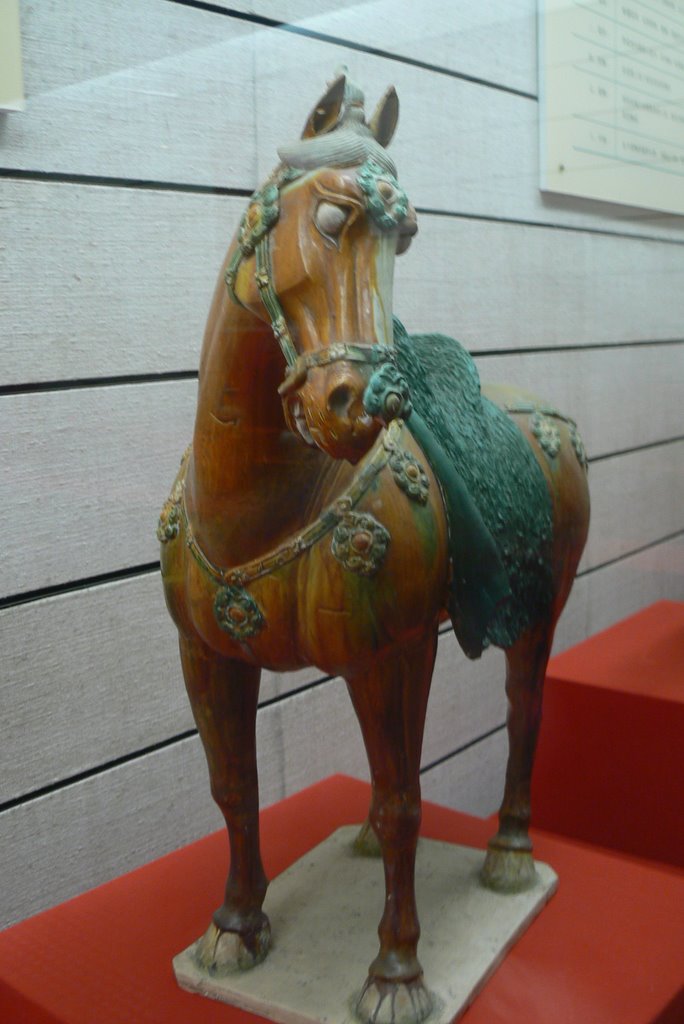
Finally, I had a quick look at Xi'an Shaanxi History Museum, where Shaanxi is the name of the Prefecture. I don't have much to say, other than that there were many interesting items:

Thursday, January 04, 2007

Jet Set Jeff Explores Xi'an

After visiting the city of Beijing, my entourage and I jetted off to Xi'an. Xi'an was the capital of China for around four hundred years, until about fifteen hundred years ago. It's famous for nearby historical sites, especially the terra-cotta warriors. However, on its own it's a very enjoyable city of seven million people, and this update will be talking about the city by itself.

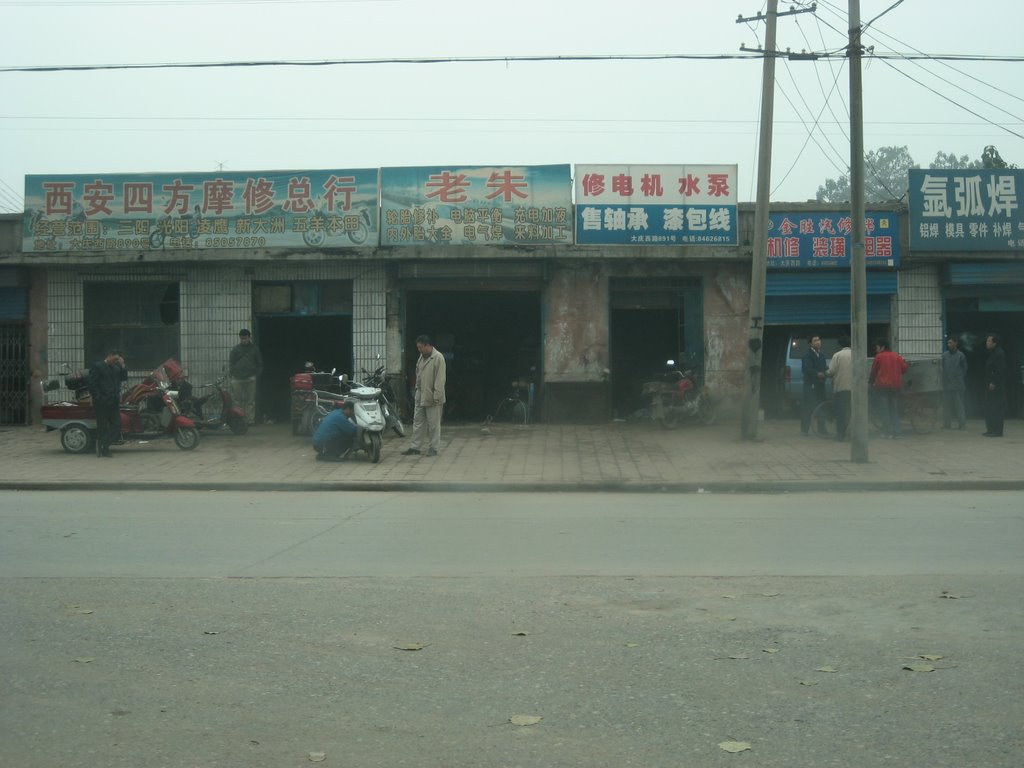
First impressions weren't that good. After arriving at the modern airport, we hopped in a cab and took the highway into town. The highway was dark, there were piles of dirt just lying around, there were coolies walking in the middle - the driver took the road at about 30 miles an hour. Days later, on the way back, I saw that the highway was literally in the middle of being constructed. Anyway the highway wasn't yet navigable all the way into town, so we got off early and found ourselves snaking through impoverished city streets. Surreal and difficult to describe, among other things there were miles and miles of shacks like this:


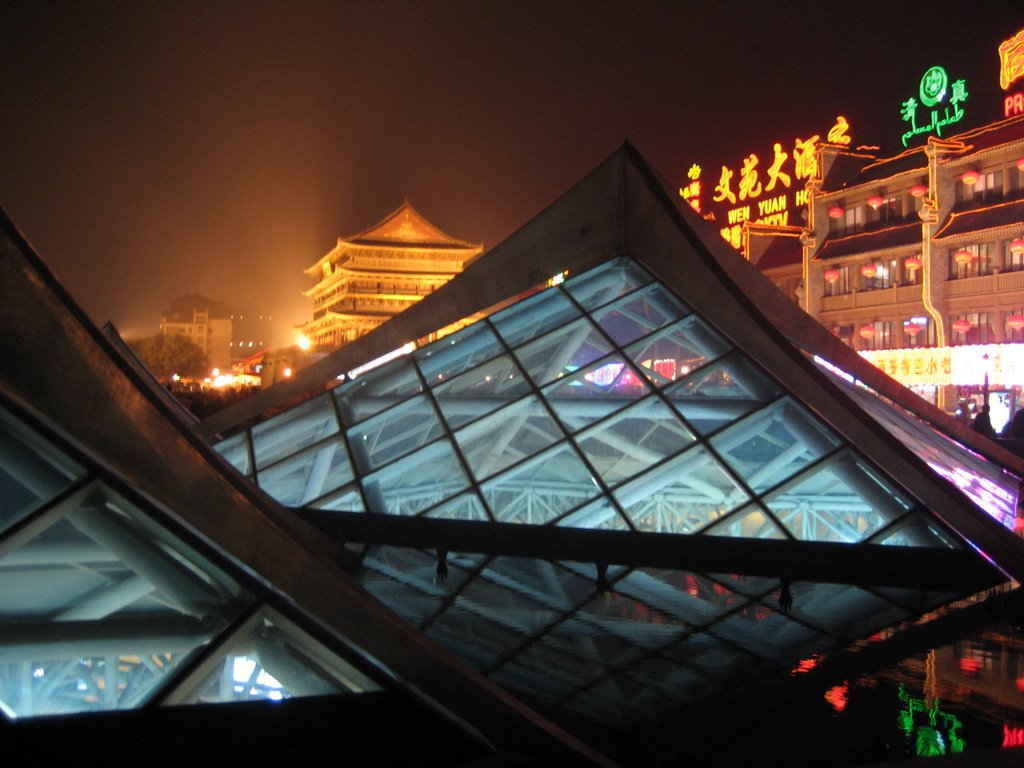
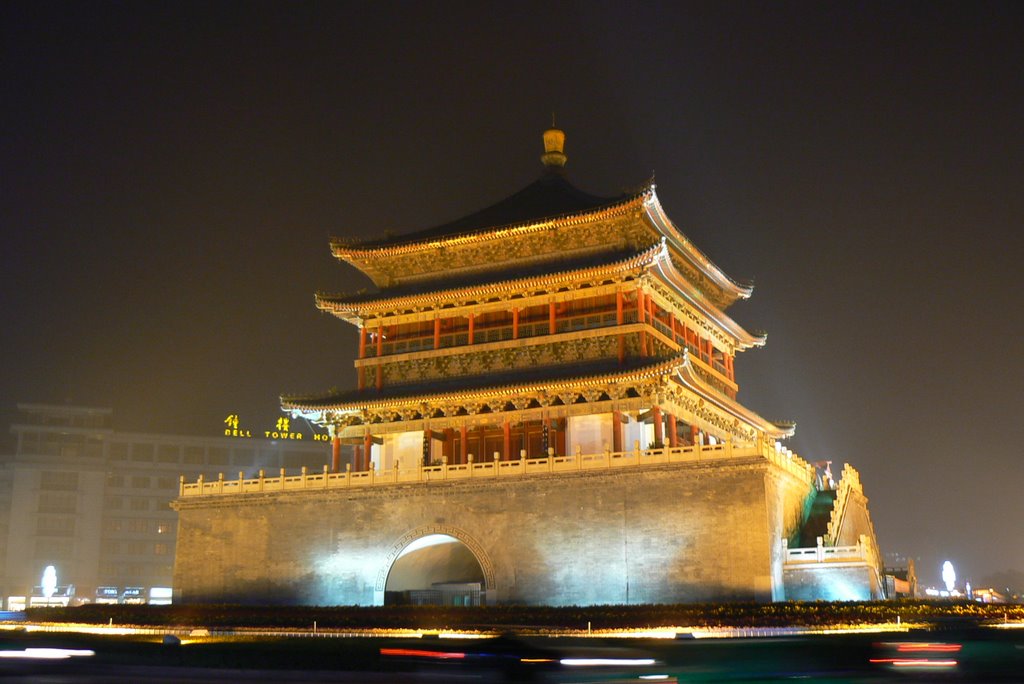
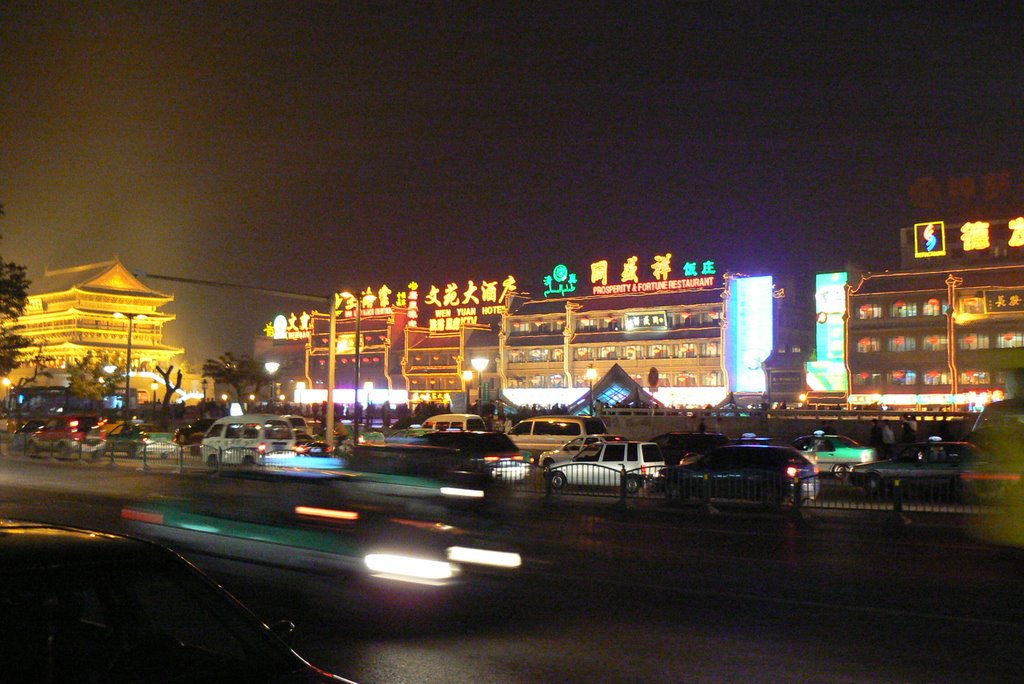
When we reached the center of town, there was a sudden and complete shift. Bright lights, wide boulevards, shopping centers, and immense restaurants, all anchored around beautiful ancient buildings. You can see the drum tower and the street restaurants in the picture to the left, underneath is a picture of the 14th century bell tower:


I very rarely come across new tastes or food in Shanghai, maybe the biggest exception is the Sichuanese ma flavor, it numbs your mouth like Novocain. By contrast, half the food in Xi'an looked like nothing I had seen before! Not in an exotic way, though - there was a lot of mutton and wheat dishes. This restaurant I went to was fun, maybe something like a higher-quality and spectacularly busy cafeteria - you pointed at what looked tasty, and they handed it over. Not the greatest food in the world, but passable, and a relaxed atmosphere counts for a lot:


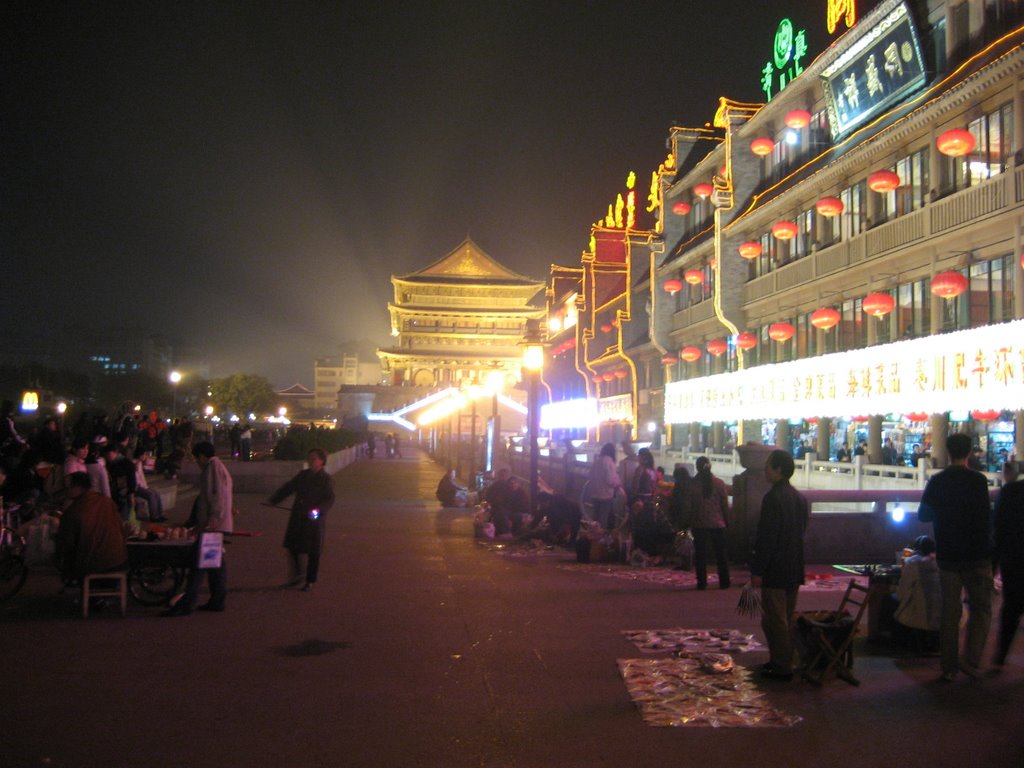
Unlike Shanghai, where for the most part the sidewalks are narrow, crowded, and full of obstacles in your path, walking on the wide sidewalks of Xi'an was very easy and fun, and even at its most crowded you didn't feel pushed. Unfortunately I didn't get a good photo of this, but here are some street vendors, set up on the sidewalks just a little off the main drag, again with the bell tower in the background:


Everything you would expect from a fairly wealthy city was here: night clubs, malls, five star hotels, and elite clothing brands. In the back of my mind I couldn't get past the miles and miles of poverty we had driven through, to get to this city center. Just one of many examples of these small upscale stores is a local cafe chain selling fancy pastries: the name was something like "American Bakery."


I should also mention that the city walls are still extant, surrounding the city center. They're very beautiful, from what I understand Xi'an is almost finished restoring the entire wall, so you can walk along the top for the whole circumference. Very cool, by contrast in most Chinese cities the walls have long been torn down, with perhaps small fragments of the city walls still remaining. There were also various districts of older buildings, many of which are partly or largely supported by the tourist industry:


I didn't have as much time as I'd have liked, and I really regret not being able to have a look at the Muslim Quarter or the Silk Road Museum. Also, I'm stealing a lot of the photographs for this update from my father, I hope he's a good sport about it and doesn't take me to court!

Thursday, December 28, 2006

Jet Set Jeff in Beijing, Part 2

I'll start off the second part of this post with a few observations that I don't have accompanying photographs for. All these observations are made after only several days, so take them as you will.

Beijing is Large - The population isn't as great as that of Shanghai, but I have to believe the physical size is much larger. What I saw of Beijing did not at all have the busy, crowded feeling that much of Shanghai has. Instead, there were wide streets and boulevards. If that sounds scenic, it didn't at all lend itself to walking around, and even in the center of the town, I felt like many of the streets were dead!

Beijing has Good Food - I had never heard this before, and the people I tell this to in Shanghai (none of whom have themselves been to Beijing) just don't believe me. But there's no denying that the random restaurants I popped into off the street would have been in the top tier of Shanghai restaurants. Perhaps I had good luck, but I suspect it's something more.

Beijing People Speak Mandarin - Kind've weird, being actually able to understand people talking on the street - here in Shanghai, so many people speak the local dialect. Beijing people do have an "r" sound ending a lot of words, I'm not used to it and to me it sounds so ugly.

Beijing People are Friendly - Again, it's a difficult thing to tell from just a few days in tourist areas, but I met a lot of friendly people, that happens few and far between on the mean streets of Shanghai.

Beijing is Cold - My God. I also hear it's the most polluted city in Asia, but I didn't think it was all that bad, when I went.

Anyway, back to the normal programming: I visited the Tibetan Temple, a relic from when the Tibetan Buddhist Manchus were in charge of the nation, and pushing Tibetan Buddhism as a unifying force for various ethnicities. The entranceway, for one, has a sign in Manchu, Tibetan, Chinese, and Mongolian:


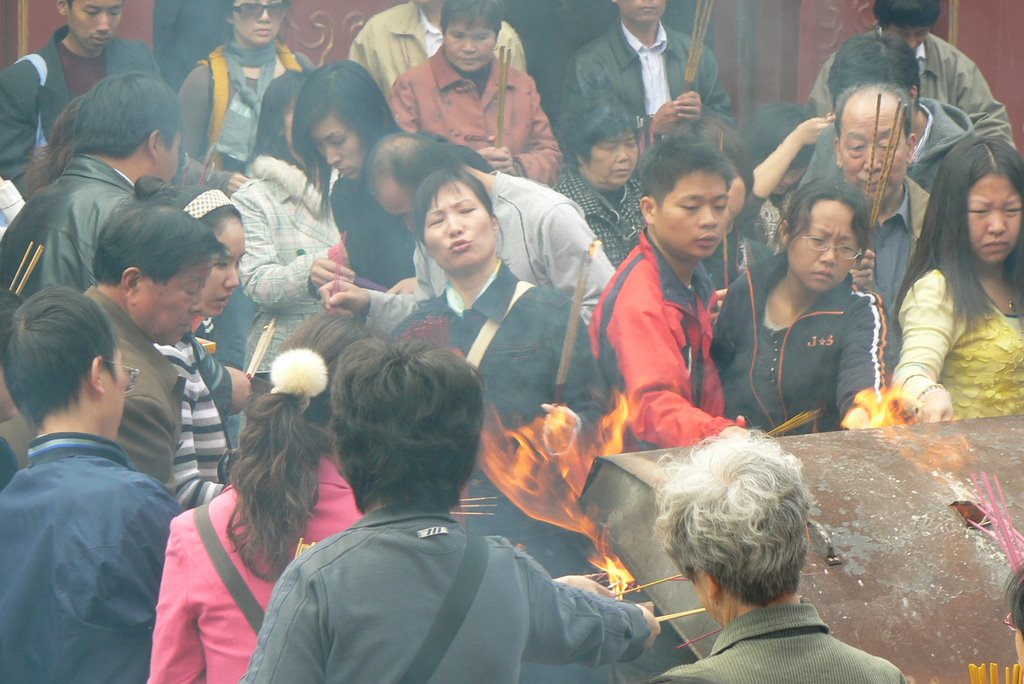
Tibetan Buddhism has a lot of elements that distinguish it from Han Chinese stylized Mahayana Buddhism, and the temple had a different feel from most others I've been to - if not nearly so different from the Buddhist temples I've seen in Japan, Thailand, or the US. The temple had fallen into disuse over the centuries, but was protected during the Cultural Revolution. It since been restored and is very popular with Han Chinese, I'm guessing mostly as a tourist attraction. There's a mini-industry of people selling incense outside, and people were buying them by the armload. The incense gets offered at points throughout. These areas get incredibly crowded with people bowing and burning incese, it looks like they're risking smoke inhalation!


One of those boring things that I still get into, all across Asia, is the elaborate roofing. Notice the figurines on the corners, or the stupas, a feature common to Buddhist temples.


Interesting to note, this temple was originated as an expansion of a royal building, and in almost every regards, including size, layout, decoration, building design, etc., there was a strong parallel to what I had seen earlier, at the Forbidden Palace - this lion is half a step removed from the lion seen in my earlier look at Beijing.


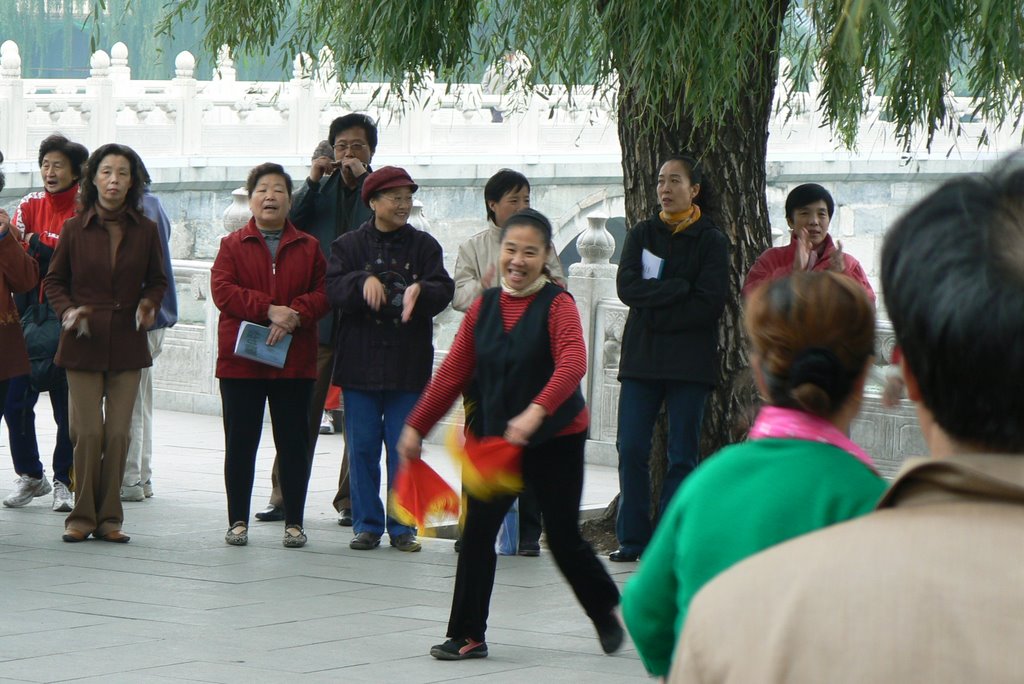
I should mention a couple things: first, I had a look at the parks to the Northwest of the Forbidden City, they were formerly a part of the Forbidden City compound. They were fun, with lots of people going there to practice dancing, or sing in groups, or play badminton, and so forth. If it seems silly, people are having fun, and that's what parks are for, right?


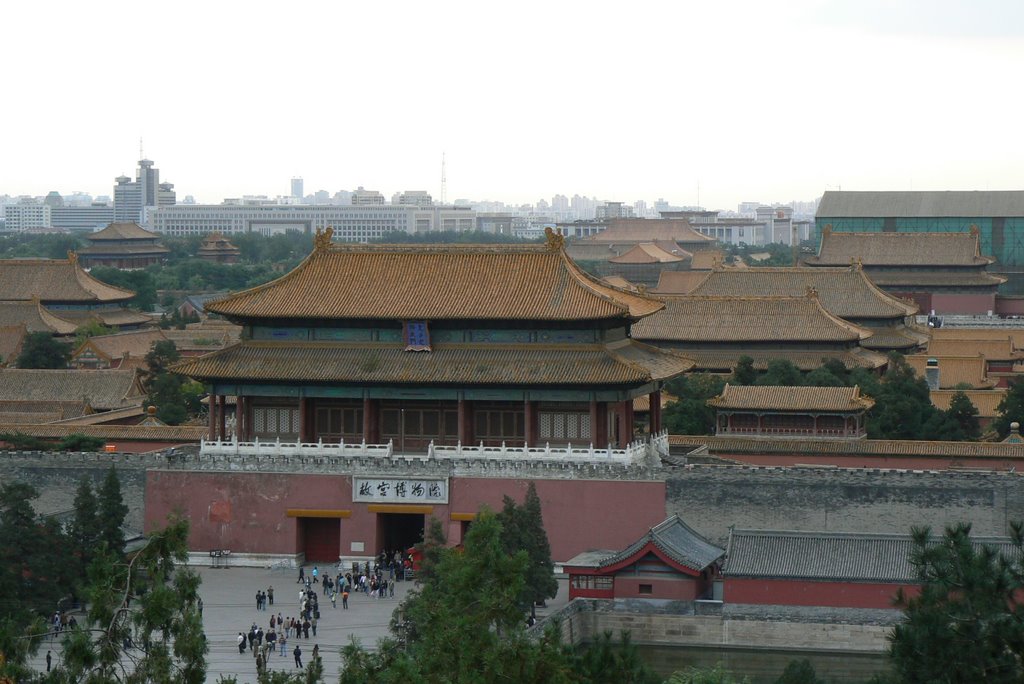
These parks also featured a few hills, that provided looks over the Forbidden City, maybe they give a better glance at its scale:


And of course I went to a nearby section of the Great Wall, to have a look. One of the surprises (or at least, things I never had thought about before) was that the Great Wall is located on the top of a series of hills and mountains.


So naturally getting there, and getting around, involves a lot of climbing up steep (and as you can see, very crowded) terrain. Actually to get from the parking lot to the wall, they had a silly little cart and pulley system, it felt like when the roller coast starts out the ride by going uphill for a minute, except it was longer. A natural thought, upon seeing all of this, was what an insanely difficult job it must have been to construct a gigantic wall on what amounts to the worst possible terrain. It did offer amazing views, even if the sky was a little hazy:


The work isn't done - it requires constant upkeep, but hasn't been of military use for centuries. In the less tourist-acessible portions, the Great Wall has greatly deteriorated, often all the way into pebbles.