Showing posts with label Government. Show all posts

Friday, March 09, 2007

The Immigration Office

This is a very painful subject for me, and so I will keep things short and to the point: there is a lot of red tape involved with being a foreigner living in China.

I had a friend call me up a ways back. He was unexpectedly sent to the Philippines, he goes "Jeff, I will come drop by Shanghai!" I ask, "Do you have a visa?" He didn't, and that was the end of that. Travelling to China requires getting a visa, either from the Chinese embassy or a specialty tourist office. It allows a stay of one to three months, depending which Chinese embassy grants it, and how generous they feel at the moment - supposedly before Communist party meetings, longer visas dry up.

But I know a lot of foreigners stay in Shanghai off these tourist visas. It involves going to Hong Kong every three months, and getting a new tourist visa. It takes a few days, all in all the process and the flights and the expenses probably cost $300 or $400 each time. What a drag!

There's also the option of heading out to East Shanghai's super Communist-looking visa office, where they give visas to students and to workers in certain industries. Actually the visa office is in the back right of the picture, most obvious is the super Communist-looking convention center. These big ugly Communist-looking buildings are grouped together in Shanghai.


There's short term workers (who are granted a visa of one year) or long term workers (who are granted a visa of one year). I kid, honestly the potential length of the visa depends on the size of the sponsoring company, among other things, I believe it varies from three months to three years. There's more paperwork for the long-term Visa. But they both involve lots of forms, and waiting in lines that make me yearn for the pleasant experience of the DMV:


Saying the experience is Kafka-esque is so trite, but I'll do just that. It's a Kafka-esque bureaucracy where they're very firm about rules that they don't disclose. Not to mention: as an inexperienced foreigner, I'm likely to make stupid mistakes as it is.

For instance, I have limited re-entries on my visas, a fact I didn't realize until I tried to get onto a return flight in Korea, and was stopped at the gates! Later, I realized I need to re-register my address with the police within 24 hours, if I move or if I change my visa status in another country. I waited three weeks and ended up spending a couple hours in the police station, filling out form after form, and paying a fine of about $40.

To be fair, this system of registering with the police isn't just for foreigners. China has a system of people with citizenship to particular cities. In Shanghai today, being a Chinese person with a good Shanghai job, or even owning a house in Shanghai, isn't enough to establish city-citizenship. These non-Shanghaiers similarly have to register their address with the police, and don't have access to subsidized public health care, free education for their children, or other basic aspects of the Great Society.

It's been pointed out to me that immigration requirements are more difficult in the US. While that's true, and overall staying in China is much easier for US citizens than vice-versa, the US has a much larger system of green cards, permanent residency, and giving immigrants citizenship. By contrast, China doesn't even give long-term residency to foreigners who marry Chinese husbands or wives.

Thursday, August 24, 2006

The Cutest Army

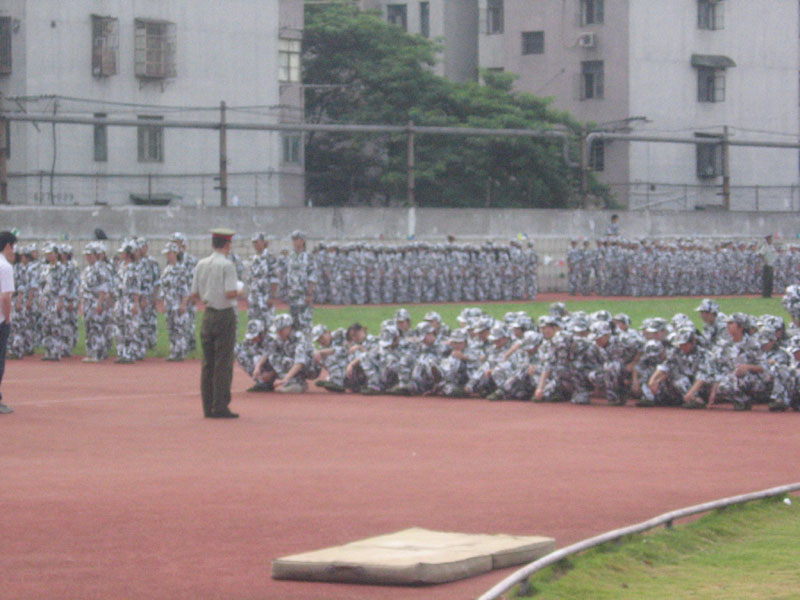
I'm taking an early-morning intensive Chinese course at a college in Shanghai. Originally I thought it would be fun to be part of a college atmosphere. But, the students studying Chinese are pretty much confined to a little corner on the sprawling campus, so I don't get much of the "Saved by the Bell" lifestyle. From what I have seen, though, Chinese university involves a lot of marching!


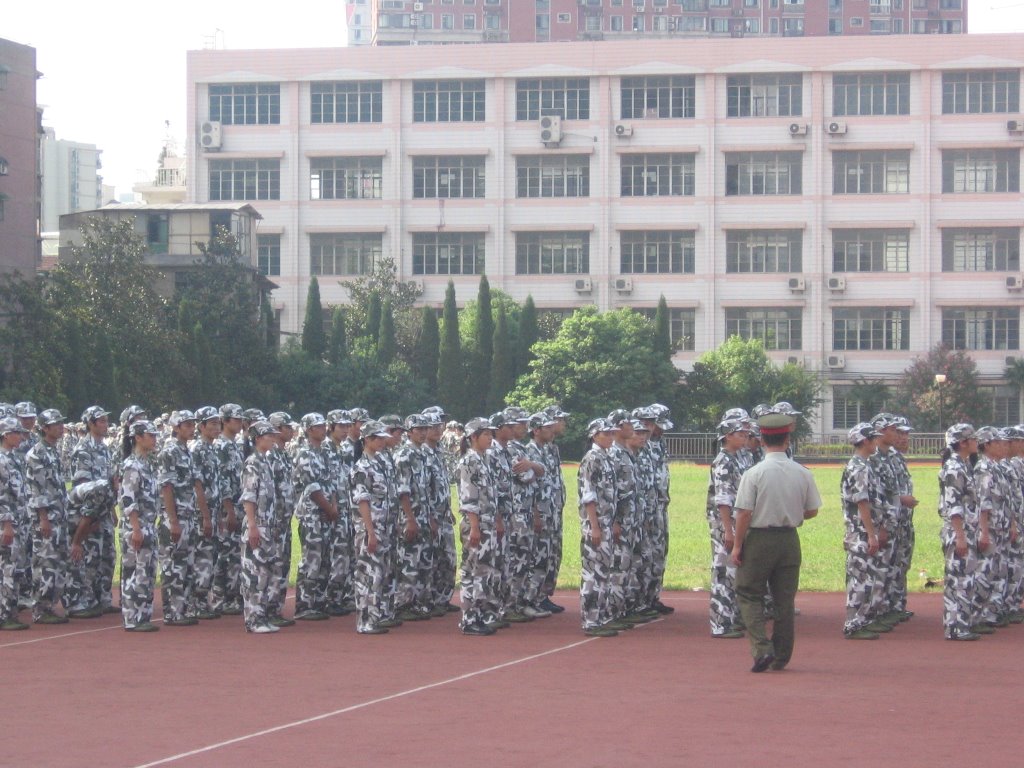
Yes, that's right, right outside my window are a bunch of 18 year olds, mostly girls, marching around in military uniforms. I'm very curious so I asked around about it. China doesn't have mandatory military service, but it does have military training. Freshman at junior high, high school, and university, will be given military training - usually three days for junior high students, a week for High Schoolers, and two weeks for college students. Outside of Shanghai or Beijing, a fair amount of people don't go to High School, and the large majority don't attend college - those people don't get the military training.


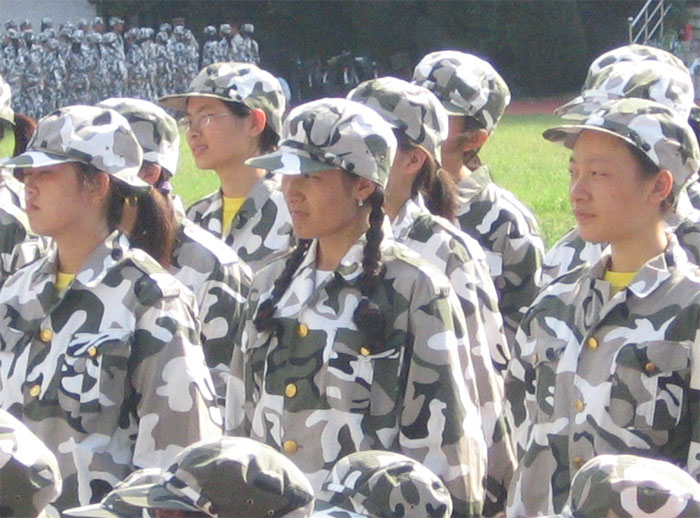
I like this girl with the pigtails - she reminds me of Cultural-Revolution era movies! Anyway at this college the military training is at the college for two weeks, but it's not standardized. Other people I talked to said they went to a special camp to train for a month, or that their college didn't have any military training, or that they only trained for a week. They told me that there was one college where you had to train in the military for a year! Although most of the people told me men and women were treated the same, one woman told me that at her college the men practiced firing a rifle for all of 8 shots apiece, at the very end of the training period, but the women didn't. Half the sky, half the sky...


While to me a very brief military training sounds kind of interesting, almost everybody I talked to about it said it was a waste of time. They marched around in heavy clothes, it was really hot, and sometimes they had practice emergency drills, really early in the morning. I mentioned the idea that the freshmen should band together and attack, say, Vietnam, but they didn't seem too keen on the idea. "It's not real military training," they told me. Which I guess is good, because what kind of genuine boot camp features parousels?

Sunday, February 12, 2006

The Po-lice

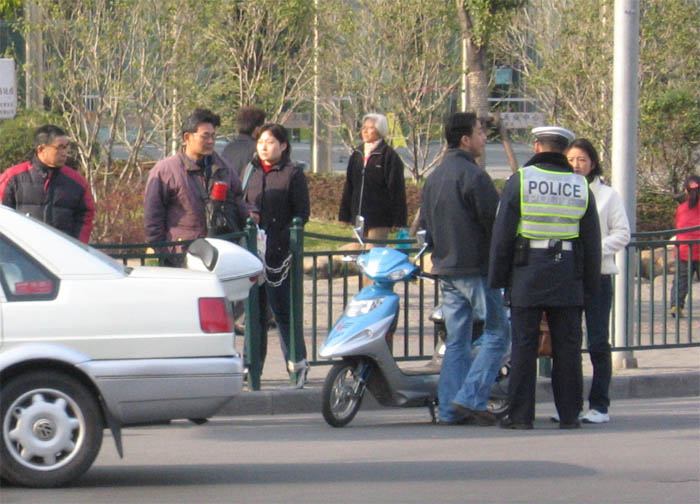
A pet peeve of mine is, I get the occasional mail or IRC asking what's it's like to live in a police state! People much more knowledgeable than me make the assertion, and I read about definite abuses of power involving police, but I personally don't think that criticism applies. It seems to me that a necessary feature of a police state is a lot of policemen, but instead policemen are strangely rare on the streets of Shanghai. It's entirely possible to walk across crowded areas of Shanghai and only see a couple of them. I could definitely imagine walking all day without seeing any, if it wasn't that Police are often used to direct traffic.


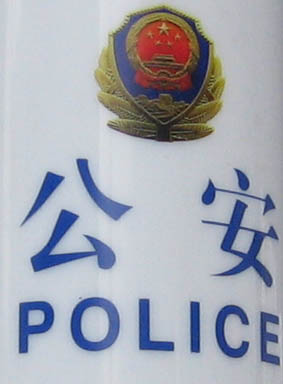
For the most part, the police are out of sight, out of mind. My only real interaction with them has been when I got my Visa half a year ago, I had to register where I lived with the closest police station, then have them stamp some form. On the right is the police station closest to my house. There's some hoopty cars out front, but I think it's more common for Police to use newer Suzuki motorcycles, or to stay in their station until someone calls them.


Which isn't to say Shanghai is unsafe. Shanghai is an extraordinarly safe city, a city where your wallet gets returned with the money still inside, and little old ladies take the shortcut through the un-lit alley. Supposedly the worst cities in China are the Southern coastal cities like Canton, although I hear this from people who've never been there. And even those cities don't so sound bad.

That said, there are some crimes a more solid police force would counteract. In some Muslim areas you'll be offered Marijuana every several seconds. Prostitution and selling counterfeit items are basically de-criminalized, although there are occasional token raids. And most annoyingly, traffic patterns are completely crazy, with motorcycles and scooters ignoring all traffic laws, and carts veering out onto the road. You do see the occasional person get pinched, but it's the exception rather than the rule.


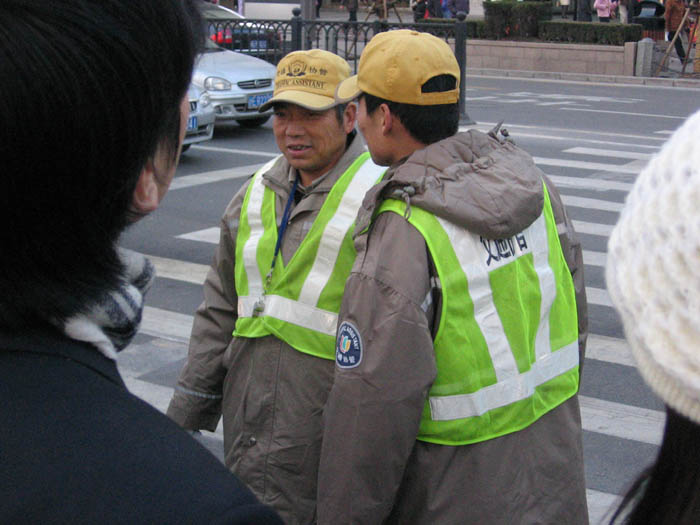
Just as in the US, some of the slack is taken up by Rent-A-Cops, who can veer from looking and acting all official, to some guy in a dirty jacket listening to Chinese Opera all day. It's probably less common than in the US, but you'll see Rent-A-Cops at banks, at malls, at the entrance gates to apartment complexes, and such. Also, most of the manned intersections will have "traffic assistants," rather than full-on-police.

Tuesday, August 16, 2005

A Lack of Propoganda


I'll admit, I love the old Communist propoganda. In form, not function, of course - it's hard to be a big fan of the Cultural Revolution, or the Russian Soviet propoganda machine. The art of Communism, however, with its goal of conveying ideals to the public rather than impressing a sense of artiness to an elite, is much more approachable in theme and subject than most Modern Art. And of course the bold design aesthetic is striking - particularly if you compare it to, say, the look of American posters from before Photoshop and desktop publishing. And I can't deny, there's a certain kitsch appeal to the simple themes, often out-dated and generally over-dramatized. Have a look at Stefan Landsberger's Chinese Progoganda page.

I realize that the glory days of this propoganda is in the past. However I expected at least some visible remnants. Maybe a Mao here or there, some kind of statues, even a few posters. Instead, I was surprised to see that state propoganda is not to be seen on the city streets. For the most part, not even a flag - I don't have to say how common state flags are in the United States, along with reminders of 9-11, signs in front of minority-owned businesses reminding people that they're also American (so please don't throw a rock through the window), and crucifixes.

In contrast, take XinTianDi (please). It's a trendy international-esque shopping center with a lot of popular bars, all of which are secretly desperately uncool. I'd been a couple of times before I realized it also houses the original meeting-place of the Chinese Communist Party. I went in to have a look, and was surprised to see a straightforward presentation of the various events that culminated in the Communist revolution. Mao Zedong, one of the thirteen attendees, was given one (1) photograph. There wasn't even a Chinese flag to be seen, although there was a flag of the Communist Party prominent in the lobby.

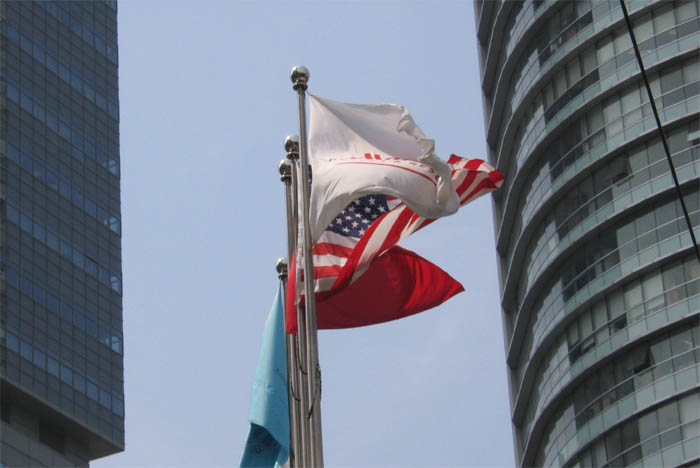
Photos are a form of lying, though, and I can collect pictures and make it seem like flags are all over the place. For instance, they mark most government buildings and offices, such as the Immigration Office. These government buildings tend to be concentrated in the city center so that makes them more visible.


You'll also see them in front of most 5-star hotels, such as the Marriot. It's right behind the American flag they use to show off being an international chain. Please note that I am staying in a hotel that is a far sight short of displaying any flag in the front. Similarly, a row of flags will sometimes mark the recently-built, elite shopping centers or office buildings.

But for the most part, you won't see them at all on the streets of Shanghai. They're rare enough that if you do spot a Chinese flag in front of a store, you'll know it sells medals and trophies, for sports tournaments and the like. It's similar to barber-shops having a striped pole in the front (which is a Shanghai practice as well).


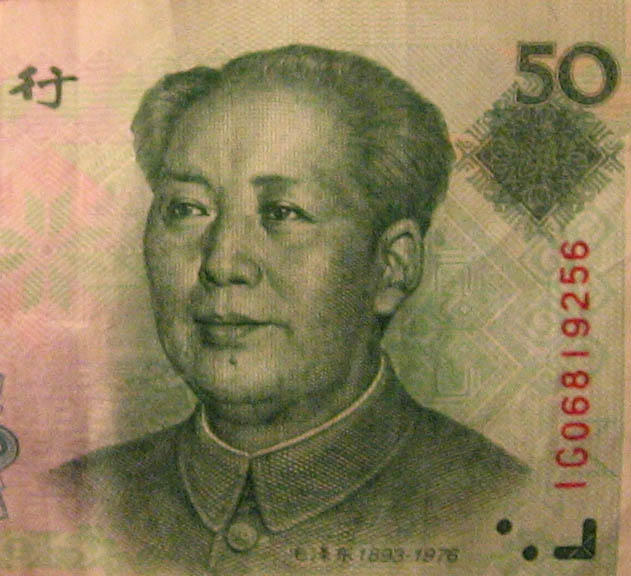
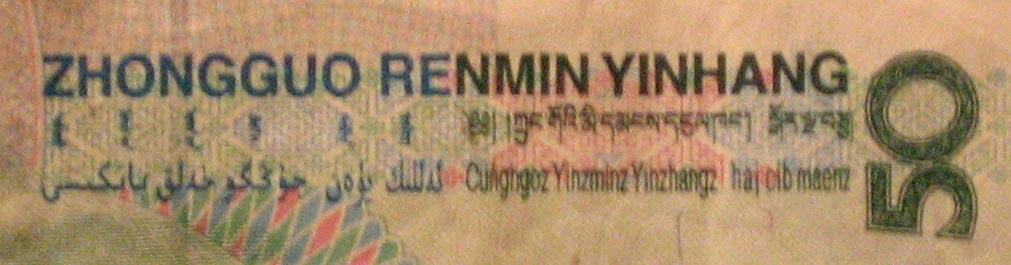
The search for Mao is even more difficult. I've heard about holdover portraits from the Cultural Revolution at select sights, but I haven't actually seen any. Ironically enough, the two places to see Chairman Mao's mug is on T-Shirts aimed squarely at foreign tourists, or on the currency. As a quick tangent, I find it pretty cool that Chinese Paper Money doesn't just use the Chinese/Han language, but also various other languages spoken in China, as well as the Chinese written in Roman characters.

However there is a little more propoganda to speak of. In addition to my earlier picture of the Soldier's Statue in People's Park, there's also a statue of Marx and Engels in the corner of Fuxing Park, which is probably my favorite park in the city. The statue wins extra cool points by being from the eighties and managing to both look its age, and look classically styled.


So I don't mean to say there's no state propoganda in China - just that it's primarily migrated into really boring News programs. And this blog itself is blocked in China - along with the rest of the blogspot domain. Blogs are supposedly getting big in China, but were blamed with assisting large anti-Japan protests several months back. Blocking this domain is perhaps some sloppy attempt at control.

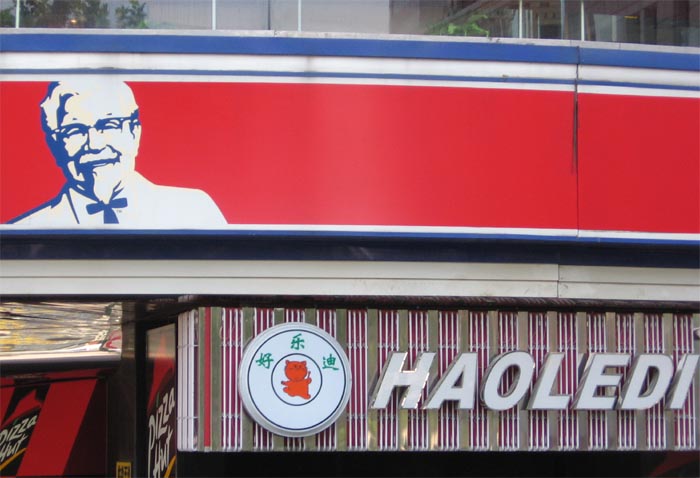
It's easy (if trite) to say consumerism is the new propoganda. While it's the exception, there are definite areas where the advertisements and conspicuous consumption are the raison d' etre. On Nanjing Donglu, you're always within view of McDonald's, KFC, or a "Haole Die" (supposedly a Karaoke Chain, but I remain suspicious). But I think the new propoganda is the cityscape itself, with wild buildings that can't help but impress, especially if you look at how undeveloped these areas were just a decade ago. Pudong is lit up at night to make it a symbol of economic might, rather than to keep the burglars away.

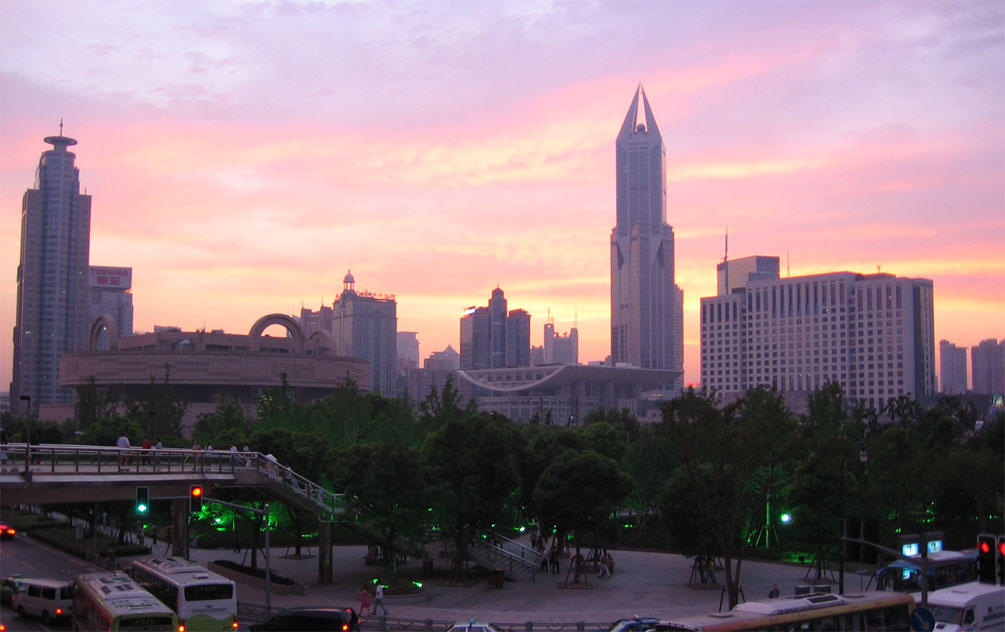
Rather than delve into deep thoughts, I'll link to a postcard view of People's Park at dusk, taken from a walking bridge near my hotel last night. I'm studying and teaching on the far side of the Park - you can't see the building in this photo, but it's right next to the tall building with the triangles encasing the ball.