Showing posts with label Alcohol. Show all posts

Tuesday, January 29, 2008

Making Cocktails in Shanghai: Manhattan, Negroni, Margarita

There's not many places that mix a decent drink in Shanghai. Clubs and bars will mostly give highballs - a soda, juice, or maybe a tea, mixed with an alcohol. It's tough to go wrong, but it's not very exciting, neither. Higher-end places are good but not great, with a tendency towards seriously sweet drinks involving vodka and frou-frou things mixed in.

As a cocktail fan I find it all a bit tragic. If I want a good cocktail I have to make it myself. However it's not as easy as in the US: there's some Shanghai-specific issues I'll bring up in making my favorite cocktails. I won't go into details on the actual mixing, as I think it comes down to personal preference, although I'll say you should used bottled water for the ice! Click on the titles for a recipe, and this video of a Negroni being made is fun:


The Manhattan


Made correctly, a Manhattan is the best cocktail.

A Manhattan is basically two parts rye whiskey, one part Italian (sweet/red) vermouth, and a dash of Bitters. There's the caveat that the amount to use in the recipe depends on matching the strength of the whiskey to the sweetness of the vermouth - balance is key. While each combination definitely has a unique optimal blend, being a little off still results in a very good drink. The picture is a CC shot taken from flickr.

Even though bourbon is usually used, it's a bad idea. It's just too sweet to make an interesting drink - there'll be no contrast in the final product. Rye is the way to go - unfortunately Rye isn't available in China!

The best alternatives are Wild Turkey Bourbon, which has a substantial percentage of Rye, or Canadian Club Whiskey, which also has some. Neither is perfect: Canadian whiskeys are mixed with neutral spirits to make a seriously wimpy product, and Wild Turkey Bourbon just doesn't taste quite right with the drink. I'd go with Canadian Club, which can be found at various superstores and foreign groceries around Shanghai. Also a CC Flickr picture.

Martini & Rossi vermouth is relatively easy to find in Shanghai, and goes great with rye, but overwhelms any bourbon - matched together, it tastes sickly-sweet, gummy, and frankly a little gross. The Lawson's Market, near Huangpi Lu, stocks the mellower Cinzano vermouth. It's a lighter vermouth, but one still needs to go easy when matched against the light-flavored Canadian Club. It costs 100 kuai (about $13) for a 1 Liter bottle. This is more vermouth than anybody needs, and vermouth will start tasting not as good a couple months after the bottle is opened. But smaller bottles aren't available and there's no choice.

Angostura Bitters are the Gold Standard. They're available at the same market, a 200mL bottle for $15. It's a rip-off, but that's enough to last a number of years, and it keeps perfectly even without refrigeration. There's no orange bitters available, which isn't a surprise, although Orange Bitters used to be a de rigueur ingredient. There's a few versions occasionally available in the US, and I understand Suntory sells an authentic pre-Prohibition style, but only in Japan, and it's hard to track down.

The Negroni


The Negroni is actually a much easier drink to make in Shanghai. It's definitely an acquired taste, but I've come to enjoy them very much. It's one (or more) parts gin, one part Campari (an Italian Bitters), and one part sweet vermouth.

So although Rye can't be found in the US, and there's not much selection of Bourbon, Rum, or tequila, gin really isn't a problem. I think Shanghai alcohol importers just follow the lead of Hong Kong, and import what's popular with English people. Not every popular brand is available, but most of them are, including the more expensive gins like 10, Plymouth, or Bombay Sapphire. But these gins are not very good in a mixed drink. The way to go is a more traditional, stronger flavor, like Beefeater's (which is sporadically available at Carrefour), Tanqueray, or the easily-found Gordon's. They're all slightly cheaper than what they cost in the US.

Campari is also not a problem. It's sold at at most places that import alcohol, at Carrefour it's 100 kuai. My friend likens the taste to "carpet cleaner." So be prepared to not be a big fan, right off the bat.


Finally, sweet vermouth, the same type or vermouth as used in a Manhattan. Either brand I mentioned will work fine, although one would want to slightly up the amount of Cinzano to make up for it having a mellower taste. Be careful, too much vermouth (especially Martini & Rossi vermouth) is really a terrible thing with this drink.

Margarita


This drink is widely available but seldom tastes right, and there's good reason for this: the ingredients are hard to find in China. It involves one part lime juice, two parts Orange Triple Sec (hopefully Cointreau), and three parts tequila.

The good news is Cointreau, it's a definite necessity for a decent Margarita. In local alcohol shops, it can still be found for 120 kuai, about $17, compared to about $35 in the US. Unfortunately the Carrefours and so forth have raised the price to $23 or so.

There's no real reason to experiment away from Cointreau, but for slightly more, Grand Marnier is also available, it's sweeter and has a brandy base. Lejay-Lagoute is recently available at City Market, a foreign grocery. It's more expensive, lighter in proof and taste, and comes in a small 500mL bottle. But I had a free sample and it seemed usable.

Lime juice is a tough one. On very rare occasions, Key Limes are available cheaply, it's always worth getting them even if there's no intention of making a Margarita, they're awesome. Usually, though, it's normal-size limes, for a very expensive price, maybe a dollar a lime. And usually these limes are some weird kind I'm not familiar with: stuffed filled with seeds, a nice fragrance, but a very astringent taste. I haven't devised a means to tell them apart from better limes, and they're sold under the same names at various stores. It's easy to buy Lime juice concentrate, and while the taste is there, using concentrated fruit juice will result in a boring drink. I've tried mixing it half and half with the concentrate, and while it's really not satisfactory, it's better than nothing. The sweetness of the triple-sec should be matched against the sourness of the limes, so if using weird limes, it needs a taste-test to make it properly.

Finally, the tequila. There's some easy-to-find brands - Olmeca, Jose Cuervo, Sauza Gold. All sell for $12-$18, and all of them are more suited towards frat parties than a nice mixed drink - still that's probably as good as it gets for making a Margarita.

Tequilas are sold as gold (crap), silver (unaged, stronger tastes, although from cheap brands it just means it's gold without caramel coloring added), Resposado (slightly aged), and Añejo (aged). All good tequilas are 100% Agave. Silver and Reposado are best suited to a Margarita, by the time it gets to Añejo the tastes are too different, it doesn't really work with a Margarita. That said, there's some decent Añejos available in Shanghai - some foreign groceries sell Jose Cuervo 1800, a peppery 100% Agave Añejo. The actual best tequila available in Shanghai is Don Julio Añejo, going for a ridiculous 650 kuai ($90) in Lawson's.

You're allowed to bring two bottles of alcohol into China: a cocktail fan should take advantage of this. And on the positive side, Shanghai has Havana Club 7 relatively easily available at foreign groceries. Even if it's not quite as cheap as it was a couple years ago, it's about as good as rum gets. Also there's some surprises- Rhum Agricole is available at the Japanese Groceries, various absinthes of wildly different qualities, and low-grade Maraschino Liqueur, which still makes for a top-grade Aviation.

Update 4/22/2008 - I ran across Delish, a small import store and bakery at 98 Yanping Lu, a little North of Jing'an Temple. There's a small and overpriced but definitely interesting selection of alcohols. Patron Silver is the standout, at an expensive $65 - Don Julio Añejo is the better tequila, but Patron Silver makes the better Margarita. They also have Marie Brizard alcohols and Orgeat (for a Mai Tai), grappas, Rhum Agricoles, and other exotica.

Sunday, February 04, 2007

Foreign Spirits

I'll start off by saying I hope I don't come off as some kind of alcoholic from this update. Fancy hard alcohols excite some kind of collecter impulse with me, I'm interested to compare and contrast the different styles, and learn how cocktails work, like I was a leading man from a 50's movie!

In Shanghai, by contrast, very few people I know care for alcohol, and nobody I know drinks cocktails - when I try to push a drink on Chinese people, it never gets more than a few polite sips. I'm not much of one to drink alone in my apartment, believe it or not, so the end result is my collection is growing to the point of being a little absurd.

Which isn't to say China is alcohol-free. Having a light beer or two with a meal is relatively common, and China has various native alcoholic drinks. Chinese hard alcohols more popular with the older generation and the poor, I think.

Western spirits are commonly found, though. Their main place is as an extremely expensive bottle that is given as a particularly elite gift, or perhaps to have around the house to show off that you can afford money on such things. It's much more common than in the US to run across bottles of Scotch or brandy in the $50+ range, any upper-end mall or shopping district will sell them one after the other . They often come in gift boxes, with a couple of tumblers, or perhaps an extra 200mL bottle on the side:


I hate to apply the term "good deal" for a $135 bottle of Scotch, but that's how much it costs for a bottle of Johnnie Walker Blue, a bottle you see all over the place. In the US, the bottle would cost perhaps $170 or $180, after taxes. On the other hand, $135 is a lot more dear in Shanghai, where the average salaries and cost of living are both much lower than in the US.

These bottles are mostly to be seen in the more elite shopping centers. But even in the boonies of Shanghai, there's generally bottles of Johnnie Walker Black and Red behind the counter of every convenience store.


I have to guess not very many bottles actually get sold this way. I've never seen it, and I go to convenience stores every day of the week! Perhaps it's behind the counters as part of a promotion. Johnnie Walker and Chivas Regal regularly sponsor events aimed at ex-pats, for example House music DJs visiting Shanghai, or the Black Eyes Peas a short while back. They also have large signs in front of a lot of bars - I think especially those aimed at HK & Taiwanese Chinese, although I'm hardly expert.

If you look at the above picture you can also see some Japanese sake and Korean shochu, which is popular with Japanese. The picture was taken at a Japanese-branded convenience store in a part of town with a relatively large number of Japanese people. I have to believe Chinese people would never purchase Japanese alcohol, and they're entirely intended for Japanese. So in most of Shanghai it's not so common, but in stores aimed at the Japanese, there's a wide selection:


Westerner-style alcohol selection is much wider, have a gander:


There's a European tilt to all of this, and not just because it's the chain of a French superstore. Scotch-style whiskey predominates, there's excellent but uncommon-in-American bottles such as Pernod and Pastis, etc. There's a little of everything, but some categories only have cheap knock off brands, or the famous brands that taste nasty. Some decent tequila is high on my wish list - 1800 Anejo Jose Cuervo is OK and the only real tequila in town, but not worth the $40 cost.


Personally I think vodkas are all the same, brand loyalty coming from which one has the best marketing. And vodka doesn't seem to be very popular in Shanghai, although you can get some of the major brands like Absolut or Stoli, substantially cheaper than in the US. Recently, a few vodka brands have launched big. They don't advertise as heavily as the whiskeys. With an immature market, and no real difference between the end product, these brands differentiate themselves by price. This bottle of Grey Goose goes for about $50, almost twice what it is in the US.


Oh, speaking of wish lists again, definitely #1 on my wish list is for Wild Turkey Rye - even though Scotch is common, other whiskeys are pretty rare. Probably the best local subsitute for Rye in a Manhattan is Canadian Club, which you can find at a few foreign grocery stores. And, my wish list for the US is Havana Club, the US has a political policy of not allowing US citizens to buy goods from Cuba.


This is different than Barardi's Havana Club knock-off they sell in Florida, which comes from the US refusing to recognize a Cuban trademark. The Havana Club 7 years is the most delicious rum I'm ever had. When you can find it at Carrefour it goes for $23. If it was in the US at that price, it would dominate the market! Well maybe not - it's a little hard to find in Shanghai, and most bars stock Bacardi, which is nasty and not much cheaper, but has the advertising and the familiar name. Oh, there's also a Havana Club 3 that is very light but good, and a Havana Club Reserva, I found it in a Thai airport, that is still good but perhaps too mild and smooth for me.

The US doesn't allow Absinthe, it is allowed in China. This brand tastes almost exactly like Listerine, and the whole absinthe mystique is BS, based on French prohibitionist hysteria from a century ago. It is an attractive bottle, though.


Another weird US policy is limits on the legitimate sizes of bottles - 700mL is not permitted. However, 700mL is the norm in France and in former French colonies, perhaps this encourages French companies to have vastly different pricing schemes for the US market. Cointreau, for example, is an absolutely necessary component of several common mixed drinks, like the Margarita. It costs $35 a bottle in the US, very steep, but goes for a comparatively cheap $15 in China.


For mixed drinks, the quality of the juice and other mixers are just as important as the quality of the alcohol. It pains me to hear Taiwanese people talking of mixing their expensive Scotch whiskeys with the sweetened iced tea you buy at convenience stores - a very popular mixed drink in Shanghai. It also pained me to use the limes that were available in Shanghai when I first arrived, I also use them a lot in the rare instances when I cook - they were fragrant, but too astringent and weird. In the last half year, it's become easy to find more familiar limes in the foreign grocery stories, but the prices are somewhat prohibitive - three normal-sized limes are here selling for $2.50.

Tuesday, August 29, 2006

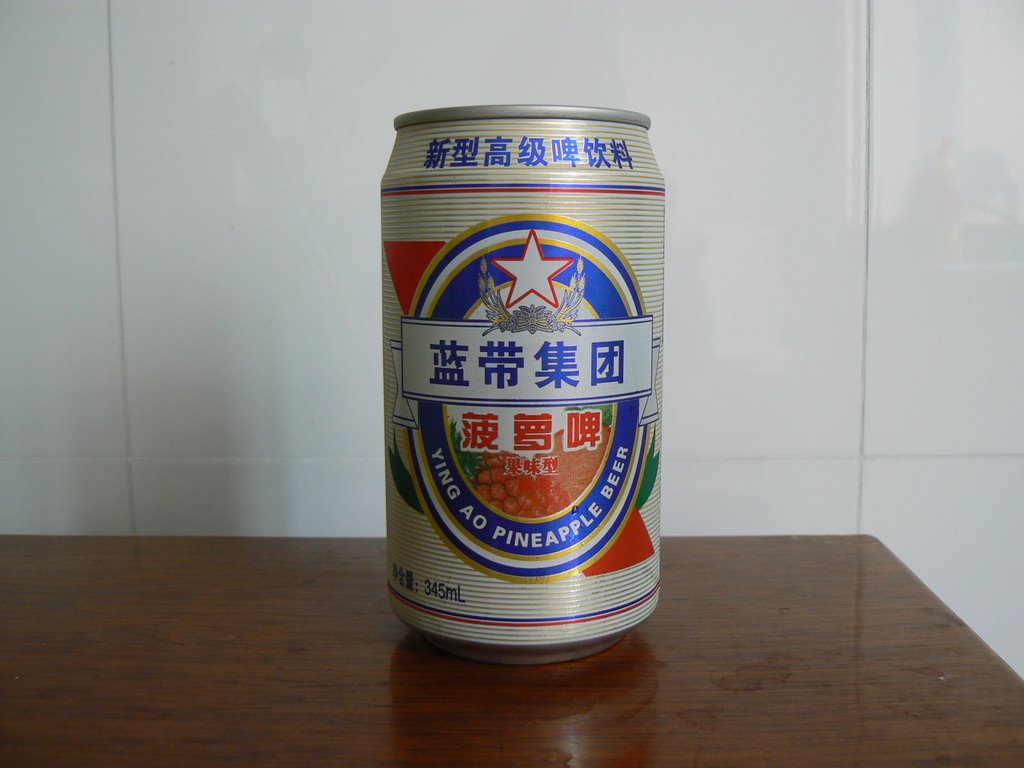
Pineapple Beer

I'm on a sort of a quest for Bittermelon Beer - or at least, that's the dramatic way to put it. Really, I just keep my eye open when I go to a new store and look at their alcohol selection. So far I haven't been lucky! As a substitute I decided to try out some pineapple beer.


This beer isn't available everywhere, but sometimes you see it around, mostly at the superstores they have around town. In this case, it was at Hymall, a disappointing Japanese-owned superstore that's nearest to my aparment. I've only seen the drink offered in a can. Same as most Chinese cans, its got the pull-top, like a cheap Mexican soda or a can of sardines. It's dangerous, and definitely you don't want to be drinking alcohol and opening cans of Pineapple Beer!


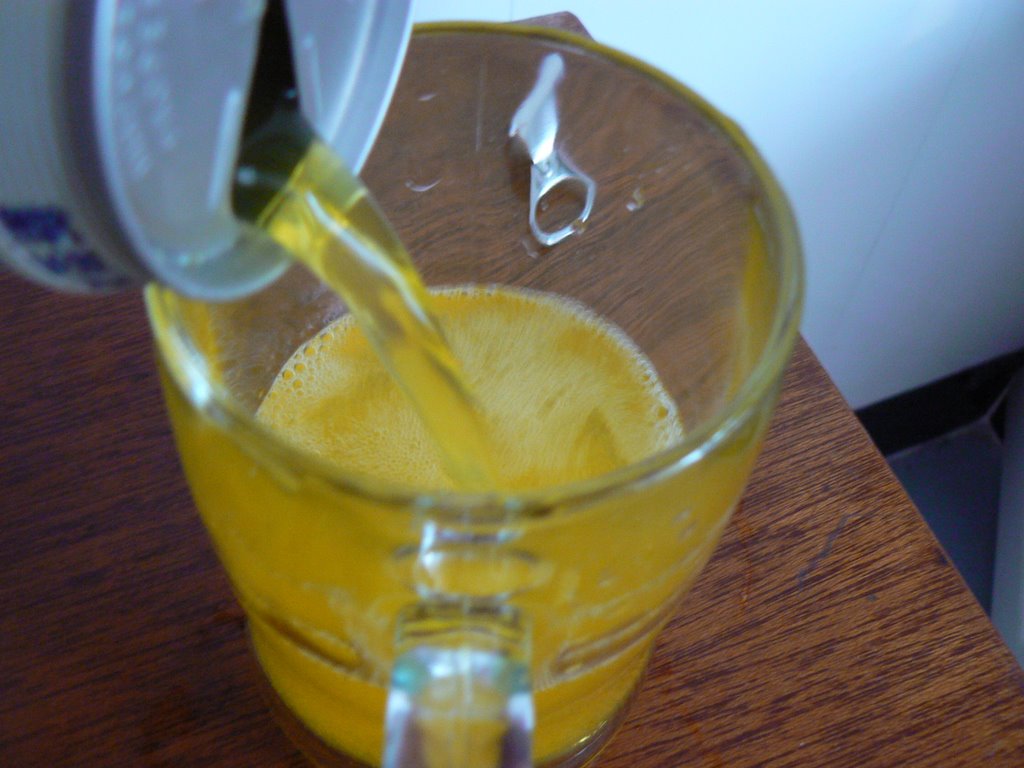
I wasn't sure whether this was going to be an actual beer with pineapple flavoring, which maybe could even be OK, or an alcoholic pineapple juice. My question was immediately answered - no beer pours this color!


The taste is what you would excpect from looking at it - a very artificial flavor, with a sickly, disgustingly sweetness. That said, the pineapple flavor and aroma are surpringle full, and the drink packs a moderate kick, without the alcohol taste. Still, similar Japanese fruit ciders are easily available in Shanghai, and taste much, much better than this.

Sunday, July 09, 2006

Beer

Beer is something easy to both love and hate in Shanghai. On one hand, there's no denying that the beer in Shanghai is no damn good. On the other hand, it isn't particularly bad, it is generally very cheap, and it goes well with Shanghai's humidity.

I mentioned before about cheap Chinese Booze. The distinct tastes of Chinese hard alcohol definitely requires acquiring. Chinese beer is the opposite: for the most part it's impossibly generic, with very little taste beyond a watery sweetness. It's often of a light lager style that I associate with American mass-produced beers.


The beer is typically sold in 640 mL bottles, about twice as large as a normal 355mL bottle of beer. It's also sold as cans or sometimes in different-sized bottles. The bottles have the manufacture date stamped and the shelf life printed on the label, rather than the expiration date stamped as in many countries.

China doesn't have a legal drinking age, although a bar would be reluctant to serve children. Drinking in Shanghai often takes place with meals, either at home or at restaurants. My neighborhood has dozens of restaurants but no corner bars, and the bars that do exist in Shanghai are dominated by foreigners and the friends of foreigners. Overall I think Chinese people drink much much less than Westerners.

Tsingtao Light Beer - Tsingtao is probably the only Chinese beer that comes to mind for a non-Chinese person. The beer goes for about fourty cents for the large bottle. Even at a restaurant, it'll only be marked up to half a dollar. At a bar, though, it can easily cost five dollars - bars are most aimed at Westerners with lots of free cash. The English name says Light, but really it's just cheap - it's worth paying the extra dime to get the mid level Tsingtao, or even upgrade to:

This is Tsingtao's premium beer, selling for eighty cents a bottle. Many beer labels will offer a large number of different labels and qualities of beer. I would call this the best lager-style beer available in China, although it loses points by force of having a light skunk smell. And to be honest, the difference between this beer and every other Chinese lager is somewhat subtle. Update 5/31/2007 - I noticed that premium Tsingtao beer is now widely available in San Francisco and Oakland. I didn't see it in Honolulu so I'm guessing it's being test-marketed. If you see it for sale, I recommend giving it a try!

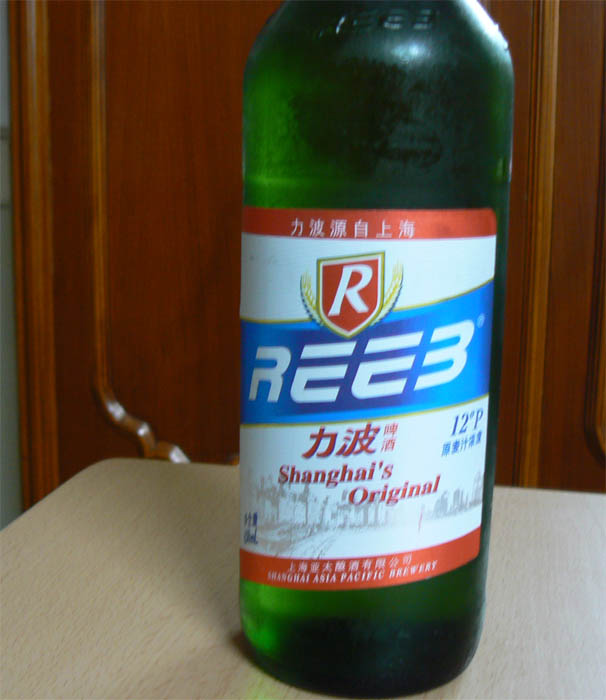
Reeb is the cheapest commonly available beer. Their beers are extremely neutral and flavorless. They don't have Tsingtao's slight skunk smell, possibly because the Reeb in Shanghai is usually very fresh - the stores near my house will have beers that are only a week or two old. Reeb has a number of different variations, this is the Shanghai-produced version that would possibly be wildly popular in the US. It's bottled at 12 proof, which in the US would make it a malt liquor - Mickey's are 11.4 proof. Also, the 24 oz sells for 36 cents.

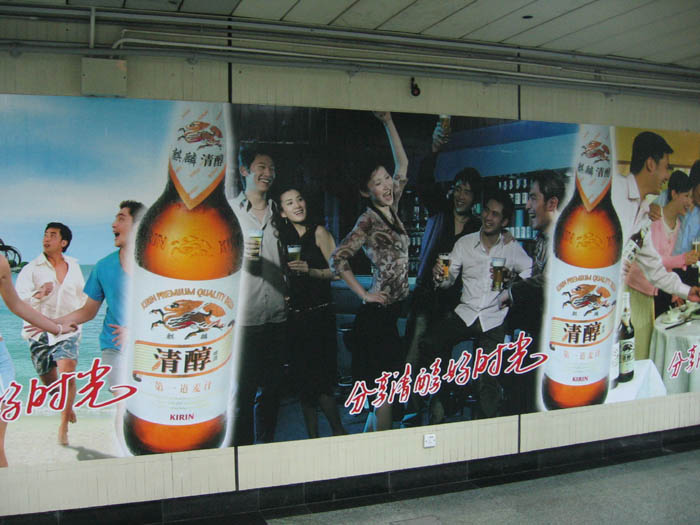
Kirin is a Japanese labeled, locally-produced beer popular in China, selling a cheaper flavorless variation, and a version that tastes more like the Japanese beer, although still lacking much flavor. The premium version is almost as good as Tsingtao premium. Japanese beers are pretty common - most popular is Suntory, which sells premium spirits in other countries but competes with Reeb for the low end beer market in Shanghai. Asahi is somewhat common - along with Kirin, it really advertises heavily.


Budweiser sells a normal and a premium beer, although confusingly enough the difference in prices is small - seventy five cents, compared to eighty five cents. It's the only American brand that manufactures here. Heineken manufactures in China as well, selling a large bottle for $1.35. Personally I think Budweiser and Heineken are flavorless, with both Tsingtao and Kirin's beers being a much better value. But I'm aware many foreigners in Shanghai think Heineken is just great. Guinness manufactures a variation of their beer for the Chinese and Indonesian market. It's lighter and generally tastes different than the Guinness back home, isn't all that easy to find, and sells at $1.50 for an American-sized bottle, but is still pretty good.

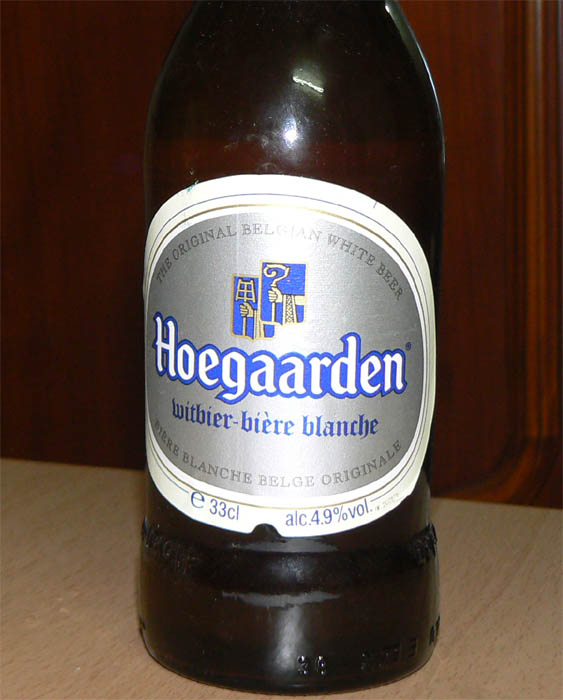
At grocery stores targetting foreigners, or at Lianhua's fancier import-oriented grocery stories, it's not all that difficult to find imported beers from Europe in China, although they're much more expensive and not entirely fresh. This Hoegaarden is certainly interesting, more resembling a Sprite more than what I consider a beer, although still pretty tasty. Anyway I have to say that the best beer you can find in Shanghai is a Newcastle - but at $3 for a large-ish can, it's too expensive. The only American import you can find is Samuel Adams. I wouldn't order it in the US, but I consider it a contender for the best beer available in Shanghai - and $1.50 for an American-size bottle is more reasonable.

I'll put Harbin Beer as the worst beer I've had in Shanghai. The taste itself is fine, but the water used is entirely metallic. It leaves an unsettling rust aftertaste and I really couldn't finish the can. Making it all the more dissappointing, I looked around to find it. The search showed the oddities of the Chinese distribution system. It's pretty common to find at restaurants, but I can't find it at even the largest grocery stores. Finally I found a chain convenience store with a few cans, although other convenience stores of the chain don't carry it. Actually I also tried a bottle of this at a restaurant, and I thought it was decent, so it could be a canning problem, or maybe the spicy food had numbed my tastebuds.

Light lagers dominate Chinese beers, but in the last year Reeb has made a large push with a dark, more flavorful beer. It's available at most grocery stores and convenience stores. I'm all for the idea of doing something different, but this beer is truly awful - it tasted unbearably sweet, with a flavor reminding me of what I don't like about Sarsaparilla Soda. I'd rather try Xinjiang's dark beer, which I hear is excellent, but I've never seen in a store.

Much better than Reeb is Tsingtao's take at dark beer - actually, they have two. The first I tried was directly bottled under the Tsingtao name, and is the most expensive Chinese-label beer I know of, costing $1 for a US-size bottle. The beer is pretty tasty, but has an unfortunate aftertaste resembling soy sauce. Better is the slightly cheaper dark beer they manufacture under the Haidao Black Beer label. The aftertaste is strongly of chocolates, toffee, and vanilla, giving it a desert feel that might be a little unusual, but keeps it interesting enough that I'd drink it from time to time, even if I was back in the US. And to be honest, that's the only Chinese beer I can say that about.

And I almost forgot to mention two important details. First, that beer is often served warm at the cheaper restaurants. Gross! There's a line of Yin-Yang medicine belief that cold drinks are bad for your health. Also refrigerators are kind of expensive. Also there is actually a second Chinese-produced American beer, although it's hard to find. Surprisingly enough, it's...Pabst!

Wednesday, September 14, 2005

Cheap Chinese Booze - a Tasting


A few weeks ago I was buying my hourly Diet Coke at a Kedi Convenience store (located on a street corner near you) when an annoying drunk cut in line in front of me, to buy a large bottle of alcohol. I was initialy peeved but it was worth it to see the price: 5.9 kuai, or slightly less than 75 cents.

Don't get me wrong, I realized this wouldn't be the top level stuff. At a logistical level, you can't run a legitimate civilization if a bottle of high-quality alcohol can be purchased for $.75. There just wouldn't be a motivation to do more than $1.50 of work a day.

From my limited earlier exposure to cheap Chinese alcohol, I have two problems. First is a sickly sweetness, worse than with a fruit brandy. Perhaps you can take it for a small amount, but I can't even imagine you'd want to keep at it. Second is a strong taste of mold. This isn't a defect in the manufacturing process. The mold is an intentional flavor that has been cultivated specifically to flavor the alcohol, much the way mold is cultivated for cheeses. Still I find the taste terrible, the smell worse, and it makes the drink impossible to mix in a cocktail.

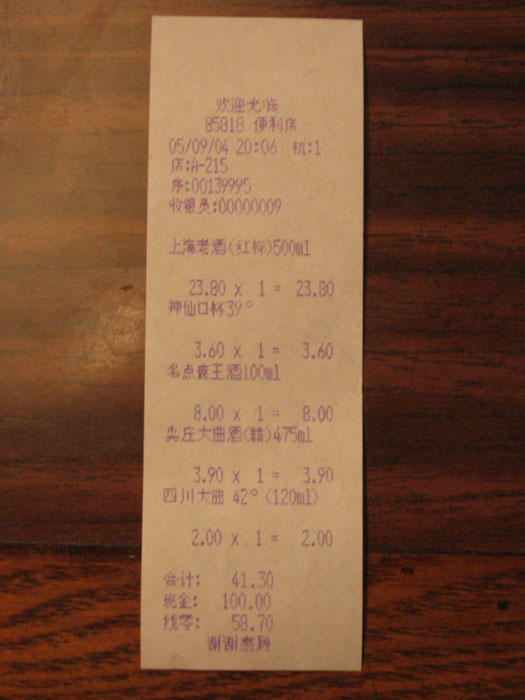
I realize an obvious criticism: if I want the quality stuff, I should spend more money. Well I'm a cheap jerk and going to China hasn't changed that a bit. Instead I went hog-wild and spent $5 trying out five bottles of the cheap stuff - and really, the lion's share went to one $3 bottle of a low proof alcohol.

Here are my tasting notes. I include a price to get drunk off the alcohol, with the mathematics that six 50mL shots of 80 proof alcohol will get a person drunk. Please believe that I didn't myself partake of more than a few sips. Also, 1 kuai is approximately twelve and a half US cents.

Tasting Notes:


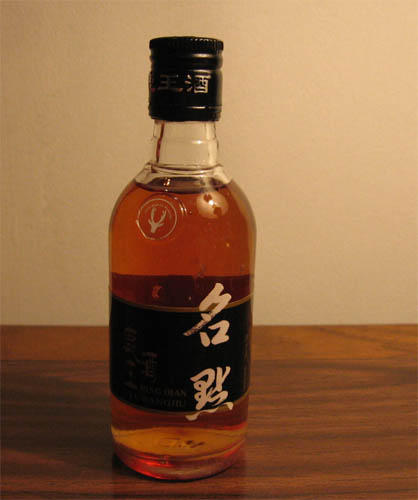
Ming Dian Lu Wang:


3.6 kuai 100mL at 70 proof: An unidentifiable but rich, musty aroma. Not stong in taste. Initial sweetness with a thin flavor gives way to a smoky moldiness. A syrupy mouthfeel. Surprisingly drinkable, although I suspect I would grow sick of it quickly. Price to get drunk: $1.54


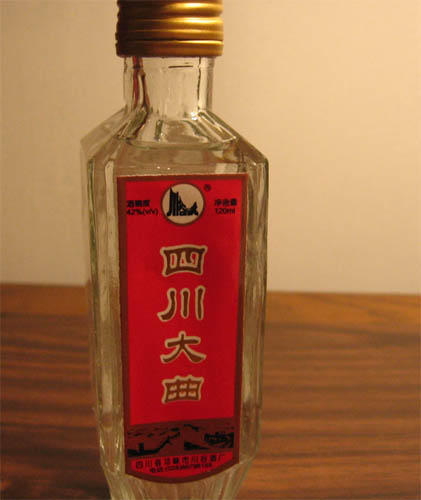
Si Zhou Da Qu:


3.9 kuai 120mL at 84 proof: Cool bottle with tapered bottom. Smells like an old cheese. Strong pungent taste that overwhelms the other flavors (sweetness, overtones of mold, and a not-subtle hint of lighter fluid). Boring. Price to get drunk: $1.16


Jian Zhuang:


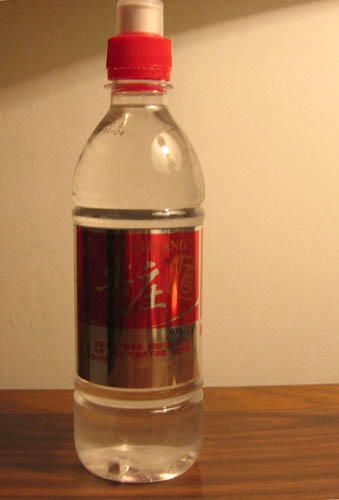
8.0 kuai 475 mL at 100 proof: Unbelievably packaged in a re-purposed plastic sports water bottle, although plastic sports water bottles aren't otherwise available in Shanghai. A somewhat repulsive smell of mold, locker room, and wet cardboard. Initial balance between a sharp pungency and mold flavor is interesting and masks the sharp bite of the alcohol, but the mold quickly overwhelms everything else. Drinking more than a small amount of this would probably make you very sick. Price to get drunk: $.50


Shen Xian:


2.0 kuai 150 mL at 78 proof: Comes packaged in a drinking glass with a plastic cap. The plastic cap is re-attachable but the definite idea is for the alcohol to be finished in one go. Overwhelming aroma, dominated by a horrid smell of mold. Upon taste, surprisingly enough, this is a step away from a neutral spirit. Very smooth, with a lesser amount of mold flavoring than previously reviewed alcohols. Dangerous. Price to get drunk: $.51


2001 Shikumen:


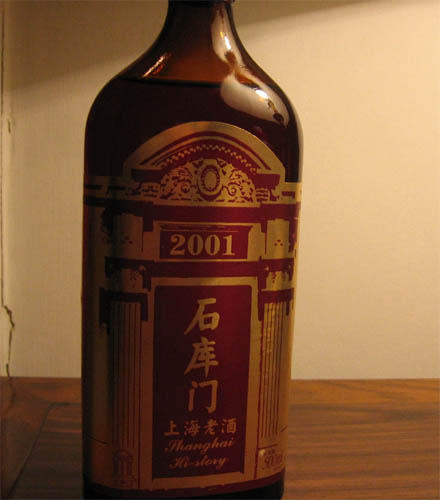
23.80 kuai 500mL at 20+ proof. A tinted caramel coloring with a somewhat musty smell. Strong initial flavor of berries is slightly sweet and tart with an appealing if somewhat chemical taste. Quickly gives way to a dissappointing wateriness. Still a likeable drink that is probably worth experimenting with in cocktails, perhaps as a replacement to Pimm's Cup. Bottle doesn't specify alcohol content, merely that it's higher than 20 proof. I'll make a guess of 30 proof. Price to get drunk: $4.78

In conclusion, I can't recommend getting drunk off of really cheap alcohol purchased from Chinese convenience stores. I can even say that I strongly advise against it. However if such is your wont, I would recommend paying the extra cent and opting for Shen Xian over Jian Zhuang, even if Jian Zhuang's packaging is more convenient at the gym or local basketball court. Ming Dian Lu Wang and 2001 Shikumen are perhaps worth an impulse purchase, and I'd even consider buying the premium versions of these alcohols.

Even if the thought of moldy alcohol is repulsive to you, China isn't the place to go for a forced sobriety. Johnnie Walker Black and Red are available on pretty much any block, and many other international hard alcohol brands are available as well, for prices equivalent or cheaper than in the US. Beer is available at convenience stores for a quarter to fifty cents apiece. Tsingtao is the best of them, unfortunately, but it's better than the Tsingtao you get in the US. And Kirin has been giving away their recently-launched fruit ciders for free, right on the street.

Finally, some cocktail experts give a few ideas about mixing Chinese alcohols into drinks on the E-Gullet Forums. David Wondrich (who wrote an excellent cocktail book for Esquire) makes some recipes that even sound appealing, in post #7. If I ever get around to trying them, I'll post the follow-up.