Showing posts with label Movies. Show all posts

Wednesday, March 11, 2009

Shanghai in the Movies: Suzhou River

“Suzhou River” is a movie that I've brought up several times in my blog, although I haven't written specifically about it before. It's my favorite mainland Chinese movie made in the last sixty years. It makes Shanghai look dusty, poor, half-built, crowded, and seedy, and was a major motivation to come out to Shanghai in the first place. Or perhaps on a subconscious level, I was just attracted to a city where Zhou Xun might be swimming around in a mermaid outfit.


It presents an honest look at the city, with a number of people in the background that are obviously not actors:


And similarly, there's a lot of settings that obviously aren't sets.


The characters are all flirting with being petty criminals, and are solidy lower class, and the apartments look the part:


Zhou Xun is currently a top Chinese actress. This was her first big role in a movie, although she was already well-known for a part in a popular TV series. While I admit I don't really like any of the other movies I've seen of hers, I admire that she varies between doing popular Chinese movies, and Chinese art films.

She plays two roles, and she does an excellent job in each, although I'd call both characters under-written. Her principle character lives in a houseboat on the Suzhou River, which I find extremely improbable. There's currently a very small amount of families living in these boats, and I understand it was somewhat more common when the movie was made, but really it's just not the sort of place a young lady who doesn't haul freight for a living would live. It's still a very cool set.


All-in-all, while I don't think this movie tries to provide a thorough or entirely representative look at the city of Shanghai, it's as good a look at Shanghai as any other Shanghai movie I've seen. By concentrating on the lower end of the city, it's an interesting alternative to movies where Shanghai is depicted as some sci-fi futuristic Hong Kong, which it clearly is not.

In many ways, the movie reminds me of Hitchcock's “Vertigo,” but with an unusual first-person viewpoint for about half of the movie, and there's also an influence of Wong Kar Wai. While it's the best Mainland Chinese movie made since the Communists took Shanghai, it has its problems, and probably wouldn't crack a “top 100 list” if I was to include it against Hong Kong & Taiwanese movies. For what it's worth, I'd call “Farewell My Concubine” the #2 Mainland Chinese movie.

It's interesting, how the politics of this movie played out: For unspecified reasons that would seem to include being generally negative about China, being co-produced by a foreign (German) company, and not receiving filming permits, the film was banned from China's miniscule movie theater industry – although in practical terms, there was/is no real local audience for art movies, and Chinese government censorship is basically an endorsement in other countries.

Furthermore, the director Lou Ye wasn't allowed to create a film in China for two years. He came back with the absolute stinker “Purple Butterfly,” a WWII Shanghai espionage thriller starring Zhang Ziyi. He then created the somewhat sexually explicit, somewhat mediocre “Summer Palace,” about student life during the Tian'anmen Square incident. After having it screened at Cannes without government approval, he was banned from filming movies in the PRC for five years. While the cause would seem to be obvious, again the actual reason wasn't publicly specified, and Lou Ye, for his part, gamely claims the five year ban was because production levels weren't up to the Film Guild's quality standards.

And for what it's worth, this post has the distinction of being my 200th update.

Update 6/8/2009 - Lou Ye managed to secretly film a a movie in Nanjing, "Spring Fever." It was submitted to the May 2009 Cannes Film Festival, and won an award for best screenplay. I'll probably have a future update on the film, additionally I assume he'll sure receive some kind of official rebuke.

Wednesday, December 17, 2008

Shanghai in the Movies: Shanghai Baby!

I could never blame somebody for not liking Wei Hui's Chinese novel “Shanghai Baby,” and similarly I hope no one holds it against me that I enjoyed the novel quite a bit. It was fun in a campy sense, in the way a really bad movie can be, where there's a mean-spirited sense of fun of laughing at a work of art that fails on so many levels. Books don't usually have that sort of appeal, but “Shanghai Baby” played like a Hollywood movie, with a fast pace, shallow ambitions, and a general appeal to crasser instincts. While the characters and plot got boring and weren't quite enough to make it a camp classic, I'd still recommend it.

So it's a disappointment that the German movie version of “Shanghai Baby” fails to deliver on a work with so much potential for camp. I don't think that's the fault of the location scout for this movie. The movie is really poorly shot and gives one the tritest possible views of Shanghai. The movie starts with a framing device in Germany. Here's the first shot shown of Shanghai, at 4:50 in:


This clichéd view of the office buildings of Shanghai is shown over and over, dozens of times throughout the movie, including three more times in the following minute. Shanghai Baby lives within sight of these offices, and goes to clubs within these offices. These offices are invariably seen in the back window whenever she rides a taxi, and the offices are frequently used as an establishing shot, when the movie's actions have moved from distant locales back to Shanghai, or sometimes just to establish the transition from day to night.

Ever the dedicated blogger, I re-watched the movie in fast forward, to determine the longest period of time between shots of the Pudong office towers. I clocked it in at nine minutes twenty three seconds, starting after the Shanghai Baby anachronistically takes a ferry to cross the Huangpu River away from the office towers:


From there, she takes a quick break to Hainan, in Southern China. When she gets back, the movie establishes this with a look at the office towers:


While a non-resident may think of these office towers (and upper-end apartments) to be the Wall Street or Le Défense of Shanghai, or perhaps as being really centrally located to Shanghai's downtown and looming over the city, in reality the area is off to the side of Shanghai, and nobody goes there unless they work there, and the large majority of office space in Shanghai is located elsewhere. It would be as ridiculous as showing Alcatraz in every single shot of a movie set in San Francisco.

It must also be said that I could make a similar exercise out of the number of times Shanghai Baby's breasts appear onscreen – the movie verges on being soft porn. However, Slums of Shaolin is for the children, so I won't show screen captures.

The area around the Suzhou River (in particular the old post office) is shown a dozen or so times, actually it's a favorite area of my to wander:


And really there's not much more to the movie's Shanghai than that. A few other postcard views do make a one-off appearance, though, here's Jing'an Si:


The movie played a few festivals and is now going straight to DVD in several countries. Its problem was that it lost the novel's sense of wannabe bohemianism and self-congratulation, made the storyline more cliché, and made the characters even more flat. To its advantage, the Chinese people living in China speaking with other Chinese people spoke in English, and it seemed that they had learned how to pronounce the words by rote, or at least that they weren't fluent enough to put inflection into what they were saying. I thought that was pretty funny. Additionally, Shanghai Baby has cool hair.

Wednesday, October 08, 2008

More Old Chinese Movies

I've posted before about old movies of Shanghai, it's become something of a hobby and I'm contemplating rolling out a separate blog about the subject. A couple months ago, I posted a list of thirteen pre-Communist Shanghai movies that were freely available, with the promise of more. Never one to disappoint...

Silent movies, with original English and Chinese intertitles:
Poor Daddy - 儿子英雄 (1929)
An Orphan - 雪中孤雏 (1929)

Silent movies, with only Chinese intertitles:
Daybreak - 天明 (1933)
Greedy Neighbours - 恶邻 (1933)
Cosmetics of Market - 脂粉市场 (1933)
National Customs - 国风 (1935)

Movies with Mandarin Chinese audio, but no English subtitles:
Plunder of Peach and Plum - 桃李劫 (1934)
Twin Sisters - 再生花 (1934)
Bible for Girls - 女儿经 (1934)
Children of Troubled Times - 风云儿女 (1935)
The Boatman's Daughter - 船家女 (1935)
Song at Midnight - 夜半歌声 (1937)
Youth on the March - 青年進行曲 (1937)
Dream of the Red Mansions - 红楼梦 (1944)
Diary of the Homecoming - 还乡日记 (1947)

I'll still post more movies, but I think I've already uploaded many of the best, so I don't expect to be updating frequently. However, all these movies are posted to the excellent archive.org, so if you're hungry for more, try browsing their archives. Also, a number of these movies are available off Amazon.com, yesasia.com, or rented from netflix.com - the ones from Netflix and Amazon will have subtitles.

Saturday, August 02, 2008

Old Chinese Movies (For Free!)

I've become a fan of old Chinese movies, and I'm trying to put my entire collection online. Unfortunately, this has proven problematic, for too many reasons to get into. However, here are a number of older Chinese movies that are freely available for download - Chinese movies become Public Domain the year following their 50th anniversary of creation.

For those who just want to try a new cinema out, I'll quickly recommend the toppermost of the poppermost. My favorite is probably Spring in a Small Town (1948), with English subtitles separately available. It's a minimalist melodrama and quite lovely, there's also a decent re-make from a few years back.

Other top movies include The Goddess (1934), which is a silent movie with English intertitles, and Scenes of City Life (1935). These are both set in a corrupt 30s Shanghai, and both have been talked about before on this blog. "Scenes of City Life" was followed up by the slightly more upbeat Street Angel (1937) which has English subtitles separately available.

I'll make a quick list of the movies I know are available. They're all taken from archive.org. Many of them are available on DVD in the US, and can be rented from, say, Netflix.

English Subtitled:
Spring in a Small Town (1948) (subtitles)
The Goddess (1934)
Scenes of City Life (1935)
Street Angel (1937) (subtitles)
Princess Iron Fan (1941)
This Life of Mine (1950)

Chinese Only:
The Big Road (1934)
New Women (1934)
Queen of Sports (1934)
Song of the Fishermen (1934)
Crossroads (1937)
The Spring River Flows East, Part 1: Eight War-Torn Years (1947)
The Spring River Flows East, Part 2: The Dawn (1947)

I personally view my videos using BSPlayer 1.37. Unlike newer versions of the program it's spyware-free, but it's starting to show its age. Additionally, most computers made in the last five years will have video-out, and can be easily plugged into a TV.

I'll try to write an update to this post soon, as I find more Chinese movies and get more posted online. I'd appreciate any tips if people know where to find more. Thanks a lot to archive.org for freely hosting these movies.

Sunday, April 22, 2007

Scenes of City Life: Shanghai in the Movies

I bought the movie "Scenes of City Life" (Dushi Fengguang) mostly because I thought it an interesting title for a movie, and because I saw from the box that it was a 1935 movie set in Shanghai. Beyond that I knew little and so my expectations weren't particularly high, but perhaps luck is going my way! This movie turned out to be a classic. I'll wait a while and re-watch it later, but right now I have to say this is both one of the best Chinese movies ever made, and also one of the best movies from the 30s worldwide.

I'll concentrate on what the movie has to say about Shanghai, but those interested and located in Shanghai may want to pick up the DVD from, say, one of the Fuzhou Lu bookstores (bootleg shops and piracy sites won't have a copy). Additionally, the movie is in the public domain, I put up a very low-quality rip on tuduo, part 1 part 2. The movie unfortunately does not have English subtitles available! But for those who follow the lingo, I recommend watching the movie before reading this.

The movie starts with an interesting dialogue-free sequence that even if it resembles stock footage (although I'm guessing it wasn't), still gives interesting quick looks at historic scenic spots of Shanghai. There's scenes from Nanjing Lu, Fuxing Park, and the Bund.


It's a whimsical way to start the movie, and the movie initially feels something like Charlie Chaplin - a poor boy who loves a girl, trying to make it in the big city of Shanghai. This plays off as a series of gags, some deriving from silly sight and sound jokes, for instance the male romantic lead is so poor, his shoe has a gaping hole in the sole.


The lead character is mostly concerned with going on dates. Here he's shown going out to the Nanking Theater, now known as the Shanghai Concert Hall, near People's Square. It's most famous as the building Shanghai moved down the block, because the nearby freeway and subway of Yan'an Lu were too loud.


Interestingly enough, the movie they go out to see is something like Steamboat Willy-era Mickey Mouse! The characters are quick to identify themselves with the cartoon characters, and the girlfriend's caddish other boyfriend in particular is later shown to have purchased a cigarette lighter with the villian's picture on it.


As the movie progresses, it increasingly turns into a mad-house version of the familiar conventions. There's no dignity to the poverty, as there is to movies of the American Depression. Characters are obsessed with money, but purely as a means to prolong their empty lives for as long as possible. It's frequently pathetic, and the main character's prized pocket-watch is pawned without a moment's hesitation:


Which is about enough money to go on a date with the girl in an upscale club, where she immediately ignores him for her other boyfriend's rich manservant. Here's a four minute sequence:


The characters are intentionally shallow, but not one-dimensional - the characters who seem noblest are quick to compromise their ideals, and even the most unlikable characters are themselves victimized and exploited. The one character who seems to have a chance of happiness obtains it through a sudden, cruel act of theft, and with a man who flippantly tosses her pet dog away, for no other reason than a mild annoyance:


The movie is clearly a critique of the shallow values and basic moral failures of 30s-era Shanghai - a popular sub-genre of the time, which "The Goddess" also falls into. It was directed by Yuan Muzhi, most famous as an actor who frequently showed intelligentsia abandoning Western influences to fight for Nationalistic causes. That's another popular sub-genre of the time, one that resulted in some seriously boring films. He had very strong Communist ties, and was one of the two singers for the soundtrack song "March of the Volunteers," that went on to become the National Anthem of the PRC.

Also, I should probably fit in here that this movie was China's first "talkie," and frequently made visual miscue-ing jokes, had actors act in a definite silent-movie acting style, had hilariously bad background noise effects, and had two characters who talked to each other like the adults from Peanuts!

Monday, March 26, 2007

The Post-Modern Life of My Aunt: Shanghai in the Movies

This will be one of several upcoming posts to look at movies which look at Shanghai, joining my take on The Goddess. I enjoy seeing familiar sights in movies or TV shows, it can make even the worst movies at least watchable - for instance, having Bollywood film star Aishwarya Rai kicking it within walking distance of my old Oaktown digs was the only thing that made "Mistress of Spices" worthwhile.

I don't want to compare "The Post-Modern Life of My Aunt" to that stinker, but it was another movie where the characters and events were overshadowed by the setting. That was partly on purpose: the aunt's life is post-modern, but the film has an expressionist streak, with the setting and environment reflecting the fortunes of the lead character.

The filming of the movie was extraordinary, extremely beautiful and capturing a number of Shanghai's distinctive elements very well, without a glance at Shanghai's tourist skylines. The picture to the right (of stars Chow Yun-Fat and Gaowa Siqin) is located at the pedestrian overpass of Yan'an Lu, very near my apartment. In the background can be seen unlicensed street sellers, in this case a girl hawking pocketbooks. I'm very curious, are these real hawkers paid not to stare at the camera, or did they pay actors to imitate hawkers? Either way it looks genuine. More sellers can be seen, with their blankets spread along the ground. The Shanghai Exhibition Center is peaking out, in the back right.


Most of the movie is set somewhat North of the Bund, and in the Hongkou district, a part of town I'm not entirely familiar with. I believe this is the restaurant street of Zhapu Lu.


Look at the bok choy all stacked up circularly like that, and the cool Aloha shirt! Some shopworkers kneel in the background, talking story while they clean vegetables in dirty water. I have no problems imagining passing by this street scene.


Here's a related picture of street sellers. I also like the bicyclist in the technicolor raincoat.


This scene interested me: I'm not familiar with the Hongkou district, and I wonder if some early scenes were actually filmed in Beijing. I don't think so, and certainly the old building with irregular air conditioning units sticking out in a completely irregular pattern is something you see everywhere in the area. On the other hand, the shot seems to stretch across - a big parking lot. That I just can't imagine, not in Shanghai, no way!


Update 2/9/09 - Perhaps I spoke too rashly, this is right off Sichuan Bei Lu, near Wuchang Lu (a little North of Suzhou River), and here's a picture:


A picture of an older brick apartment building, done up with the distinctive pattern of orange and grey bricks. If the Shanghai government had any sense they would make it part of some loose building code for the city.


And finally, what a beautiful shot, of a woman eating noodles at a local hole in the wall joint. Just seeing this picture makes me miss living more in the outskirts of town. Central Shanghai is too snooty for this sort of place.


The movie isn't generally sold in the US, but is available as a bootleg from the usual sources, including as an emule download (which requires an emule downloading program) with English and Chinese subtitles, on verycd. The site is in Chinese, but it's easy, click the button below and to the left of the list of files in order to download. Here's the seriously ill-concieved trailer. The movie is somewhat problematic, but really not as boring as this:

Sunday, March 04, 2007

The Goddess, Redux

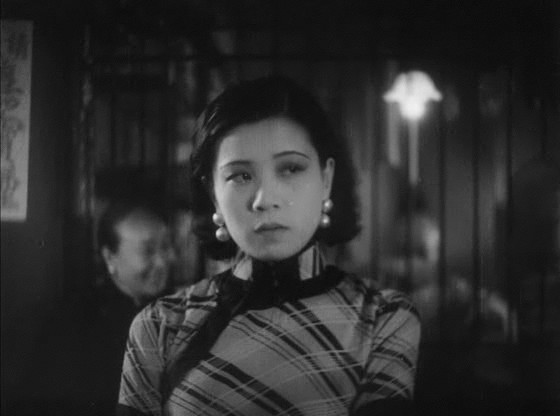
A quick follow-up to an earlier posting I made, about the old Shanghai B&W silent film "The Goddess," starring Ruan Lingyu.

While I linked a four minute clip, a few people mailed, asking about finding the entire movie. In Shanghai I found it at the foreigner's bookstore on Fuzhou Lu, I imagine other large sellers of non-bootleg DVDs, in China, will also have it. In foreign countries I'm not sure, although my version was published by Boying.

I also received an e-mail that the movie will be re-scored live and shown at the Edinburgh Film Festival on March 9th. An outline of Ruan Lingyu's face graces the brochures. Additionally, the amazing Maggie Cheung (who among other things, starred in "Center Stage," a biopic of Ruan Lingyu) will be there. If Edinburgh wasn't on the other side of the globe, I would be so down!

Finally, the movie in its entirety can be found on Youtube. Watching movies on Youtube is obviously less than ideal. But it can be done, and if you click around enough the movies can be watched in a full screen window, rather than just a little video box. It's divided into the first and second half, and the inter titles are in English.


Friday, January 12, 2007

Ruminations on China and India

Over the next several weeks I'll be talking about the nation of India, interspersed with my normal updates about Shanghai. Before I begin, I'll collect a few thoughts and observations about the relation between Shanghai, and China, with India.

First of all, one of those small things about Shanghai that I still find immensely amusing is that if I ever mention India, in any possible context, the automatic reaction will be "Indian women are beautiful." It goes alongside other memes like "Tibet is very mysterious, I want to visit" or "I don't like Japanese people." From what I gather, it comes from the supernaturally beautiful and glamourous actresses of Bollywood movies - India's famously singular film industry, where movies are three hours long, encompass as many genres as possible, and incorporate lengthy and elaborate music videos.

Indian movies aren't now popular in China, although the older generation still seems to have a sentimental attachment, and the soundtracks have a measure of popularity. In the 50s through 70s, though, Russian and Indian movies made up the bulk of the movies allowed to be imported into China. It's a little strange, as China and India were at war with each other. However India was positioned somewhere between the two sides of the Cold War, and economically and culturally shared much with Chinese Communism. For instance, the classic "Mother India" is a melodrama that's more fun than didactic, but with a firm Communist message of strong peasants being brow-beaten by their capitalist landlords. And even now, India has a very large number of businesses, small and large, that advertise themselves as being an economic concern of the central government:


If you're curious to have a look at Bollywood movies, here's an iconic if slightly old-school video, taken from the film "Dil Se."


I am a very passionate fan of Bollywood movies, I'm a little starved for them out here. Even with the largest DVD bootleggers, who carry the most obscure French art films or blaxploitation flicks, you'll be lucky to find even a couple modern Bollywood movies. The older ones aren't so difficult to find, though, especially on VCD.

Anyway, I admit dwelling on Bollywood comes off as a little trite, and I joked with Chinese people that that was the only thing I knew about India. They joked back that the only thing they knew was from "Journey to the West," probably the most famous literary work of China. It chronicles four Pilgrims (most famously, the Monkey King) who travel to India, all the way battling various monsters, to retrieve Buddhist texts.

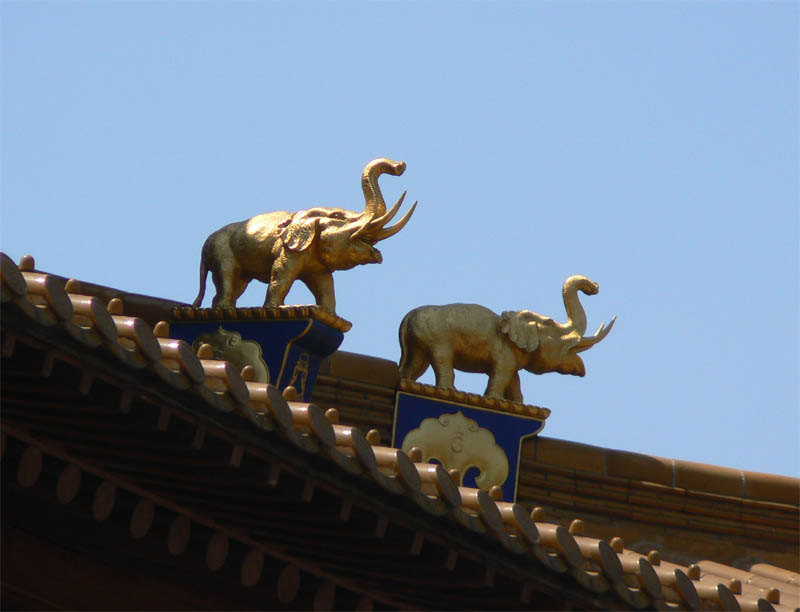
I've talked a little about Buddhism in China before, and I definitely will say more in the future. But as a quick look at an obvious difference between Chinese Buddhism and Western Christianity: even though Christianity comes from the Middle East, the Western European Jesus looks firmly Nordic, and various American Christian leaders claim America as a kind of chosen land. In Shanghai, on the other hand, Buddhism remains largely an exotic Indian religion, despite millenia of history, and being much more popular in China than in India. As a small example, this Jing'an Buddhist Temple is decorated with Indian elephants:


A few more things: from what I understand, ten years ago there were no yoga studios in Shanghai. Now, they're relatively common, and extremely trendy with women. I've heard it's most popular with the expatriate community, but I know some Chinese people who practice. Some of these studios employ Indians as the main instructor. Just today, my apartment building recieved a mailbox drop of brochures for a Yoga studio, one of them is pictured on the right. As far as I know, I'm the only foreigner in the complex, and the brochure is almost entirely in Chinese, although the part I show offers both English and Chinese writing.

Furthermore, if you look at very old movies of Shanghai, they often show a few Sikhs, acting as low-level police officers. This is also true of older Hong Kong movies - both Shanghai and Hong Kong were touched by the British Empire. The difference is that Shanghai's Indian community dispersed alongside the British Empire leaving, while Hong Kong retains a large, segregated Indian presence. I try to keep this blog in the first person, but Tales of Old Shanghai has some interesting historical anecdotes.


And, from what I understand, Shanghai's Indian restaurants are actually very good. Honestly I haven't tried them, it wasn't much of a priority for me as I generally believe foreign restaurants in Shanghai to be average at best. However I definitely will make it a point to try a few places in the near future.

But I don't want to overstate the case. I don't think India dominates the imagination of most Chinese people. When I told people I was going, the average reaction was of a poorly-hidden confusion about why I would choose to go there.

And now for the inverse! I did see a surprisingly large amount of things Chinese in India. It certainly didn't compare to being in Honolulu or Oakland, but I did run across Chinese stores and neighborhoods, I did see Chinese religious signs being used as talismans (most often the Taoist yin-yang sign, which I rarely see in Shanghai), and I did see a huge amount of Chinese food - both aimed at tourists and not. Not only are Chinese restaurants and snack stalls common, it seems every Indian diner has a large selection of Chinese food. The cooks are Indian and the food is localized, of course, with some seeming like a small variation, and some being unrecognizably Indian. I wish I had taken photographs so I could describe the food in detail, but I didn't! I did take a snapshot of this funny store: