Showing posts with label Buddhist Temples. Show all posts

Wednesday, May 13, 2009

Longhua Temple

For a city of more than twenty million people, it's somewhat eerie how few respectable Buddhist Temples there are. The very few that do exist are more recently-constructed tourist attractions than temples. Really, there's substantially more impressive Buddhist temples in San Francisco or Honolulu, not to mention any city of Japan or Thailand.

The most impressive of the lot is Longhua Temple. It's quite large, and it has a lengthy history, and unlike some of the other Buddhist temples with lengthy histories (such as Jing'an Temple, or Xiahai Temple), it has the feel of a restoration, rather than a wholesale reconstruction.

I don't want to get all Wikipedia with this update, so I'll just give a few basic facts and show the pictures. The temple dates all the way back to 242, and the oldest surviving building is the pagoda outside, which dates to 977.


Most of the other buildings are re-constructions of that period's style, but as opposed to the goofy concrete buildings of other Shanghai temples, these re-constructions feel more authentic, and are often quite old themselves.

The busiest and best time to go is on the first or fifteenth of the Chinese calendar, it corresponds to the new and full moon. For those curious, here's a handy Western-Chinese calendar converter, with an ugly interface. There's a number of worshipers to be seen around Longhua, often bowing before Buddhas:


More popular is lighting incense, there's a lot of bowing and facing different directions that goes along with that. Here's an incense holder, the buckets nearby are actually to hold all the excess ashes:


It's probably stretching the definition of worship, but there's a few visitors who seem inordinately concerned with throwing a coin inside the stupas. The guy in the red shirt was at it for about ten minutes.


It's a Zen Temple, but that doesn't mean as much as it would in the Japanese tradition - the layout and iconography of the temple is basically the same as every other Chinese Buddhist temple. The grounds are pleasant, and the surrounding area is a bunch of tourist streets and shops that make for nice enough surroundings, although still best ignored. There's a cheap vegetarian restaurant inside the temple.

All in all, this temple is impressive if not amazing, and honestly I think it's the only Buddhist temple in Shanghai that's worth a look. It's not entirely convenient to get to, the closest subway is line #3's Longcao Lu, and from there it's about a fifteen minute walk east. It's probably best to go to Xujiahui or the Indoor Stadium, and then take a taxi. There's also the 933 Bus, which goes past Hongkou, Taikang Lu, the Xing Guang camera mall, and then on to a stop across the street from the temple.

Friday, February 16, 2007

Jade Buddha Temple

This is a quick look at the Jade Buddhist Temple in Shanghai. This post has the distinction of being the one-hundredth update!

The Jade Buddha Temple is slightly northwest of Central Shanghai, on Jianguo Lu. The area around it has a comfortable feel, although it's nothing special: a long procession of older two story buildings, with trees lining the street, and small restaurants and shops often occupying the first floor.


Right next to the temple, there's a number of smaller stores selling Buddhist relics. They generally aren't selling the incense in force, however, like can be seen near some other Buddhist temples. Outside incense is prohibited, the temple make some claim that's it's for safety's sake. Shouldn't a religious site, you know, not lie? Anyway have a gander, I like the lucky cat!


Compared to the Jing'an Temple, it all feels much more traditional. On the other hand, Jing'an Temple has an 1800 year history, and this temple has a history of only 80 years. That's more a reflection on how poorly Jing'an Temple has been treated, rather than the Jade Buddha Temple being some kind of Buddhist kitsch:


What looks like dust in front of the lens is actually dust in front of the lens, it was a windy day and the ashes of the incense being offered was flying around.


Chinese Buddhist temples follow a regular schematic, with a large main building. This larger main building has a lot of interesting sights, for instance carvings of animals on the outside walls:


And the insides are stuffed with Buddhist imagery, some of which were very impressive.


There were side courtyards that felt peaceful, either as the quarters for the Buddhist Monks living there, or as Buddhist shops! Jade Buddha Temple almost felt like a commercial center. A little commercialism is common in big-city Buddhist temples, and the vegetarian restaurant is probably entirely welcome to some. However the temple feels over-packed with gift stores selling upper-grade touristy things, upper-grade tea, there's a gift shop you exit the temple through, and even the titular Jade Buddha costs an extra $1.25 to see, once you're already inside. No photography's allowed, or I'd show a picture. I don't know what to say about it, it's impressive, but nothing amazing - maybe just because visitors aren't allowed within twenty feet.

The side yards also had some interesting little artworks that I couldn't quite place in context, with my limited knowledge of Chinese Buddhism. There's a pillar of four elephants facing in four directions, which I thought was a Hindu thing. And check out this demon, it looks cool but I have no idea what it does, or why it's missing its left horn:


There weren't all so many people when I was there. But supposedly the place gets massively crowded in just a few days, for the Chinese New Year's celebration.

Saturday, August 05, 2006

Jing'An Si Buddhist Temple

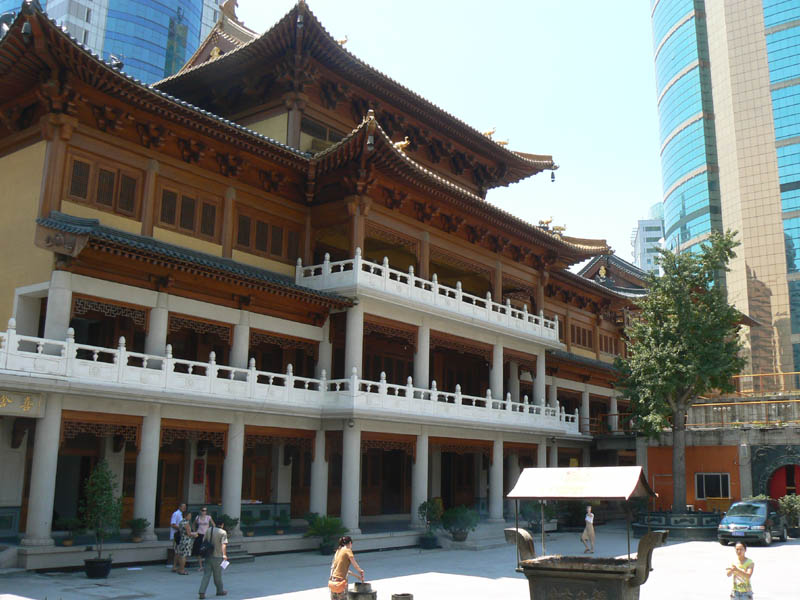
Jing'An Si is a Buddhist temple in the center of Shanghai. There's a certain dramatic contrast to the ancient temple and the gleaming office towers going up nearby:


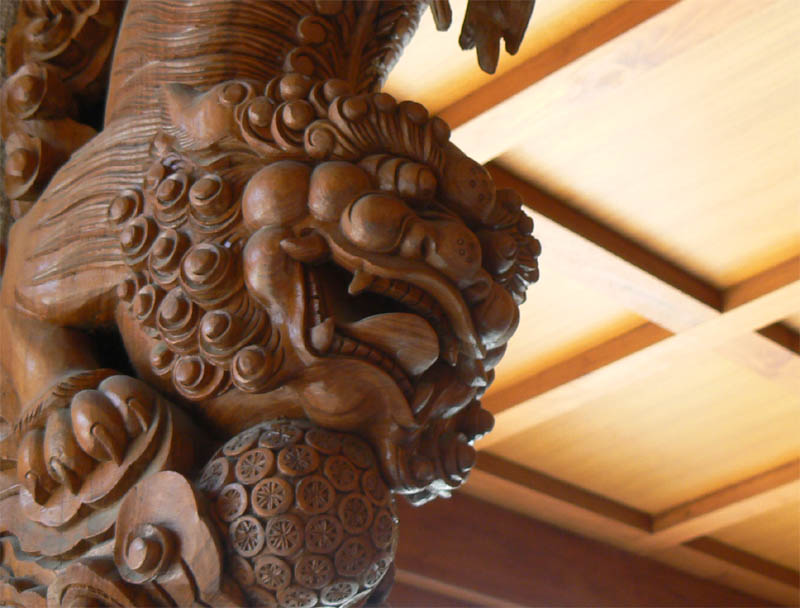
But I don't want to exaggerate the effect. It's really more an ancient temple site than an ancient temple: the temple burnt down a century ago, and what was re-built was supposedly heavily damaged in the early Communist era. What exists now is a modern re-construction, one that uses far too much concrete. Something about it seems so 1970s to me. Maybe it's merely the shade of the wood used, or perhaps the way the exaggerated lacquering giving a plastic-wood look to the whole affair. The plain wooden ceiling panels are a whole lot more attractive than the carved lions:


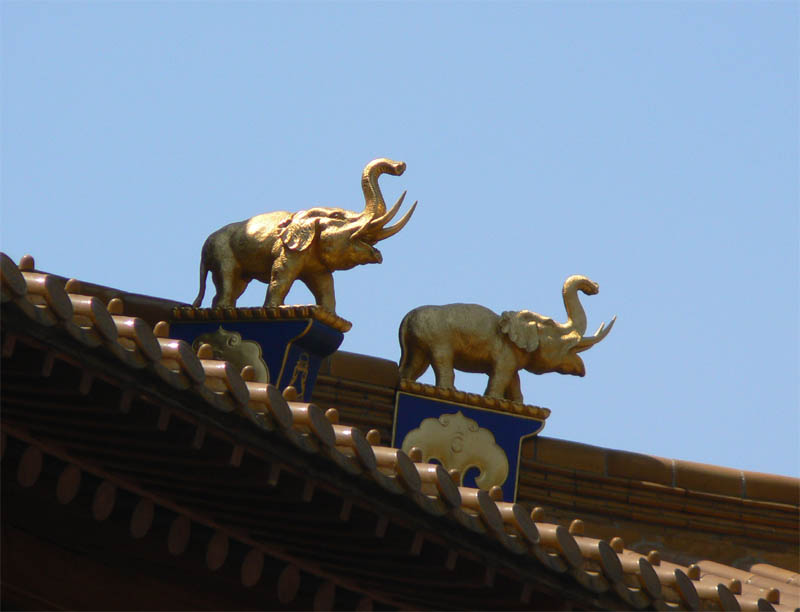
On the other hand there's some more interesting sculptures on the roof. They almost seem whimsical. "Why elephants?" I ask people. I guess it's the connection of Buddhism being from India and India having lots of elephants, and people guess that I'm right, but nobody's 100%, and I've seen a whole lot of Buddhist temples without an elephant motif to the roof.


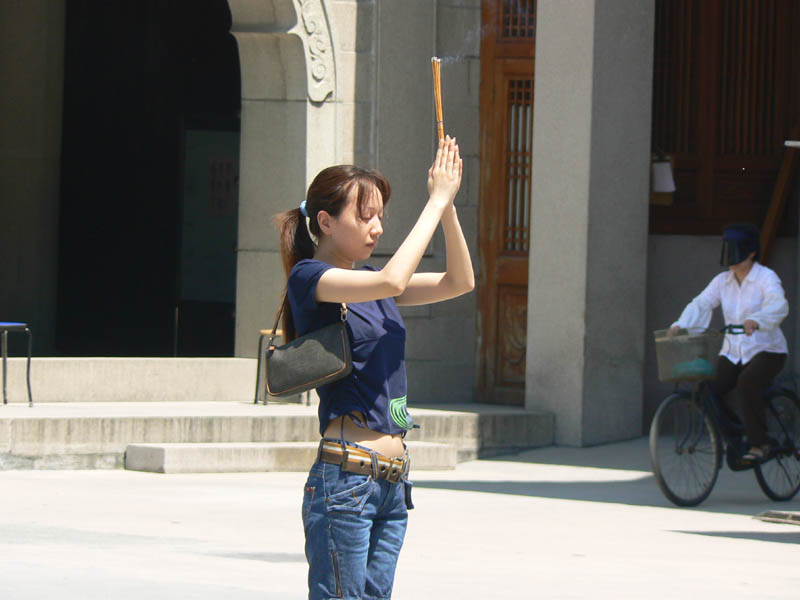
There aren't so many Buddhist temples in Shanghai, and the ones that do exist are only popular during times of Buddhist celebrations. I went on a weekday and only a few women were praying:


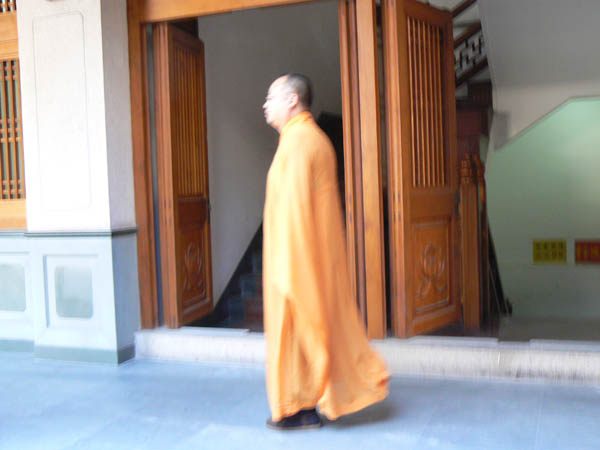
There are many wildly different schools of Buddhism, in America the most famous ones are the versions emphasizing meditation, self-study, and enlightenment. However, with Han Chinese, supposedly Buddhism is pretty homogenous. It emphasizes the ability of mystical beings to bring people's souls to a better world, and is somewhat analagous to Christianity - it's a style of Buddhism common to the other Northeast Asian nations. One of the exceptions to the analogy is a strong element of exoticism, with monks wearing colorful robes, and temples decorated by intricate artworks. It's very Indian-influenced, and Buddhism is not percieved as a native religion. For instance you will never see a Han Chinese who looks like this:


Appealing to the god for salvation is big in this form of Buddhism. A good way to do this is with incense.


Personally I don't care for the smell but maybe that has something to do with not yet having achieved god-head. The incense sticks are sold on the honor system, which I must admit I couldn't even imagine elsewhere in Shanghai. It's twenty five cents a stick.


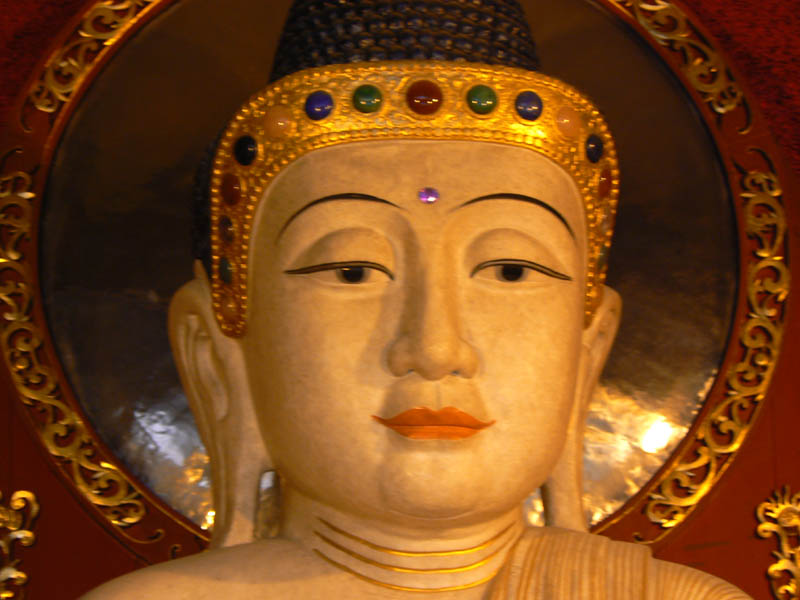
Around the grounds are scattered different Buddhas - this form of Buddhism doesn't just believe in the historical Buddha, but a range of real Buddhas, mystical Buddhas, demons, Buddhas who put off their salvation to help others, etc. They're assigned various mystical powers, and depending on the mystical power you're particularly sympathetic to, you pray there. Some of the different Buddhas have offerings of fruits and flowers at their feet, put there by the priests.


Perhaps it's all good for the soul, and I guess I'll have a chance to find out, as I'm moving about a minute away from the temple. While I'll miss living towards the outskirts of Shanghai, and the chance to see live chickens killed near my front door and then hanged up to dry on the clothesline, I'm also really looking forward to living in a more crowded area with more people and places to see.