On an entirely different note, if there's anybody in Shanghai who might be interested in jamming either old-school Hawaiian Music or stupid indie pop, please either leave a response or give me a mail at jeff oaktowncrack com.
Showing posts with label Construction. Show all posts
Tuesday, August 21, 2007
Xintiandi and Shikumen
On an entirely different note, if there's anybody in Shanghai who might be interested in jamming either old-school Hawaiian Music or stupid indie pop, please either leave a response or give me a mail at jeff oaktowncrack com.
Thursday, August 02, 2007
The Fate of Shikumen Districts
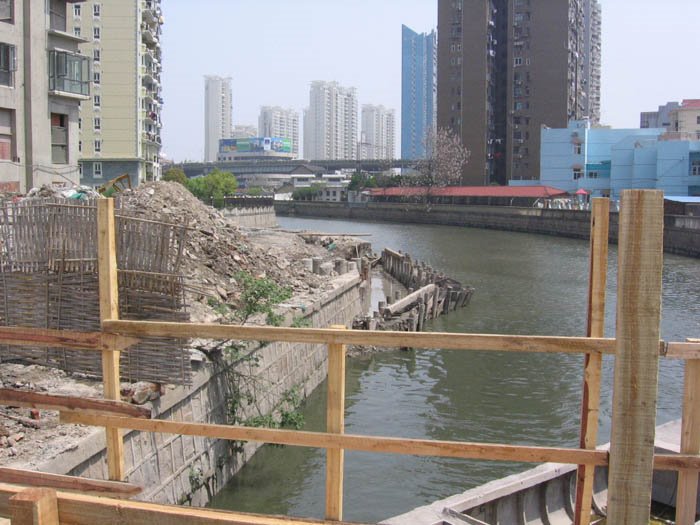
This is to follow up on my update about Old Shanghai, and the Shikumen that define the area. A favorite area is in the center of the historical old city, south of Yuyuan Gardens, where a large network of narrow roads and lanes criss-cross haphazardly. It's a dense and confusing jumble, it feels like nowhere else in Shanghai, and it's all getting torn down, inevitably to make way for massive apartment towers like those in the background:

I have mixed opinions. As stated in the last update, I'd never even consider living in a classical shikumen or row house. They're an old style of housing that don't allow for privacy or often even running water. They were built to last a much shorter time than they've actually lasted, and they're relatively low-density housing on incredibly expensive real estate, in a rapidly growing city. At the same time, they have a strong and distinct character, whereas I can almost guarantee that the apartment complex going up will basically be a concrete box, with no real character to it other than a few tacky pseudo-Grecian statues littered about the grounds.
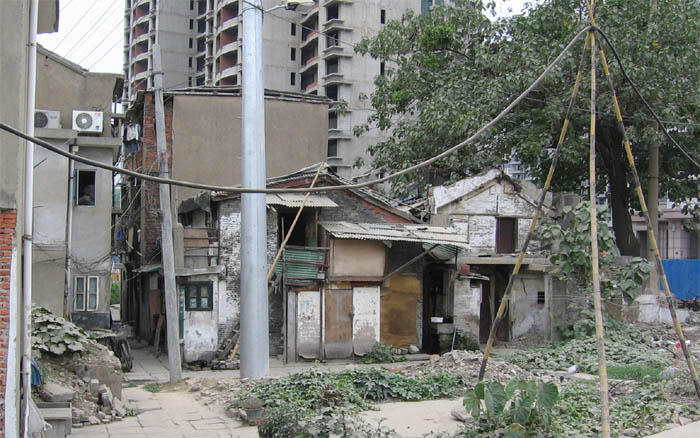
Wandering around the area has an eerie feeling to it. There's piles of debris or shells of houses with only rubble inside, the area feels something like a bomb went off:

The area is being destroyed bit by bit, perhaps it has to do with relocating the current residents. How they are relocated varies, but usually they're given an apartment way the hell out in Pudong somewhere. But there's other schemes, and I've been to modern tony apartment complexes which also have a number of residents who lived on the location before the apartments were built.

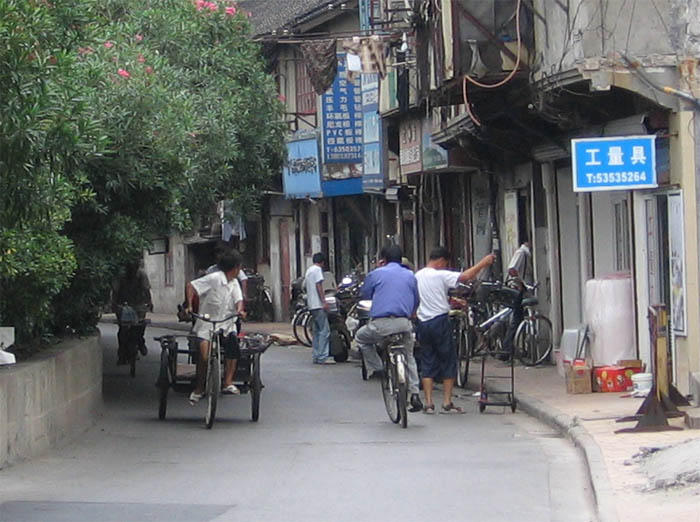
Oddly enough, the neighborhoods still seem pretty vital, people hurriedly going about their lives:

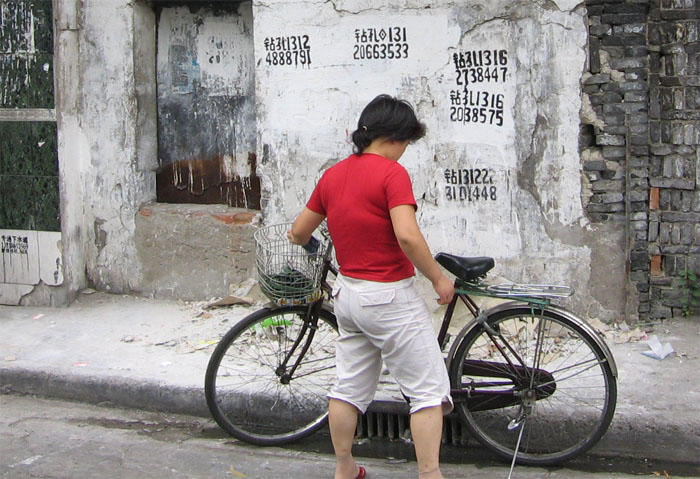
But there's reminders that it's temporary, and as on the right, many of the buildings have the character for "demolish" written on the side.
Wandering around the area has an eerie feeling to it. There's piles of debris or shells of houses with only rubble inside, the area feels something like a bomb went off:
The area is being destroyed bit by bit, perhaps it has to do with relocating the current residents. How they are relocated varies, but usually they're given an apartment way the hell out in Pudong somewhere. But there's other schemes, and I've been to modern tony apartment complexes which also have a number of residents who lived on the location before the apartments were built.
Oddly enough, the neighborhoods still seem pretty vital, people hurriedly going about their lives:
But there's reminders that it's temporary, and as on the right, many of the buildings have the character for "demolish" written on the side.
Saturday, April 07, 2007
In Which Is Detailed a Novel Method of Window-Washing
This will be a small update, about an everyday sight in a country with weak OSHA laws. Rather than explain...

If there were a caption to that photo, it would be - "people sitting on seats that are hanging from ropes, off the top of a large skyscraper." There's no apparent secondary support or even belt, crazy! They're all wearing hard hats, though, which is a rather optimistic take on the powers of modern hard-hats. There's also buckets next to them, filled with cleaning fluid I guess.

Some of the windows aren't quite so easy to reach, this window-washer is put in a very awkward position to reach them...

This requires another guy on the ground, pulling the rope to the side. This picture also gives a better idea for just how thick the rope isn't.
If there were a caption to that photo, it would be - "people sitting on seats that are hanging from ropes, off the top of a large skyscraper." There's no apparent secondary support or even belt, crazy! They're all wearing hard hats, though, which is a rather optimistic take on the powers of modern hard-hats. There's also buckets next to them, filled with cleaning fluid I guess.

Some of the windows aren't quite so easy to reach, this window-washer is put in a very awkward position to reach them...

This requires another guy on the ground, pulling the rope to the side. This picture also gives a better idea for just how thick the rope isn't.
Wednesday, January 10, 2007
A Pudong Construction Site
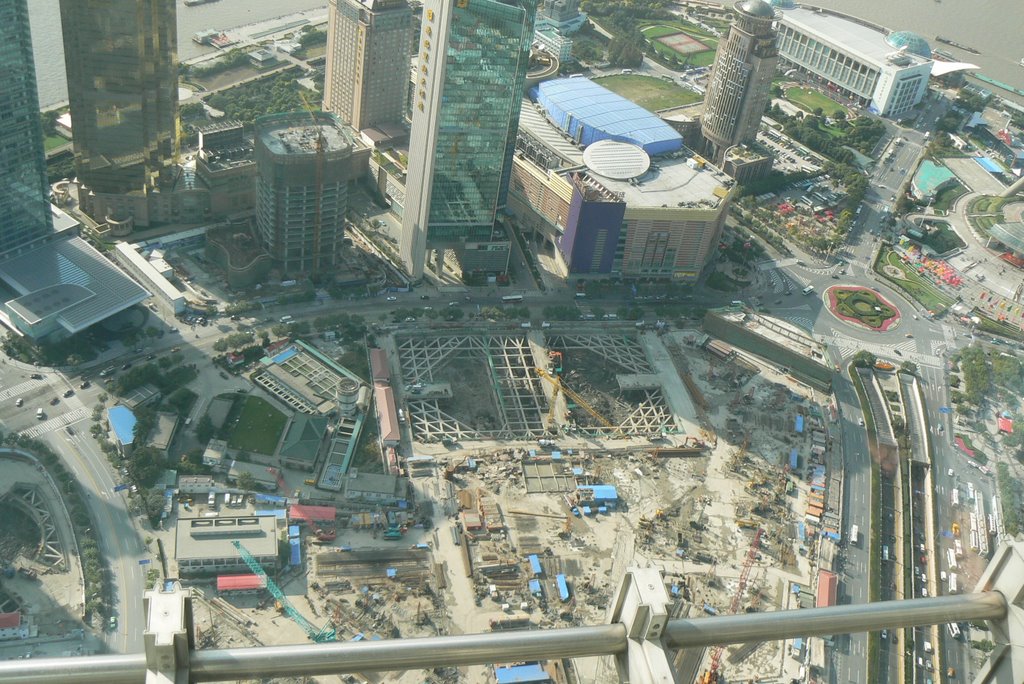
This is a short update about a construction project, using pictures again taken from my father. This will be my last update to use his pictures, at least until next time he visits! He snapped a number of shots of a massive multi-use complex that's going up in Pudong - upscale shopping and upscale apartments. The location is directly between the Jinmao Tower I mentioned in my last update, and the enormous Super Brands Mall. Actually none of these shots are my own, except for this picture showing the scope of the project. The image is pretty evenly split in halves. The bottom half shows the area being worked on, the top half shows a mall and six skyscrapers:

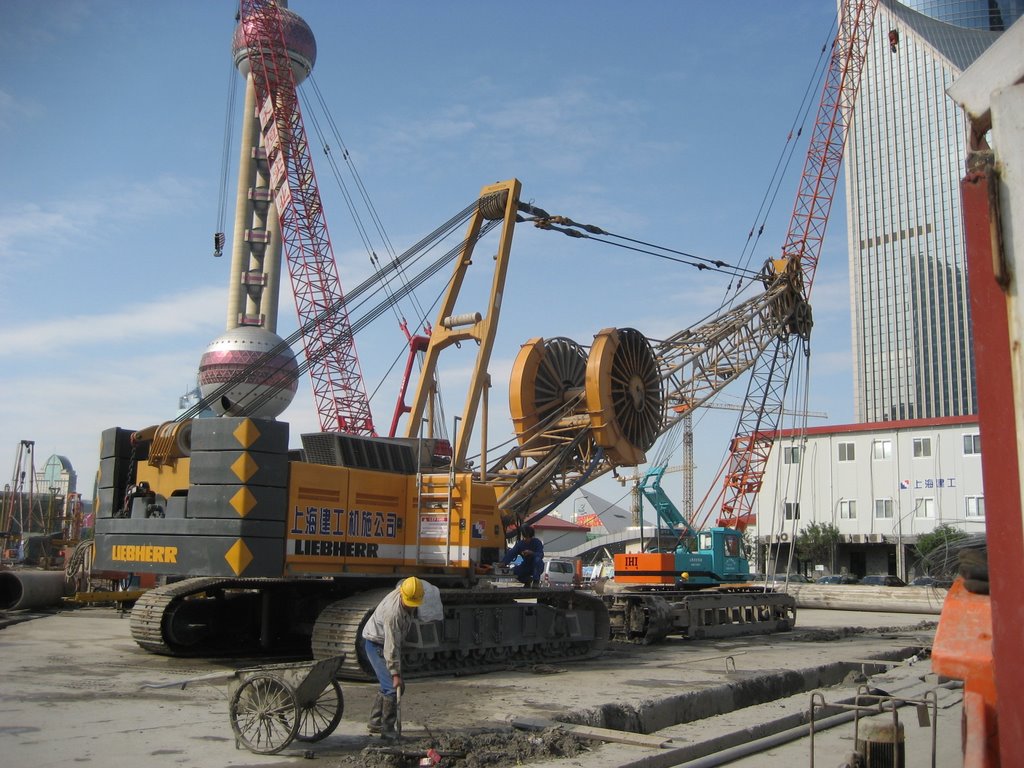
I've said it before, I'll say it again: there are construction projects everywhere you go in Shanghai, and everywhere I've been in China for that matter. I talked before about an apartment complex going up. This project is much larger, you can see it's one piece of heavy equipment after the next:

This project is a lot more modern than most you'll come across in China. For instance, much of the equipment looks brand new, and recently imported - Liebherr is a German brand, this site also features some American brands, although in general imported construction equipment in China comes from Japan or Korea.

But there's also equipment that looks like a relic from the Great Leap Forward. I'm not the expert, but this looks something like mining equipment. I assume it has to do with building deep foundation supports, a necessity given the Pudong being marshland and all.

Construction projects often have a fundamentally different look to them in China. There's less ready access to advanced machinery and skilled workers, but construction worker wages are extremely low and there's less safety regulations for workers. The end result is you see a lot of people doing things by hand, or a large crowd of workers working directly alongside the machinery. Honestly, this worksite is more modern than most, but you can still see oildrums being carted on bike, or trenches being hand-shoveled.

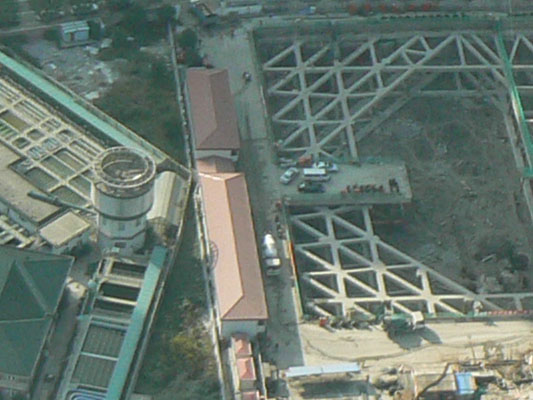
Many Shanghai construction sites feature on-site living for the workers, who are usually young men straight from the countryside. They're just tin-shack accomodations, obviously. I don't think this site features on-site living. Regardless, I enjoy zooming in on my top-down photo like it was a spy satellite, and I did come across this complex. While I'm pretty sure it's not on-site housing, have a look and judge for yourself:

I've said it before, I'll say it again: there are construction projects everywhere you go in Shanghai, and everywhere I've been in China for that matter. I talked before about an apartment complex going up. This project is much larger, you can see it's one piece of heavy equipment after the next:

This project is a lot more modern than most you'll come across in China. For instance, much of the equipment looks brand new, and recently imported - Liebherr is a German brand, this site also features some American brands, although in general imported construction equipment in China comes from Japan or Korea.

But there's also equipment that looks like a relic from the Great Leap Forward. I'm not the expert, but this looks something like mining equipment. I assume it has to do with building deep foundation supports, a necessity given the Pudong being marshland and all.

Construction projects often have a fundamentally different look to them in China. There's less ready access to advanced machinery and skilled workers, but construction worker wages are extremely low and there's less safety regulations for workers. The end result is you see a lot of people doing things by hand, or a large crowd of workers working directly alongside the machinery. Honestly, this worksite is more modern than most, but you can still see oildrums being carted on bike, or trenches being hand-shoveled.

Many Shanghai construction sites feature on-site living for the workers, who are usually young men straight from the countryside. They're just tin-shack accomodations, obviously. I don't think this site features on-site living. Regardless, I enjoy zooming in on my top-down photo like it was a spy satellite, and I did come across this complex. While I'm pretty sure it's not on-site housing, have a look and judge for yourself:
Monday, January 08, 2007
A View From Above
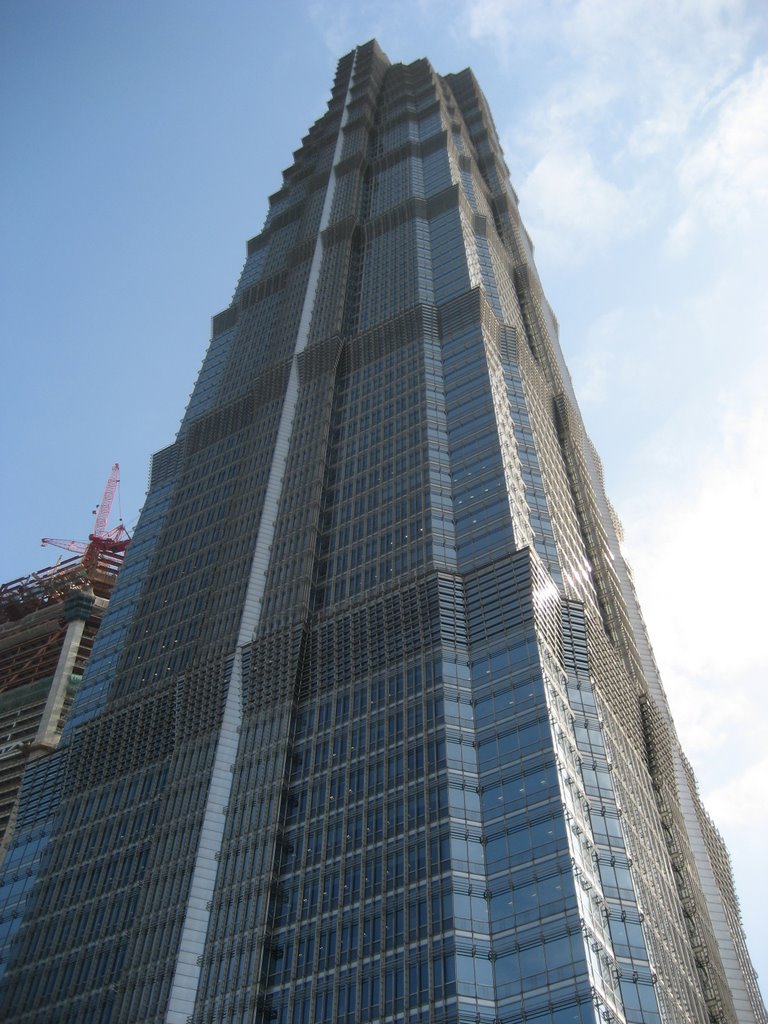
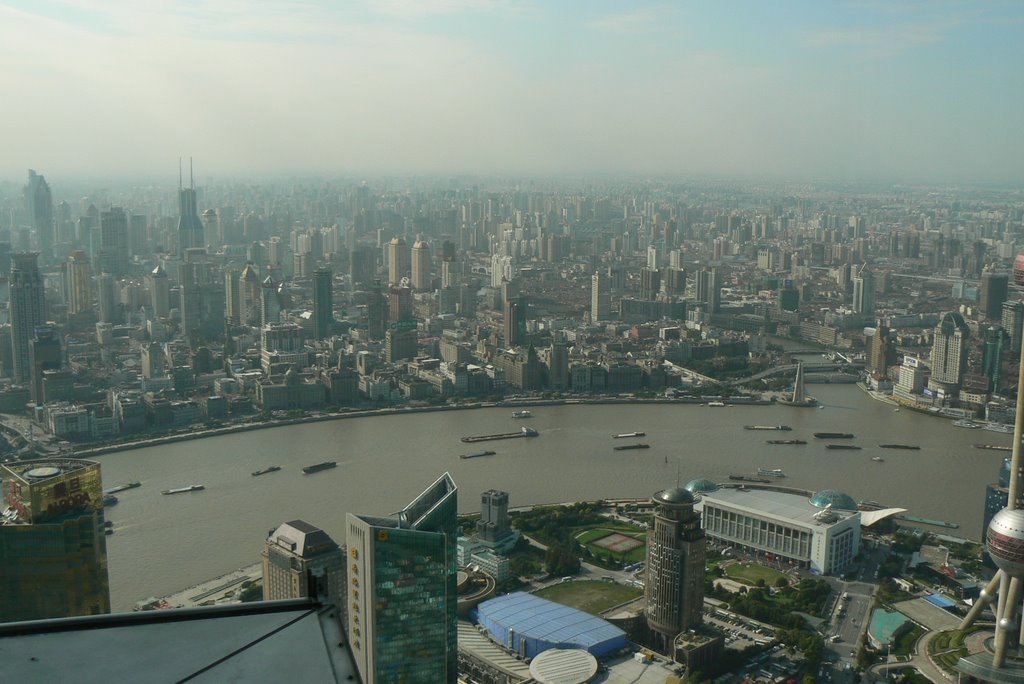
This will be a quick take on something that was more interesting than I thought it would be - a top-down look at Shanghai. Most of these pictures were taken from the Jinmao Tower, a very tall (one of the tallest buildings in the world), very odd-looking building in the Pudong district of Shanghai - you can see the massive steel girders on the outside, arranged in a step pattern. The location provides look over both the Pearl Tower, and downtown Shanghai:
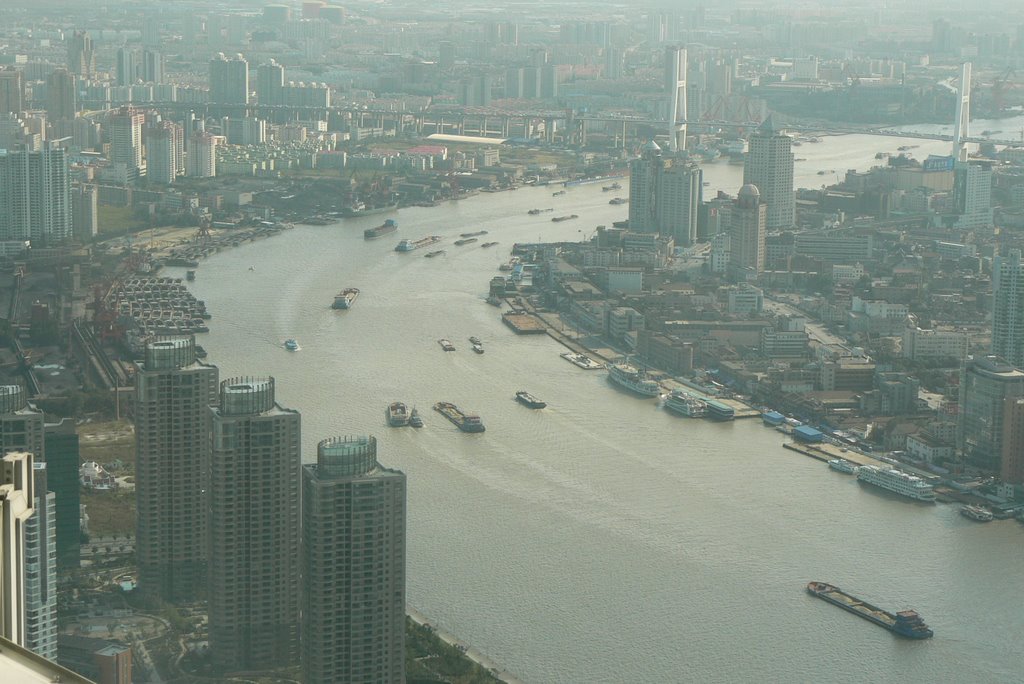
You can zoom in on the picture by clicking on the image, of course. Below is another view, slightly to the left. Some of these places will be familiar to the gentle readers of this blog. For instance, the central riverbank defines the Bund, the river flowing into it on the right is the Suzhou River, the area around alongside the Suzhou River could be call the North of the Bund Area, and the skyscraper with two immense prongs on top is located across from People's Park.

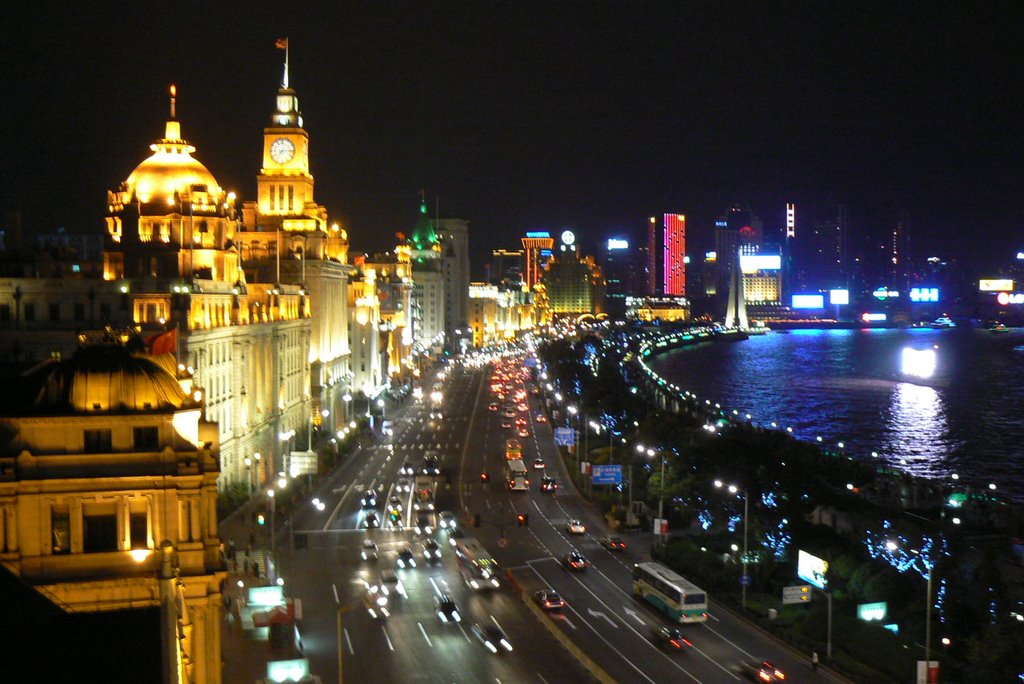
One thing that impressed me was the view of the Peace Hotel, the building in the below zoom with the pointed green roof. The road it's on is the shopping street of Nanjing Donglu, and the riverfront area is the center of the Bund.

The Peace Hotel was built in 1930. At the time it was the tallest building in Asia. Now it's a small speck on the face of Shanghai city. Here is a photograph of the same area taken from Shanghai's well- regarded M on the Bund restaurant - you can again see the green roof of the Peace Hotel. Personally I prefer T8 to M on the Bund, if you're going for an elite non-Chinese restaurant - more on that in another update.

Even though Shanghai is located at the base of the Yangtze River, I had never given much thought to Shanghai being a port town, just because it's mostly out of site, out of mind - as opposed to living in Oakland, where I saw distant views of the docks every day of the week. Looking down from the Jinmao Tower, it came as a surprise to see the constant flow of commercial boats, making their way through the city:

I also got an interesting view on the construction of what will perhaps very briefly be the world's tallest skyscraper. It will be around fifteen hundred feet tall, as opposed to the Jinmao Tower's fourteen hundreed feet. Both will be dwarfed by a tower going up in Dubai, that's just a few feet short of five thousand, two hundred and eighty. Note the tract housing, immediately aside the skyskraper:

Simple economics doesn't ever necessitate building these kinds of buildings, it's especially true in Shanghai. Like other modern ultra-tall skyscrapers, propaganda and projecting an image of wealth is the largest part of the reason for its construction, rather than direct economic concerns. This is especially true with the location of Pudong, which is essentially over-loaded and receding swampland, expected to recede even quicker with the Three Gorges Dam now holding soil runoff. More scary is, these buildings lack adequate earthquake bracing.
On the other hand, perhaps the propaganda does what it's supposed to do, as the skyscraper boom has been accompanied by a wealth of elite hotels opening branches in Pudong, corporations re-locating their Asian headquarters to Shanghai, and hyperbolic magazine articles about Shanghai's Blade Runner-esque skyline.
Sunday, April 16, 2006
Moon River - A Construction Site
Shanghai is in the midst of the world's largest construction boom, ever. There's no getting around it: no matter what area of Shanghai you're in, you're likely to be within view of at least one massive high rise going up.
There's a particularly large apartment complex going up near my apartment. It's still going to be a while before it's finished, but it seems like it will be a fairly upscale, if fairly generic, place to live. It's called "Moon River," a kind of cute name for an apartment built along a polluted stream:

But I like to stay positive, and hope that the apartment complex reflects a commitment to cleaning up the stream, which actually is true with some other Shanghai housing developments. If you notice the bridge, it's a temporary walking bridge. The current bridge is one-lane only, and will be torn down soon.

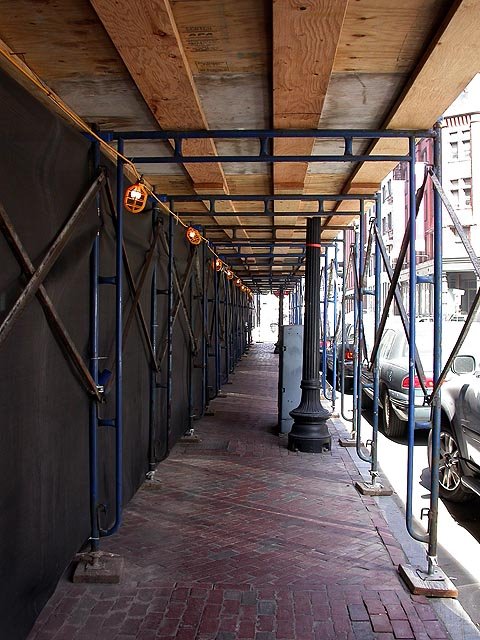
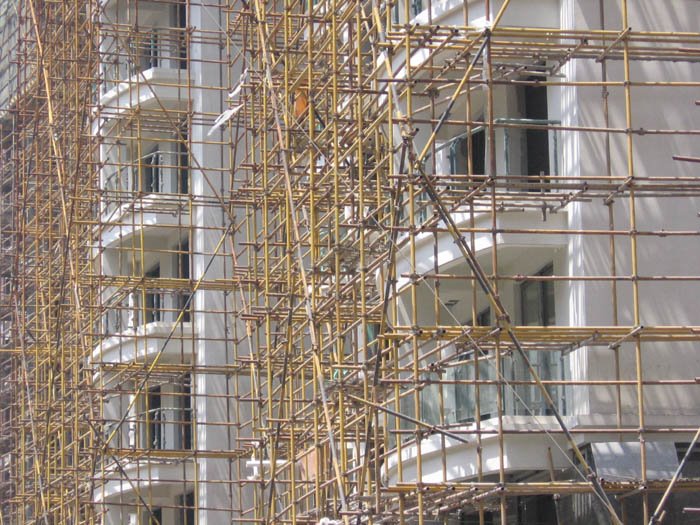
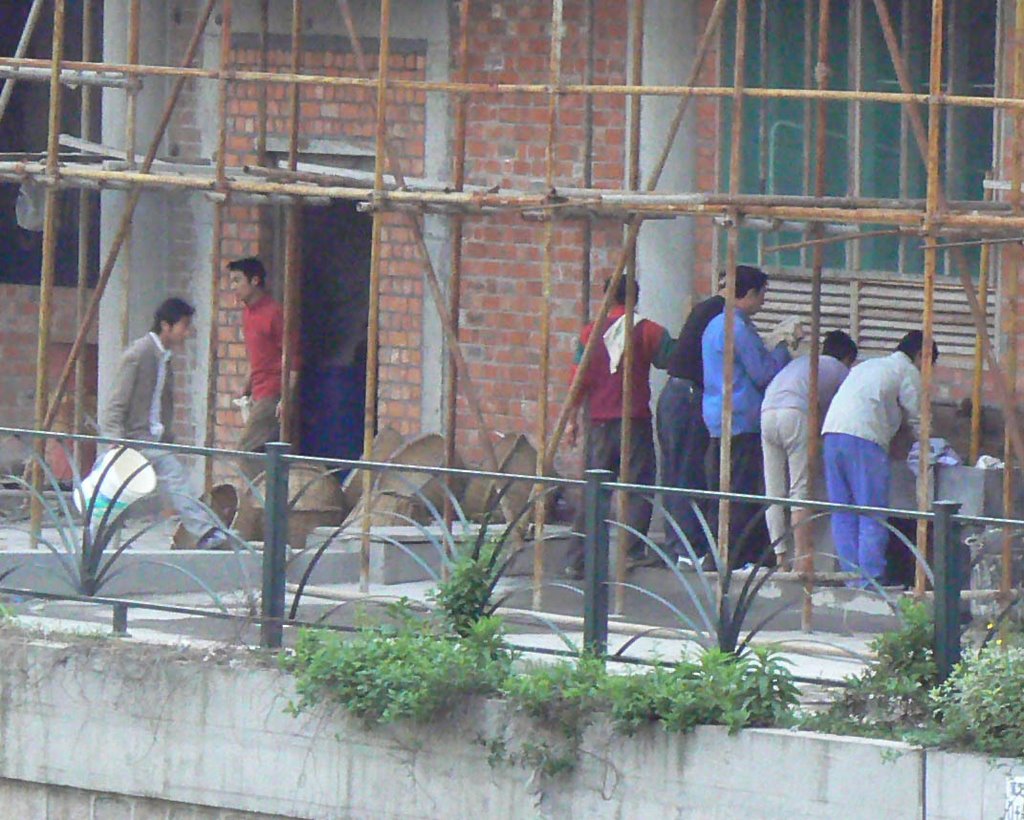
The bridge doesn't look like it's up to any sort of safety code, and I suspect that's true of the entire project. A simple example is the fact that I could walk through the whole project snapping pictures. There's also the scaffolding on the outside of the buildings, to give access to contruction workers. The shot on the left shows the underside of an American scaffolding system - obviously it isn't a permanent structure, but it looks pretty solid. By comparison, Moon River's scaffolding system is just a series of bars, both on the sides and on the 'floor' of the scaffoldings. Sometimes bamboo stakes are lay down on the floor to make them more stable, but not always.

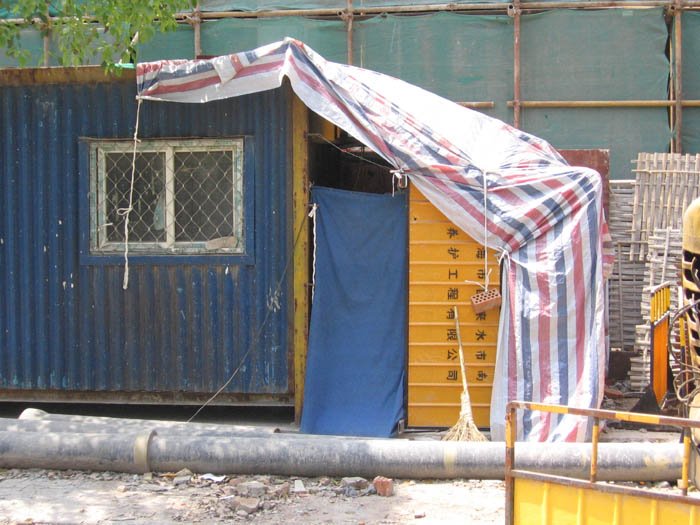
The workers seem to have a hard life. They used to live in a temporary housing on the worksite, it obviously didn't have plumbing or any amneties:

But that has since been torn down. The construction workers now live in the lower levels of the half-completed buildings.

That might sound overly strange to those outside of Shanghai. Half-finished apartment and office buildings are often occupied in Shanghai, even by fairly normal people and respectable-seeming businesses. I've been inside such offices and you wouldn't know the building was still being worked on, if it wasn't for the occasional drilling noise. With some of Moon River's buildings, floors are still being added to the top of the building, even while windows are being installed in the lower levels. Anyway I can't comment on the living conditions insides of these buildings, I've never been inside to have a look. I've just noticed the laundry hanging outside. There's also a few metal shacks, at night you'll glimpse a few workers laying in hammocks. There's small kitchen areas and card tables nearby.

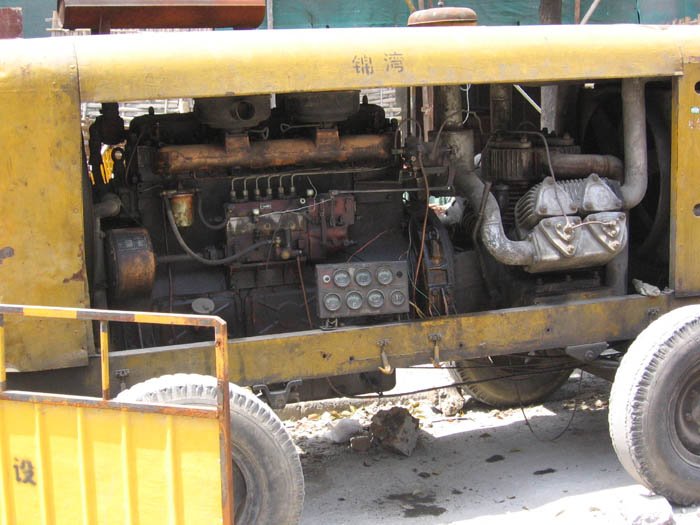
I wish I could comment more on the work being done. A lot of it is hidden from me, taking place inside the shells of the buildings. What I do see doesn't look substantially different from what you'd see on an American construction site, although you do see a few things being done with massive groups of people rather than a machine, or machinery that looks like it's past its prime.

The picture below is of a different job site, but I was still impressed - how did they get that up on top, anyway, and why?

There does seem to be more workers on hand then there would be at an American site, they don't always look like they're working very hard. It's a hard thing to photograph, but this guy was going slow at it, and a few people were watching him go slow at it:

Sometimes the work goes on through the night, but here workers seem to be coming to an end with the sun setting, 6:00 on a Sunday evening:

And speaking of the sun setting: South Shanghai has a big problem with dust from construction, and today was particularly bad. The haze was something fierce.
There's a particularly large apartment complex going up near my apartment. It's still going to be a while before it's finished, but it seems like it will be a fairly upscale, if fairly generic, place to live. It's called "Moon River," a kind of cute name for an apartment built along a polluted stream:

But I like to stay positive, and hope that the apartment complex reflects a commitment to cleaning up the stream, which actually is true with some other Shanghai housing developments. If you notice the bridge, it's a temporary walking bridge. The current bridge is one-lane only, and will be torn down soon.

The bridge doesn't look like it's up to any sort of safety code, and I suspect that's true of the entire project. A simple example is the fact that I could walk through the whole project snapping pictures. There's also the scaffolding on the outside of the buildings, to give access to contruction workers. The shot on the left shows the underside of an American scaffolding system - obviously it isn't a permanent structure, but it looks pretty solid. By comparison, Moon River's scaffolding system is just a series of bars, both on the sides and on the 'floor' of the scaffoldings. Sometimes bamboo stakes are lay down on the floor to make them more stable, but not always. 
The workers seem to have a hard life. They used to live in a temporary housing on the worksite, it obviously didn't have plumbing or any amneties:

But that has since been torn down. The construction workers now live in the lower levels of the half-completed buildings.

That might sound overly strange to those outside of Shanghai. Half-finished apartment and office buildings are often occupied in Shanghai, even by fairly normal people and respectable-seeming businesses. I've been inside such offices and you wouldn't know the building was still being worked on, if it wasn't for the occasional drilling noise. With some of Moon River's buildings, floors are still being added to the top of the building, even while windows are being installed in the lower levels. Anyway I can't comment on the living conditions insides of these buildings, I've never been inside to have a look. I've just noticed the laundry hanging outside. There's also a few metal shacks, at night you'll glimpse a few workers laying in hammocks. There's small kitchen areas and card tables nearby.

I wish I could comment more on the work being done. A lot of it is hidden from me, taking place inside the shells of the buildings. What I do see doesn't look substantially different from what you'd see on an American construction site, although you do see a few things being done with massive groups of people rather than a machine, or machinery that looks like it's past its prime.
The picture below is of a different job site, but I was still impressed - how did they get that up on top, anyway, and why?

There does seem to be more workers on hand then there would be at an American site, they don't always look like they're working very hard. It's a hard thing to photograph, but this guy was going slow at it, and a few people were watching him go slow at it:

Sometimes the work goes on through the night, but here workers seem to be coming to an end with the sun setting, 6:00 on a Sunday evening:

And speaking of the sun setting: South Shanghai has a big problem with dust from construction, and today was particularly bad. The haze was something fierce.
Thursday, August 25, 2005
A Random Walk down Suzhou River
One piece of tourist advice you will never find in a Shanghai Guidebook is "Go to the end of the Subway line and walk right back, following the Suzhou River for ten miles through all its bends and turns." Which is precisely what I did, and will describe here. This posting will be longer and larger than my previous updates.
Part of the motivation was to retrace the setting of Suzhou River, a small & quirky art film I consider to be the best movie ever made in the PRC proper. The movie depicts the river as a vast armpit to the city, wildly polluted and populated by gangsters and squatters - but which still holds an attraction to the videoographer narrator.
I knew the scenery would be different from the movie, because the movie is all of five or six years old, which is equal to about ten times that in US city years. Also, I talked to a local girl the day before the hike, she's into the art movies - she says right after the movie came out, there was a huge cleanup of the area.
I took the metro out to ZhongShan Park on an overcast day that wasn't quite the best for photography, but kept me from dying of sunstroke. Between the park and the river is a colorful area combining the back-alley charm of Shanghai with big apartment buildings, with a lot of local restaurants to boot. I was thinking it would be a pleasant place to live when I stumbled across the river. This look at the Suzhou River was a surprise: rather than the neighberhood being built around the river, the river was nearly boxed in by concrete barriers I could barely see over despite my height, and surrounded by warehouses and the like.
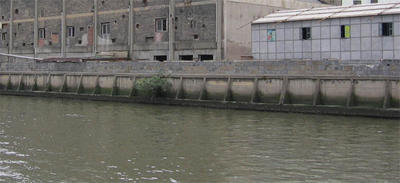
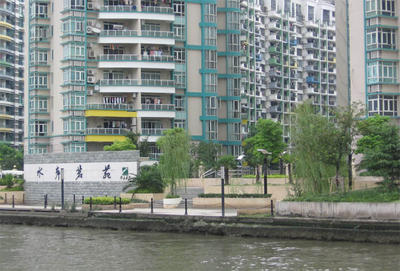
Although of course it makes sense if you consider that until recently, the river was basically a sewer. I walked down the dirt road, and it wasn't too long until I could see a row of new apartment buildings across the river. There was a break in the river-barriers, and a small park front where you could look over the river. Also note the laundry hanging in nearly every lanai.
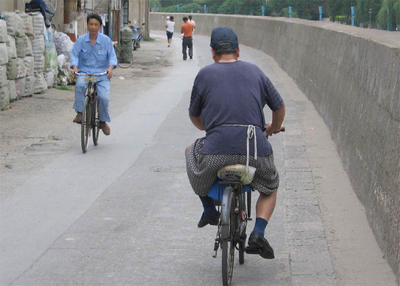
However the barriers went right back up, and there was a long stretch of sparcely peopled road, with small warehouses and the occasional recycling center. And "sparcely peopled" isn't something you often get to say about Shanghai.
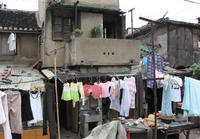
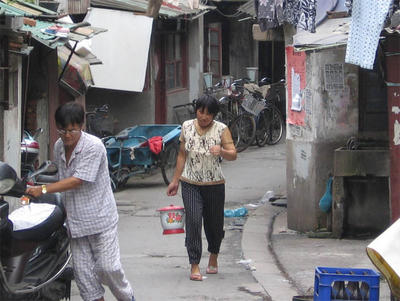
I also ran across the occasional alleyway of houses. I'm not sure if these houses were occupied by squatters or if it's a step above that. Either way, the houses seem stuck together with whatever happened to be handy at the time. I hate to dwell on the negative, but these houses don't have running water. Here a lady carries out her Chamber Pot. I presume she dumped it into the River.
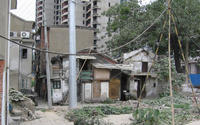
Scattered along this section of the river are massive apartment complexes, most of them either obviously very new or still being built. Some of the areas are too far out to attract development, but many of the older areas are being replaced by such apartment complexes. You can see the apartments going up behind this dilapidated area, and it's obvious its days are numbered.
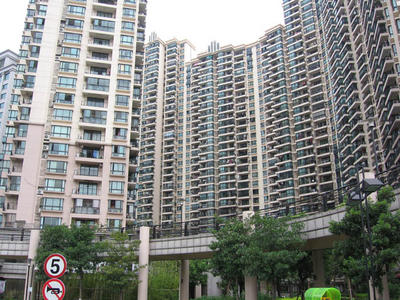
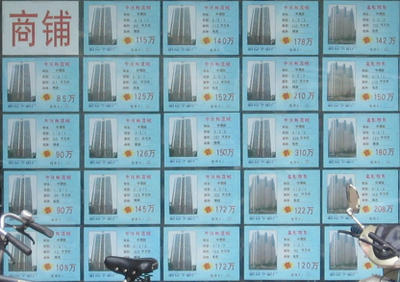
Which leads up to Brilliant City, by far the largest apartment complex I've ever seen. It's located where the Suzhou meets the ZhongTan Light Rail Station, on both sides of the river. The scope is hard to imagine, I made a very rough guess that it holds a hundred fifty thousand people. Rather than blocking off its view of the Suzhou River, it seems to be built around a particularly meandering portion of the river, with the occasional grandstand looking over. A lot of the pathways are closed, however, with willow trees overgrowing them. Here's a quick price guide if interested in moving in and joining me over here. These prices range from 850,000 Yuan to 3,100,000 Yuan - about $100,000 to $400,000.
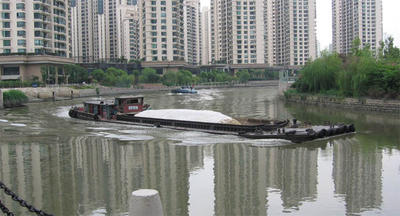
Up until this point, I had one big surprise. In the movie "Suzhou River," long flatboats formed a kind of backdrop to the movie, but I hadn't seen a single one. Then suddenly they came, one ofter the other. There was about fifteen of them. While that was all I saw of them, it was kind of fun. They had small houses at the rear, with clothes hanging and miniature gardens, just like in the movie. They carried what looked like sand, for mixing in with concrete I guess. And yes, the apartment buildings in the back of the photo are also part of the same complex.
After this, a construction sight cut off access to the riverside. They were still carting off rubble and rather than walk around, I cut through. Nobody seemed to give a second thought to a foreigner in a T-Shirt walking through a construction sight. Sometimes you have to love Shanghai.
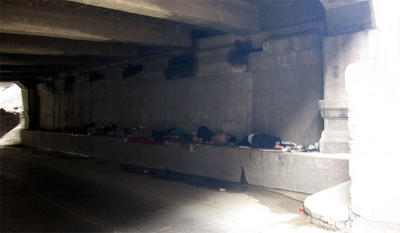
Anyway, continuing on, I came to the area that most reminded me of the underbelly depicted in "Suzhou River" - and probably the only part of the way I wouldn't want to walk though at night. It started underneath this bridge. This is just of a few of about a hundred homeless people (mostly families) sleeping and hanging out in the early afternoon.
This was followed by a very colorful but very poor area, where a foreigner walking through was a definite center of attention, albeit I competed with the children being washed in the street, and the odd game of mahjong. I must admit I didn't feel comfortable whipping out my digital camera, but this small area was a highlight of my walk. Afterwards were more abandoned buildings, often gated up or even bricked off. I guess they ran out of bricks halfway through on this one - it was the reception booth to a living area?
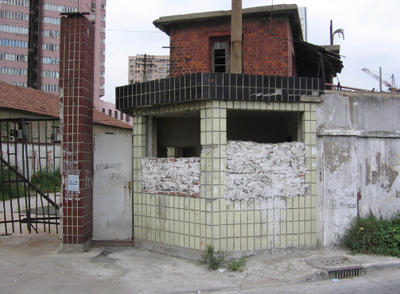
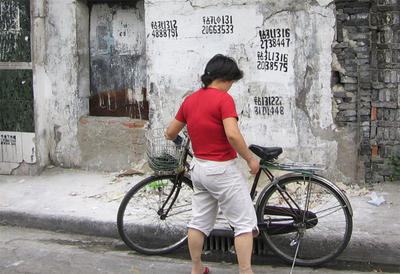
Keen eyes will look at the above picture and notice something that also had a prominent place in "Suzhou River" - the advertisements spray-paint-stenciled onto the wall. While the narrator of that movie spray-paints his videographer advertisement on every building he sees in Shanghai, it's rare to see them in other areas of Shanghai. Here they're everywhere. The ads below use a graphic slang for having sex, followed by a cell phone number.
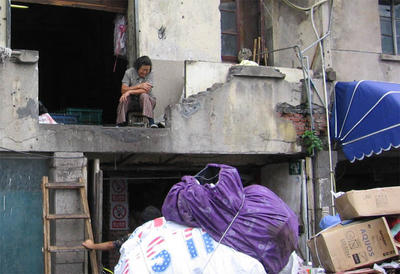
Continuing on, the area gets much more crowded, with a large group of electronics stores, and the occasional apartment complex that looks larger and more lived-in than before, if not actually any nicer. At this point I had to cross the street to get away from the river. There are occasional decks and pathways along this stretch, apparently built for looking over at the river. While there were only a very few young hoodlum types hanging around, it's obviously not a pleasant place to be at night. The decks are riddled with human filth and about as disgusting as anything I've ever seen. I won't show a picture, but this lady could probably tell a story or two - she has a good view over the action!
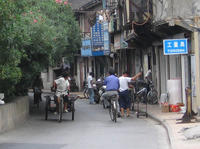
But it isn't much longer until the Suzhou merges with the downtown area, and abruptly turns into a back street for Beijing Lu, where machine-part stores are gathered. You wouldn't know you're even along the river, as the view is completely cut off by a thick row of plants.
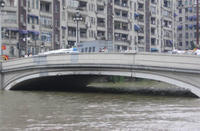
By the way, it's also obvious why the boats along the Suzhou are shaped so extremely long and flat. Sure it's high tide, but the clearance to the bridges along this stretch can't be more than five feet.
At this point I reached the end of my trip. The Suzhou flows into the Huangpu River, which flows into the Pacific. Being the dividing line between the historical city center and the growing sub-city of Pudong, the Huangpu defines Shanghai more than the Suzhou probably ever did - on the other hand, you wouldn't even think to create a movie around it.
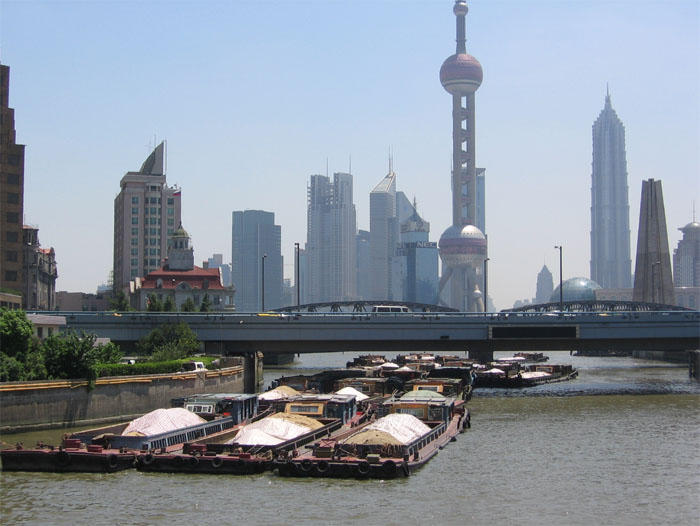
As a last picture, taken on a different day, you can see the setting of Moudan's climactic jump. Pudong lies across the way, and the Russian Embassy is mid-ground on the left. A small caravan of boats waits at the mouth of the Suzhou for the gates to open, so they can take their cargo upriver.

I took a lot of pictures, some of which are here and the rest of which can be seen at Flickr.com. I'll re-trace the trip eventually, so check back later if such is your interest.
I knew the scenery would be different from the movie, because the movie is all of five or six years old, which is equal to about ten times that in US city years. Also, I talked to a local girl the day before the hike, she's into the art movies - she says right after the movie came out, there was a huge cleanup of the area.
I took the metro out to ZhongShan Park on an overcast day that wasn't quite the best for photography, but kept me from dying of sunstroke. Between the park and the river is a colorful area combining the back-alley charm of Shanghai with big apartment buildings, with a lot of local restaurants to boot. I was thinking it would be a pleasant place to live when I stumbled across the river. This look at the Suzhou River was a surprise: rather than the neighberhood being built around the river, the river was nearly boxed in by concrete barriers I could barely see over despite my height, and surrounded by warehouses and the like.

Although of course it makes sense if you consider that until recently, the river was basically a sewer. I walked down the dirt road, and it wasn't too long until I could see a row of new apartment buildings across the river. There was a break in the river-barriers, and a small park front where you could look over the river. Also note the laundry hanging in nearly every lanai.

However the barriers went right back up, and there was a long stretch of sparcely peopled road, with small warehouses and the occasional recycling center. And "sparcely peopled" isn't something you often get to say about Shanghai.


I also ran across the occasional alleyway of houses. I'm not sure if these houses were occupied by squatters or if it's a step above that. Either way, the houses seem stuck together with whatever happened to be handy at the time. I hate to dwell on the negative, but these houses don't have running water. Here a lady carries out her Chamber Pot. I presume she dumped it into the River.

Scattered along this section of the river are massive apartment complexes, most of them either obviously very new or still being built. Some of the areas are too far out to attract development, but many of the older areas are being replaced by such apartment complexes. You can see the apartments going up behind this dilapidated area, and it's obvious its days are numbered.
Which leads up to Brilliant City, by far the largest apartment complex I've ever seen. It's located where the Suzhou meets the ZhongTan Light Rail Station, on both sides of the river. The scope is hard to imagine, I made a very rough guess that it holds a hundred fifty thousand people. Rather than blocking off its view of the Suzhou River, it seems to be built around a particularly meandering portion of the river, with the occasional grandstand looking over. A lot of the pathways are closed, however, with willow trees overgrowing them. Here's a quick price guide if interested in moving in and joining me over here. These prices range from 850,000 Yuan to 3,100,000 Yuan - about $100,000 to $400,000.

Up until this point, I had one big surprise. In the movie "Suzhou River," long flatboats formed a kind of backdrop to the movie, but I hadn't seen a single one. Then suddenly they came, one ofter the other. There was about fifteen of them. While that was all I saw of them, it was kind of fun. They had small houses at the rear, with clothes hanging and miniature gardens, just like in the movie. They carried what looked like sand, for mixing in with concrete I guess. And yes, the apartment buildings in the back of the photo are also part of the same complex.

After this, a construction sight cut off access to the riverside. They were still carting off rubble and rather than walk around, I cut through. Nobody seemed to give a second thought to a foreigner in a T-Shirt walking through a construction sight. Sometimes you have to love Shanghai.Anyway, continuing on, I came to the area that most reminded me of the underbelly depicted in "Suzhou River" - and probably the only part of the way I wouldn't want to walk though at night. It started underneath this bridge. This is just of a few of about a hundred homeless people (mostly families) sleeping and hanging out in the early afternoon.

This was followed by a very colorful but very poor area, where a foreigner walking through was a definite center of attention, albeit I competed with the children being washed in the street, and the odd game of mahjong. I must admit I didn't feel comfortable whipping out my digital camera, but this small area was a highlight of my walk. Afterwards were more abandoned buildings, often gated up or even bricked off. I guess they ran out of bricks halfway through on this one - it was the reception booth to a living area?

Keen eyes will look at the above picture and notice something that also had a prominent place in "Suzhou River" - the advertisements spray-paint-stenciled onto the wall. While the narrator of that movie spray-paints his videographer advertisement on every building he sees in Shanghai, it's rare to see them in other areas of Shanghai. Here they're everywhere. The ads below use a graphic slang for having sex, followed by a cell phone number.

Continuing on, the area gets much more crowded, with a large group of electronics stores, and the occasional apartment complex that looks larger and more lived-in than before, if not actually any nicer. At this point I had to cross the street to get away from the river. There are occasional decks and pathways along this stretch, apparently built for looking over at the river. While there were only a very few young hoodlum types hanging around, it's obviously not a pleasant place to be at night. The decks are riddled with human filth and about as disgusting as anything I've ever seen. I won't show a picture, but this lady could probably tell a story or two - she has a good view over the action!

But it isn't much longer until the Suzhou merges with the downtown area, and abruptly turns into a back street for Beijing Lu, where machine-part stores are gathered. You wouldn't know you're even along the river, as the view is completely cut off by a thick row of plants.
By the way, it's also obvious why the boats along the Suzhou are shaped so extremely long and flat. Sure it's high tide, but the clearance to the bridges along this stretch can't be more than five feet. At this point I reached the end of my trip. The Suzhou flows into the Huangpu River, which flows into the Pacific. Being the dividing line between the historical city center and the growing sub-city of Pudong, the Huangpu defines Shanghai more than the Suzhou probably ever did - on the other hand, you wouldn't even think to create a movie around it.
As a last picture, taken on a different day, you can see the setting of Moudan's climactic jump. Pudong lies across the way, and the Russian Embassy is mid-ground on the left. A small caravan of boats waits at the mouth of the Suzhou for the gates to open, so they can take their cargo upriver.

I took a lot of pictures, some of which are here and the rest of which can be seen at Flickr.com. I'll re-trace the trip eventually, so check back later if such is your interest.
Subscribe to:
Posts (Atom)