Showing posts with label Nearby Cities. Show all posts

Thursday, November 06, 2008

Songjiang Mosque


Shanghai has a visible Muslim population, with Chinese Hui Muslims all about town (often seeming to run Pulled-Noodle Stands), and the generally-Muslim Eastern Turks visible as well (often seeming to sell barbequed meats or raisins). However outside of the food services, there doesn't seem to be much of a Muslim presence – for instance, businesses that aim themselves at a Muslim clientele. The only mosque I've seen in Shanghai has been the underwhelming Peach Garden Mosque, near the Old City of Shanghai.

I'm curious about the Islamic religion, so I've wanted to go to the mosque in the suburb of Songjiang for a long time now. The mosque was originally built in 1391, I had read it's one of the oldest mosques in China. However Songjiang is quite a ways out of town, so I never made it out, until I heard that Shanghai's new line #9 went out to Songjiang, and I decided to give it a try – the line also goes to Qibao Old Street.

The subway ride and transfer there is so annoying, worlds beyond the terrible People's Square Station. There are two stations, both named Yishan Lu – the line #3 version is the proper one to transfer from. From there, the two lines don't actually connect, and there's a long line for a free bus to the line #9 station, and then after the short bus ride, it's about an hour long subway ride to Songjiang terminal station, and a further ten minute taxi ride.

To my untrained eyes, the mosque didn't look all that different from a Chinese temple:


The largest difference being that there were gardens on site:


And also a small graveyard:


As well as the occasional Arabic sign or calligraphy:


There weren't any people worshipping when I went to the Mosque, although I went on a Saturday rather than a Friday. However, I understand it's still an active mosque, here's a snapshot of the Prayer Hall:


So honestly I found the mosque a little disappointing. However, it's worth a gander for those who are already in Songjiang, for whatever obscure reason.

Sunday, September 02, 2007

Qixia Temple

Qixia Temple is a large temple complex, fifteen miles Northeast of Nanjing. I very much enjoyed it all and would even recommend it as a day trip from Shanghai, although there certainly aren't any Disneyland-type thrills, and it's not nearly as busy or as elaborately decorated as even the Jade Buddha Temple, in Shanghai.

It's not approached quite as casually as ideal - supposedly there's a bus from the train station, but I couldn't find one, and ended up taking a private taxi where we payed 10 kuai ($1.25) apiece for the ride there, with a few strangers - there was no English possible, obviously. It was in an old beat-up mini-mini-van, it took about a minute to get up to speed once we got on the highway.

Once there, we passed by a few bored touts and passed through the gates to get in. The temple occupies a huge, beautiful grounds, it has a large number of Buddhist monks and Buddhist seminary students going about their business - I actually went with some Methodist seminary students. It's a curious mix of the old and the new, and Qixia temple seems to be in the middle of a massive building project. For instance, the pavilion looks old and worn, and is right next to a fountain and a modern-looking Guanyin, riding on a Dragon throne:


The grounds aren't particularly well marked, but it's a lot of fun just wandering through the paths, they steadily but not particularly steeply make their way uphill.


Things weren't particularly well-marked and I wasn't sure what to expect anyway. I just enjoyed wandering around the forest grounds and seeing what I came across. It's so much fun to chance one's way across a fourteen-hundred year old stone pagoda:


Right next to it are a number of stone Buddhas, carved out of the side of a small cliff. A lot of their heads are smashed in, I assume it's a relic of the Cultural Revolution. I similarly guess that a lot of the construction being done is actually re-building Cultural Revolution damage, but really it's just a guess as I didn't ask anybody about this - next time I'll make a it a point!


Towards the middle heights of the temple complex were the living quarters. The day I visited was the first sunny day in a while, so the laundry was hanging out to dry in force. Which is an inane thing to point out, there's no denying, but it was interesting to see the every-day life of a monk.


Most of what I came across was smaller, though - little pavilions and ponds and vantage points and so forth.


Here a short video of myself turning around in front of the central temple complex. It's about the same as the center of every other Chinese Buddhist temple. The music in the background is Buddhist chant/singing. There's a guy at the end, wearing shorts without a T-shirt! So obviously the dress code is more relaxed than, say, Sikh Temples.


There were massive incense bells, even though the temple wasn't particularly busy. I wonder how busy they'd be if I had gone on the first or the fifteenth of the Chinese calendar, corresponding to the full moon and the half moon. Those are the days that draw the big crowds in, and I imagine that would be the best time to visit.


There's also elephant statues, very interesting. It suggests the strong perceived connection of Buddhism to its native India, although I had never seen Elephants before aside from Jing'an temple. I'm no Buddhism expert, and I'll post if I learn anything more about this.


Finally, although the bus station was a five or ten minute walk from the temple, we ended up taking a private bus, carrying maybe twenty people. It was interesting, it took a somewhat meandering route back to Nanjing. If the driver saw people walking alongside the road on the way, she offered to give them a ride - we ended up spending a quarter for our ride, once the bus got closer to town the fare dropped down to half of that.

Sunday, August 26, 2007

A Few Days in Nanjing

Nanjing is a couple hours from Shanghai - geographically it's in the center of China, but the name means "Southern Capital," historically it was the capital of a divided Southern China, fifteen hundred years ago. It was again a Ming Dynasty capital five hundred years ago, then a capital of the short-lived Taiping Rebellion one hundred forty years ago, and then the capital of the Republic of China, before and after the Japanese invasion.

I won't go into the historic details, I just listed what I did to show that it's an ancient, important city. When I visited, I didn't know what to expect, but perhaps a lesser Beijing or Seoul, which are filled with ancient temples and palaces. But I felt it was more similar to Shanghai - generally modern, with historic sites scattered about.

I had put off a visit because it's a five hour train ride, what a pain. However there's a new train service going to Nanjing, it looks something like a French LGV train and does the trip in only two hours. It's also a very comfortable ride, the downside being that it's $12 each way, whereas the slower, older trains start at $2.50 according to this nifty if unfortunately Chinese-only train website. Travelling about Nanjing is also easy, there's a brand-new Subway system that goes straight from the train station to downtown.


A lot of the main sites to Nanjing revolve around its more recent history, and that includes memorials to the Nanking Massacre, Dr. Sun Yatsen's mausoleum, and the Taiping Rebellion. I wasn't quite feeling history when I went, so I either gave such places a miss or just had a cursory look. A lot of it is lost on me because I am still way more ignorant of Chinese history than I should be, and what I did see often wasn't very well presented for a clueless English-language tourist. Here's a small teahouse, located inside the re-constructed Taiping capital building - the reconstruction had its own history, as a government building of the Republic of China.


But the obvious highlight of the city is to the North-East of the downtown, with the Xuanwu Lake Park, and the adjacent Purple Mountain. Xuanwu Lake Park is reached by passing by the Jiming Temple (pictured at the top) and some scenic, gigantic, Ming Dynasty walls. These walls don't form a complete circle, but the large majority still exists, and surrounds a huge area of the downtown.


The park is a big lake, with a thin strip of land that meanders through it - it's nothing historic or amazing, but it's a pleasant walk - with a couple of caveats. First, the park is absurdly large, but when I went all the shops were closed, and there weren't any working water fountains, and I had been walking all day, and fell into some kind of panic mode. Secondly is, the pollution in the area is thick and disgusting, and combines with all the fog to make an impenetrable haze - there might have been great views, but it was hard to tell.


The pollution is more of a problem at Purple Mountain, where there's a half-hour ski-lift to the top of the mountain. It's a fun ride, but then when I go to the top I realized it was almost impossible to look back down at the city - I could also see that the nearby mountains held the pollution in. Another interesting perspective was the the very large city seemed to be built almost directly against thick mountain forests. Here's the best shot I got:


I've mentioned before that Shanghai is in the midst of a crazy building boom. Well that news is outdated. Shanghai still has a lot of building going on, including some extremely high-level projects. But it seems to have calmed down a bit, and there's no longer a new building going up on seemingly every single street. Whereas, going to Nanjing seemed to be like stepping into a time machine, and visiting this mythical quick-building Shanghai of 2005. These buildings generally looked a lot more bland and cheap than the buildings going up in Shanghai, though:


The downtown was the typical Chinese strip of brightly-lit shops and malls - which can be fun for a visitor, but I've gotten more than enough of that in Shanghai. More interesting was a long strip of restaurants and shops near Nanjing University. Four friends visiting from the US, and I, went to one place that looked nice - it served Nanjing cuisine. Everything was so cheap, I assumed the portions were small, and ordered to match. I came to realize that in truth, food in Nanjing is much cheaper than in Shanghai, and for less than $20, I ended up ordering a completely absurd amount, we ate less than half of it. This is just a part of the feast - note the roast duck heads up front! The food was excellent, the highlights being the country-style tofu and the pumpkin soup:


A little quirk on Nanjing is that even though I looked in a number of places, it was impossible to find Diet Coke - which would definitely be a major crimp on my lifestyle. I also never saw any Chinese beers except for the cheapest, lightest versions, the kind I wouldn't ever order in Shanghai. That was negated by running into the kind of bar I like: dark and dirty!


So while I can't say Nanjing is my favorite place in China, I definitely think it's worth a weekend trip, especially when factoring in the nearby Qixia Temple complex, which I'll talk about within the next week.

And for those in China dealing with blogspot and Wikipedia frequently being blocked and un-blocked for no apparent reason, the Lost Laowai blog shows how to set Firefox to automatically get past the Great Firewall.

Wednesday, June 06, 2007

Another Word on Suzhou

Suzhou is a city about an hour's train ride from Shanghai. I've been a few times, and I wrote a bit on Suzhou before. I find Suzhou an intriguing alternate take on Shanghai: despite being so near Shanghai, and also having a very large population, the feel is extremely different - among other things, it maintains more historic sites, it feels more like a city built on a river, and it doesn't have the shock-and-awe skyscraper districts like Pudong.
But I'll admit I didn't stay for long, just enough to get a feel and meet a friend I hadn't seen in a while. Eventually I'll make a long trip of it and have a wonderful take on the city and how it compares and contrasts to Shanghai.

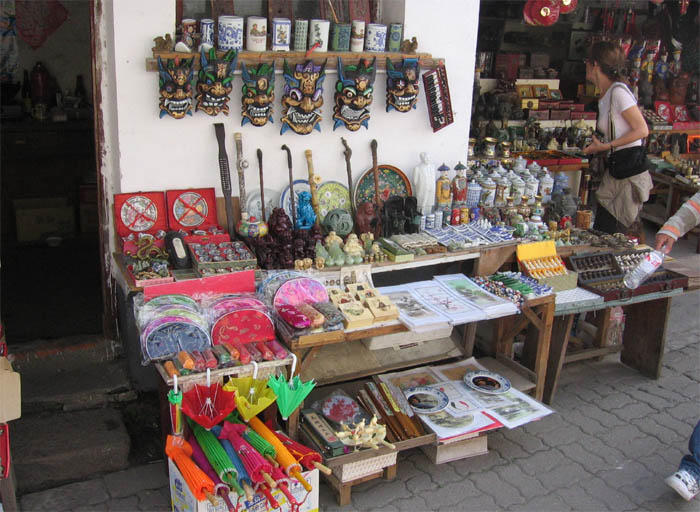
From what I gather, metropolitan Suzhou is divided into three areas: the historic center, a more modern area that resembles a humbler version of Shanghai, and districts dominated by foreign-invested business parks. Naturally the historic center is of the most interest for a tourist like me. Shanghai doesn't really have extended neighborhoods with a traditional feel, the way Suzhou does. It's all very quaint, in a way perhaps a tourist to China would hope for:


Most of the area is just normal people going about their lives, but of course there are areas that are thoroughly tourist-ized, although perhaps not as professionally as Shanghai. As a trite example, on a hot day there were a number of vendors on a particular street selling drinks, none of which were refrigerated or even chilled. It goes along with yin-yang medical beliefs, but it was a bummer for me.


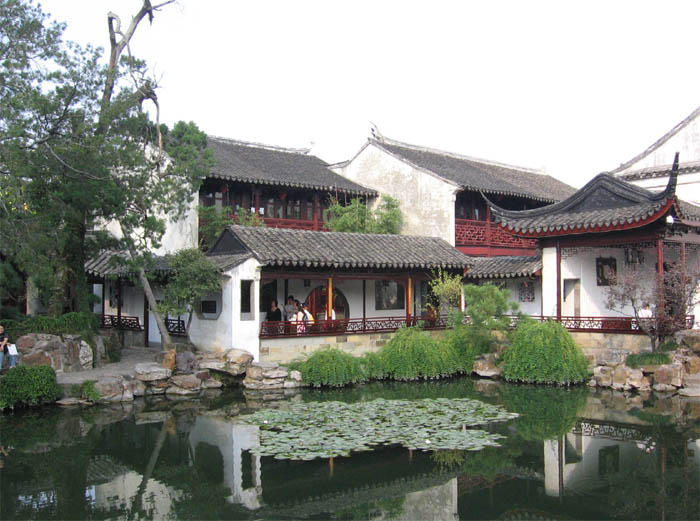
Suzhou is most well-known for a number of gardens. Rather than a Europe-style garden with kids playing on the lawn, it's a more whimsical take, where certain vantage points allow visitors to see sculpted landscapes, punctuated by understated buildings, bridges, and so forth. This one, the Humble Administrator's Garden, is very large, but it was also very crowded - I think it's best to choose a time when there'll be as few visitors as possible, or just to seek out less crowded gardens. To me the garden felt a little too busy, and only half-restored.


I then took a very long bus across town to see the Cold Mountain Temple. I got there after it had already closed, but when a monk saw that I was a foreigner he let me go in and have a look! There wasn't much to see in the dark, though. I was told it's famous for a poem written about it. Because it's short I'll copy it here: it's by Zhang Ji, A Night Mooring near Maple Bridge, and from thirteen hundred years ago:

While I watch the moon go down, a crow caws through the frost;
Under the shadows of maple-trees a fisherman moves with his torch;
And I hear, from beyond Suzhou, from the temple on Cold Mountain,
Ringing for me, here in my boat, the midnight bell.


According to the Chinese tourist board, the poem can lead to Buddhist Enlightenment! Although my preferred method remains putting a shoe on your head.

More impressive was a high-arching humpback bridge nearby, just like the US cliche of Asian gardens.


It was getting late, so I had dinner in Suzhou's downtown, which is concentrated, with one restaurant after the next. It looks fun, and was lit up like Vegas. Truth be told, both the dinner and my earlier lunch were pretty good - in particular the local specialties like eel that I thought were better than any equivalent Shanghainese version I've eaten.

Thursday, August 31, 2006

A Short Trip to Hangzhou

As the title suggests, I recently made a trip to Hangzhou, that was entirely too short. The fault is all mine: I left later than I should, I didn't get a train ticket ahead of time, and had to wait an hour and a half to buy the ticket and then board the train, and I was entirely lazy making my way from the station to West Lake, Hangzhou's principle tourist attraction. Instead I sort of wandered around the city. It was nothing special, but I eventually made it to the "Old Town."


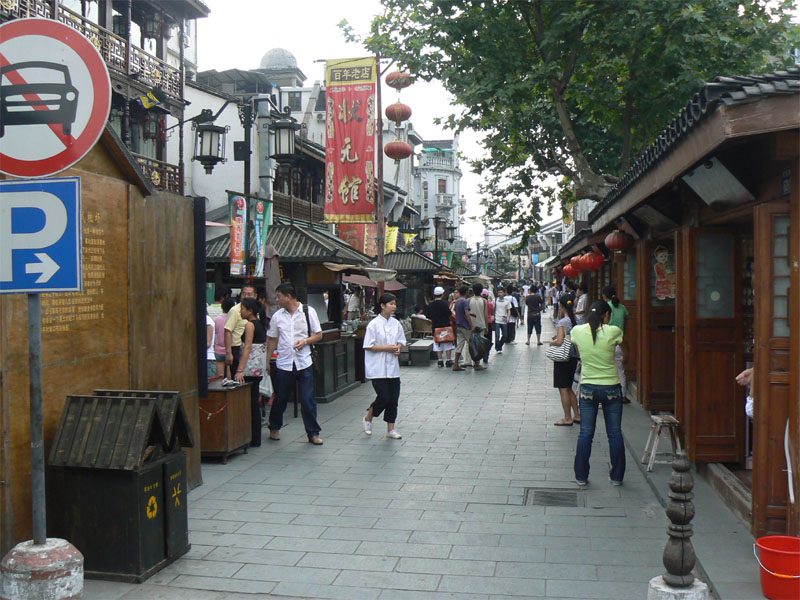
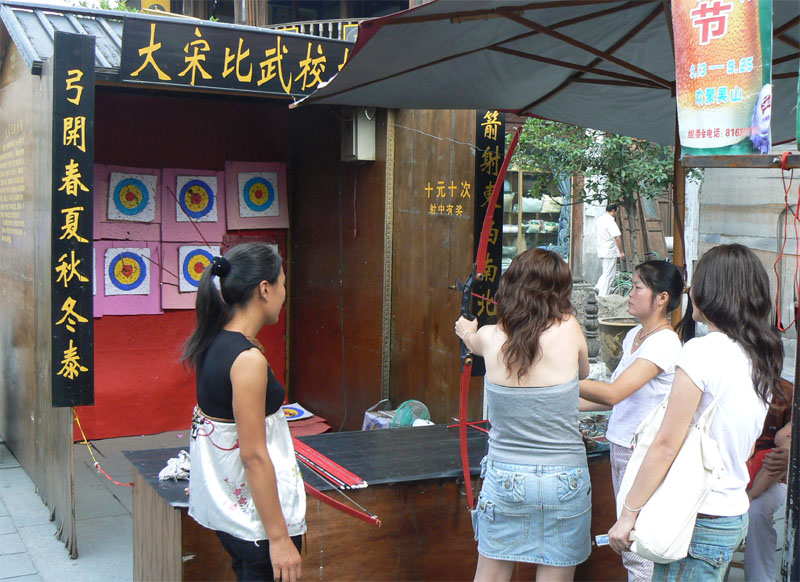
It's a turn-of-the-century looking part of Hangzhou, with a bunch of small shops aimed entirely at tourists. Still, while it certainly wasn't a highlight to the trip, I thought it was a lot cooler than the similar kitschy markets around Yuyuan Gardens, in Shanghai. Maybe because the sellers were a lot less pushy, maybe because it wasn't so over-crowded, or maybe I was just in a better mood that day.


They also sold foods, Hangzhou has distinctive street foods from Shanghai. It's not a traditional choice, but I was very impressed with one variation on Tujia Minority Chinese Style Pizza, with spongy bread and higher-quality meat. Occasionally, over the buildings, I could see a large, beautiful temple on a hill. It was a little out of my way, and I didn't get to have a closer look:


Walking down this road directed me in the direction of Hangzhou's West Lake, which is generally considered one of the top tourist attractions of China. It's a lake ten miles around, surrounded by at least a thin strip of parkground, and oftentimes larger parks, ancient buildings, temples, pagodas, low-key (if exclusive) shopping areasm, statues, and so forth.


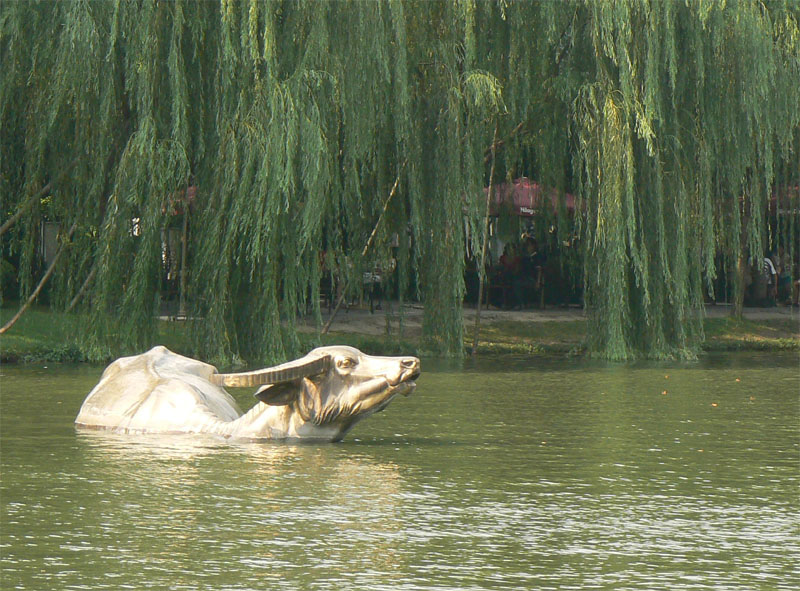
Partly the attraction of the lake is lost on me. I don't mean to say it isn't beautiful, which it certainly is. However the lake is also famous for its importance in over a thousand years of Chinese art, a subject I admit I'm pretty much completely ignorant about. My entire connection to the pavilion dedicated to Chinese poet Li Po, is a Chinese dive bar in San Francisco name "Li Po Lounge," where I once saw eXtreme Elvis. I will adress this ignorance, sometime in the indeterminate future. This golden bull is an allusion to a Chinese version of the Golden Goose story, a story I knew nothing about:


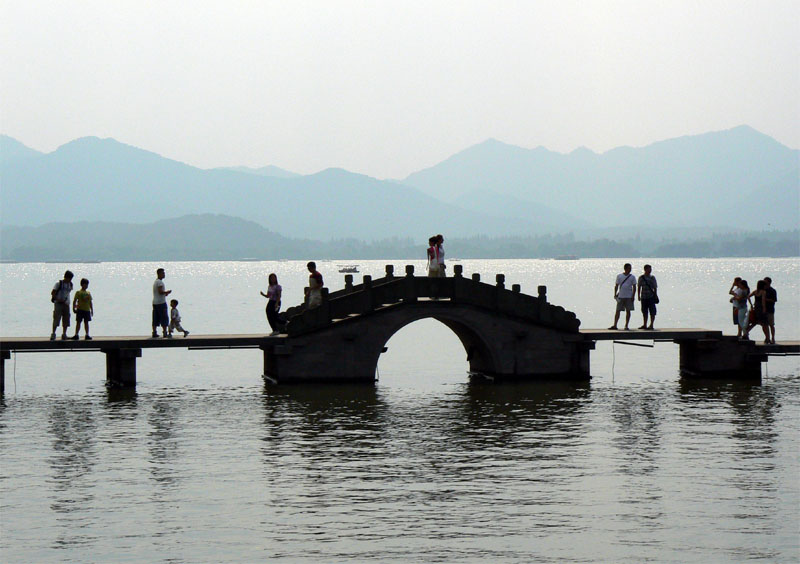
Hangzhou has more than its fair share of non-Chinese people, both tourists and locals. Still, there was a constant stream of Chinese people saying "laowai" or "waiguoren" as I passed by, meaning "foreigner" in CHinese. They generally weren't talking with other people, and they had no intent to talking with me. The reason why people say this baffles me, and also the Chinese people I ask about it. It also annoys me to no end, there is no way I could live in Hangzhou. I admit it happens in Shanghai sometimes, but very rarely, maybe once a week or so, no big deal. One short (and beautiful) bridge, and I got informed that I was a foreigner three times!


I didn't get to walk all the way across the lake, the way I would have liked. But it's a beautiful look across, even with the hazy afternoon sky. Check out the pagoda to the left, and the way the different hills all seem to have a slightly distinct color:


There were also some boats, both relatively small cruise boats, and old-style hand-cranked boats, which moved surprisingly fast. This isn't the most exciting of videos, but it gives a nice panorama to the lake, a look at the weird corkscrew propulsion, and at the beginning you can hear a little of a traditional Chinese-music quintet playing:


Hangzhou city has recently been growing rapidly too, as a second city to Shanghai. There's currently a maglev train being built, that will make the distance an amazing 25 minutes. Surprisingly, there's also a Ferrari Dealership, with a Maserati Dealership right next to it. The Porsche dealership is a few doors down. Honestly, I can't imagine seeing any of these cars on the city streets.

Friday, October 21, 2005

I am a Tourist: Suzhou

It's turning into Fall, and I'm worried about the Shanghai Winter. People tell me it's just horrible, all cold and windy. So I'm trying to take full advantage of the good weather while I have it. Last Thursday was a nice day and I didn't have any work or school, so I decided to take a trip to Suzhou, a famous tourist city that's about sixty miles from Shanghai - it's no relation to the Suzhou River I mentioned earlier.

I decided to take the bus there, and the train back. The bus was no problem, no matter how much of a bother it was to get to the Jiading. The bus ride was about an hour long. The only real hassle was, right after the bus got going, I was called about going to a job interview later that day! I was able to schedule for Friday and I consoled myself by watching the oddball movie "Once a Thief" on the TV screens - we only got to the halfway mark, though.

Looking out the window on the way there, you notice that Shanghai doesn't have the extensive suburbs that California has, and almost immediately outside the city you come across farming villages. A lot of these small cities seem to be built around canals, even though Shanghai doesn't have much of that.

Suzhou has two million people, and six million people in the metropolis area, but it still felt more like these smaller towns to me. I walked a couple miles from the Southern bus station to the tourist area, and it was mostly smaller-scale buildings, with much fewer people on the streets than Shanghai. Canals and rivers are all about, the water generally seems pretty clean, and the houses are often built up right againt the water.


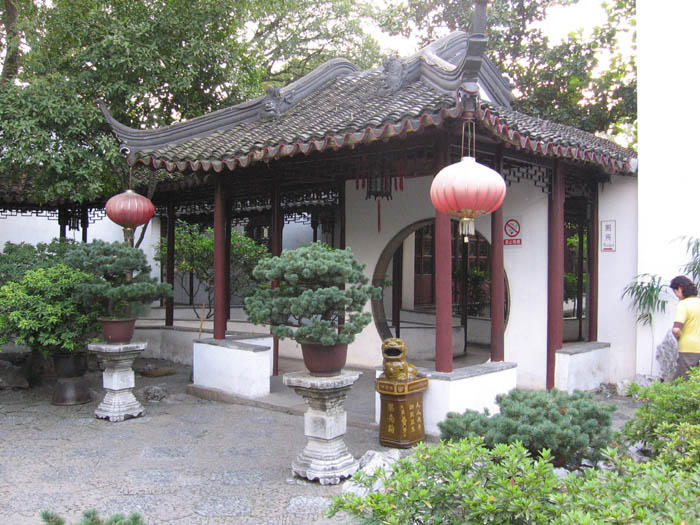
Suzhou is most known for the ancient Chinese Gardens. I decided to start at the Garden of the Master of Nets, which the Lonely Planet Guidebook and Chinese sources consider better than all Suzhou's other garderns, combined. Even though the garden was at the end of an alleyway, there was still the familar row of tourist stores.


The initial view of the garden was a small lake, looked over by traditional-looking buildings. It was small but everything felt very well-placed.


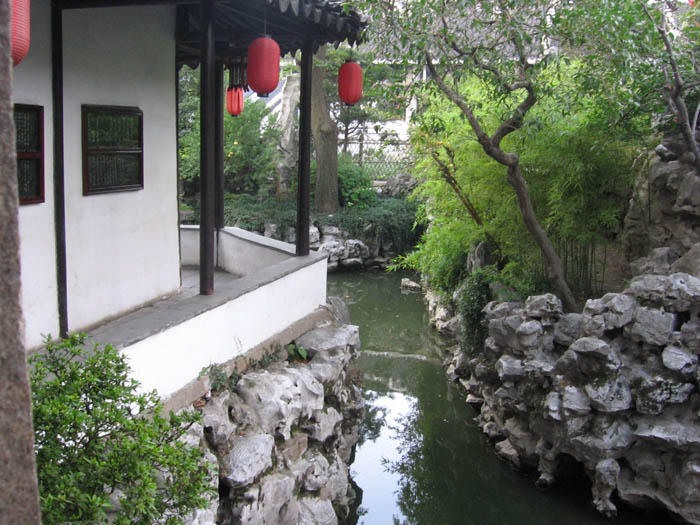
Also the garden had a cool collection of weirdly formed rocks. Some of the rocks here look like they're multiple rocks glued together or something. This and a similar sense of whimsy is common to Chinese gardens.


But I must admit I didn't so much care for the garden. Maybe it was too small, or maybe because all the internal halls don't hold much interest for me.

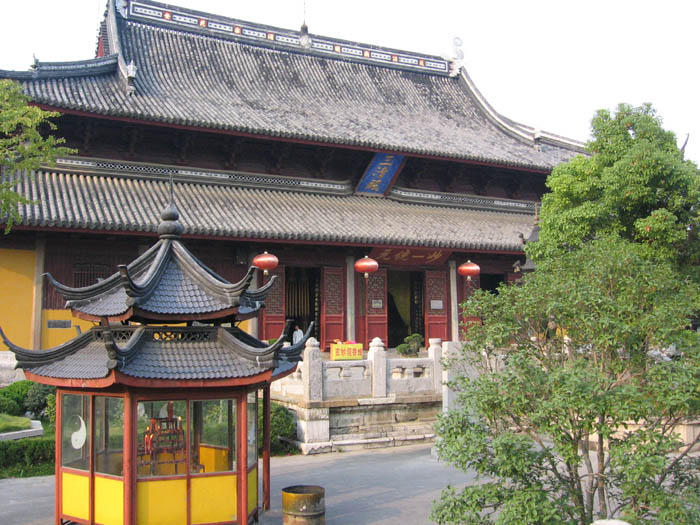
Compared with Shanghai, the streets of Suzhou look a lot more traditional and stereotypically Chinese, but perhaps the city is too large to be called charming. Like a US city, many parts of the main ways are dominated by car traffic, with pedestrians a little rare. It's a nice contrast to the international/post-modern look to Shanghai architecture, but it's not a city I'd want to live in. In fairness, though, there was a street scene around this massive Taoist temple.


From there I headed to the North End of the City. I had a look at another garden, the Garden of Harmony, which is a bit rococo in its multiple stylings. It was larger than the Master of Nets Garden, although there wasn't the sweet spot you look for in these gardens - points where you can stand, look around, and think the surroundings have been arranged, placed, and plotted with the care of a master painter. It did have plenty of nice smaller views, though.


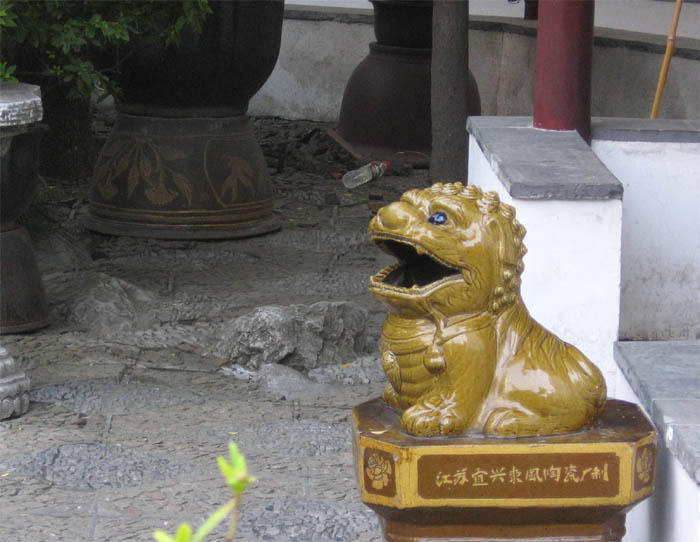
I also thought the Guardian Lions were cool-looking. I guess I'm not the only one who thought so, as they don't just guard the gates, but various random points around the Garden.


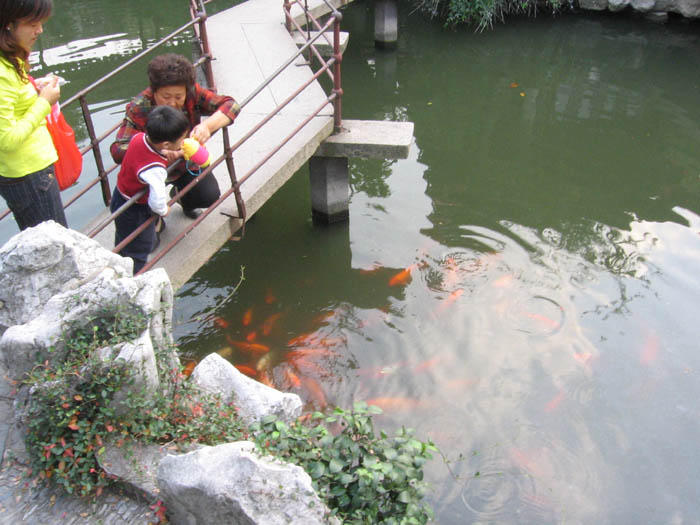
And I'm a sucker for koi fish. Some of the fish here were incredibly large. This kid fed them some rice.


Anyway it was too short a day-trip and there's still a lot of things I didn't see in Suzhou - I'll leave that for some other time! I finished off my visit by wandering around a waterfront park, and then I took the train back to Shanghai. It's the first time I've taken a train in China, and I thought it was very convenient and cheap, although the train-station was a bit of a madhouse.