Showing posts with label Food. Show all posts

Sunday, March 01, 2009

More Potato Chips!

Is it possible for a blog to “Jump the Shark” twice? I'll leave the question as an exercise for philosophers, but on a more empirical level, here's a second update about Potato Chips in Shanghai. Potato Chips are still the most common snack found at just about every street corner in Shanghai. I can't say I'm a huge fan, but sometimes I'll get them, especially after I've found that my meal was just too small for me – it's an occupational hazard of being six and a half feet tall and living in China!

Blueberry Potato Chips:


Hats off to market leader Lay's: in the three years since my first Potato Chip update, they've managed to do a good job of keeping their best flavors and replacing the stranger ones – actually, Cucumber Potato Chips are the only holdover from the earlier update. However, they've introduced strange new sweet-flavored ones, Blueberry Potato chips are very common and do a surprisingly good job of matching two flavors that would seem to be impossible to match. I have never once ever seen a blueberry in mainland China, but recently it's a popular flavor for snack foods, chocolates, and the like.

There's also mango and lychee potato chips, I tried them out of curiosity. They're awful!

Sweet and Sour Tomato Ruffled Potato Chips:


Most potato chips in China are of the normal, sliced variety. The ruffles are a nice change, personally I think the texture is much better. Unfortunately their flavors suck – this one's just weird, they also have plain, which I find boring, and generally unappetizing beef & pork flavors.

Lime Potato Chips:


Shortly after my last update, Lay's discontinued Lemon flavor and replaced it with lime flavor, despite that Limes aren't generally available in China. It's a lot less sweet and a little more Sour, and is pretty good stuff. This is probably the most common flavor of Lay's Potato chip, anyway it's definitely my favorite. My second favorite is Cherry Tomato flavor.

Doritos D2 Corn Chips:


Corn chips! I like them more than potato. D2 chips used to be called “Nacho Cheese Flavor.” There's also D3 chips, which used to be called “Taco Flavor,” and aren't very good. I guess they got re-named after some marketing guru realized that somewhere around 100% of Chinese people have never eaten either Nacho Cheese or Tacos. Still, I don't really understand the names “D2” or “D3.” Why isn't there a “D1”?

Cheese Cheetos:


I haven't had these in years, let me say that the Chinese version here is pretty bad. It's just bland-cheese flavor, there's no tang. Unfortunately there's no “Spicy Nacho Cheese with Lime” flavor, I had a college roommate who loved that stuff. They also have “Beef” flavor, and “Brazilian Beef” flavor, very strange.

Cheetos are produced by the Dorito's company, which means there can be a little bit of searching to find them. Lay's are everywhere, but there’s also Doritos, Pringles, a Japanese brand called Oishi, and a Chinese brand that is really sorry.

Wednesday, September 10, 2008

Danta

Here's a short update about a favorite subject: danta! Danta is an egg custard tart. It's a dessert that's associated with Macau, although I've read that it originated as a slight riff on some Portuguese or English desert.

To my mind, Lillian Cake Shop, a chain that's located throughout Shanghai, creates pretty much the perfect danta. The reason it's better than the competitors is mostly that it's cooked at a higher temperature. Like a creme brulee, the sugar at the top of the danta hardens and forms a thin caramelized layer at the very top - most places don't do this. In addition, the crust is light and flaky, but salty, a very nice contrast with the intense sweetness of the cream. It all goes for just 3 kuai, and out of the oven it's impossible to beat.


These cakes are located all around Shanghai, including inside a large number of subway stations. If none of these other danta are quite as good, a number of them bear mention. The first is from Lisboa Macau Restaurant, a favorite restaurant which I've written about before on this blog. They make a standard danta, as well as an egg-white danta. The egg white danta is lighter, bordering on a meringue, and definitely worth trying:


The other I plan to talk about is a little embarassing: KFC! It's the most popular fast food in China, but KFC makes some efforts to localize the menu, and one of these localizations is danta. KFC's dantas are actually pretty decent. It's in the same vein as Lillian Cake Shop, and they even caramelize the top layer, just overall it's not quite as good. They offer standard danta, and then a danta with candied fruit on top. The candied fruit is disgustingly sweet and throws off the whole balance of the flavors! Anyway, the worst thing that can be said about KFC's danta is that the 5 kuai/danta price, about equivalent to seventy five cents US, is much more than charged elsewhere.

Tuesday, October 30, 2007

A Chinese Zagat's, Decent California-Mexican

Feeling guilty about not updating my blog more regularly is pretty low, maybe a little pathetic even. But that's exactly how it is. So now that I've got my SLR set up, a mental list of what I want to talk about, and a stockpile of photos, I hope to come back with a vengeance!

But not quite yet. In this update I'm just passing on two recommendations - first is a Zagat's type site, dianping.com. It's a review of many of the restaurants of Shanghai, and while it mostly concentrates on restaurants on the expensive side (whereas I mostly eat just normal street-side restaurants), it's introduced me to a number of great places and I recommend giving it a try. Like Zagat's, it rates restaurants from one to thirty in three categories, first on taste, then environment, then on service. The listings divide into sub-sections, by type of food or district of the city.

The site is Chinese only, but is usable (if a little weird) run through machine translation into English, from Babelfish or Google Translate.

Here's what they had to say about Thai House, Lao Kele, City Diner, and, uhh, Burger King.

Also, I've resolved to not write anything more about Western Food, at least not for a while. But I very much enjoyed Cal Kitchen, the Cal is for California. So, I'll mention it in passing, and maybe I'll talk about it in the far future if it's still around. Here's a menu:


There's only four things on the menu: Burritos, Quesadillas, Chili, and (oddly enough) Corn Dogs. But the Burrito is in the San Francisco style and actually they do a pretty good job of it - you choose the type of meat, the type of beans, and it all gets wrapped up in tin-foil.

The menu mentions that it's based off instructions and recipes from Los Hermanos, a restaurant in San Francisco. I looked it up, and it's in the yuppie-ish Marina. Cal Kitchen's burrito tastes almost exactly like what you'd expect a burrito purchased in the Marina to taste like, for both better and worse. The chili is decent, and I'll say this is my favorite casual Western restaurant in Shanghai - with the caveat that Western food here is terrible.

It's on 376 Dagu Lu, a street of high-end bars, restaurants, and wine shops, a little South-East of the Nanjing Xi Lu station.

Update 4/28/09 - It moved to Jing'an District, right upstairs from exit #7 of line #2 of the Zhongshan Park Subway station - kind of off to the side as you go up the escalator. It's a small mall-court location that seems to specialize in doing deliveries, and they now also serve Japanese-style dessert crepes. But despite a recent influx of Mexican restaurants to Shanghai, it pains me to say that Cal Kitchen is still the only place in town to get a burrito anywhere near authentic.

Oh, and by a wild coincidince, some friends and I found ourselves by the Marina in San Francisco, and we stopped by Los Hermanos for a burrito. Not very yuppie, but not very good and not very similar. It didn't look like the sort of place to branch out to Shanghai. I didn't ask about it, but I should have.

Tuesday, September 18, 2007

The Specter of Food Inflation

Inflation in China is a complex subject that's outside the typical range of this blog, however at a 6.5% inflation rate last month, the subject's become difficult to ignore. Inflation is being led by rising food prices, which hurts more in a poor country like China, where food tends to be a larger percentage of people's daily spending.

I'm going to reveal my personal biases in this one, as I don't much shop at grocery stores, mostly I go out to the high-quality restaurants like this corner manapua/baozi shack:


The most commonly consumed (by me) manapua, with plain pork, goes for a whopping 13 US cents, up from a reasonable-ish 9 cents just a few months ago! It's outrageous, obviously, but it's also to be expected. Pork prices have climbed 50% from what they were last year. It's the default meat of China - the sign doesn't actually specify that it's pork, but when they say "meat" it's a given. Most other staples have also gotten more expensive, generally around 25%.

That's a big price jump for manapua, and most shacks opt not to raise prices, and instead have ever-decreasing amounts of meat in the middle. The profit margin on these is incredibly small, so I'm sure the amount of meat used closely follows the daily price of pork.

Anyway this idea of just lessening how much pork is used has had a broad influence on Shanghai dining, at least with the cheap eats. Here's a Tofu and Shepherd's Purse Soup, from a favorite Shanghai-style restaurant. Obviously pork isn't one of the two main ingredients, but on a recent visit the meat was looking a little sparse:


Western restaurants haven't adjusted prices or portions, though - they're already much more expensive than Chinese restaurants, so in the short term that's to be expected- I wouldn't be surprised to see changes coming soon, though.

In the meantime, a lot of local restaurants paste new prices over their old ones, or are constantly updating their signs: check out the bright fresh "5", to go along with the old dull .00 beside it. It's something like how prices are done at the local gas station! At this shop, the price of xiaolongbao has gone from three to four to five kuai, in just the past half year.

Tuesday, April 03, 2007

Mexican Food in Shanghai

I'm an avid reader of the city's English-language magazines, and the city site Shanghaiist.com. I even clip out particularly promising reviews from these magazines. However, I just as promptly entirely ignore every single piece of advice they give. No good reason for that - mostly it's because the restaurants they recommend are more than half a block from my apartment. Either I'm at home and feeling lazy, or I'm out and about and not carrying magazing clippings with me.

However I was motivated out of my wan slumber when Shanghaiist.com recently put out the good word for NYC Deli's burritos. I'm a big fan of Mexican food, it's definitely one of the top fifteen foreign foods I miss now that I live in Shanghai. Here's a look at what they have:


Ha Ha I wish. Actually that was ordered in a burrito shop in San Francisco's Mission district, last year. Obviously it's California-style Mexican food, as opposed to anything served in Mexico City. For those not familiar it might look disgusting but it's a glutton's dream food. I'd like to mention that I prefer the much less decadent burritos, without the sour cream and cheese and guacamole. Well maybe the sour cream is OK. Anyway, that's much closer to what I actually got from NYC Deli:


The keen eye of the gentle reader may notice that it's missing some crucial ingredients: namely beans and salsa, additionally the sour cream was few and far between. I was willing to forgive because the ingredients that did show up were all of excellent quality, particularly the pulled pork which was way delicious. I spent the extra $2 and got a tub of salsa. This is a lot of food:


The burrito was more than a foot long and fairly wide. My god. This is probably enough food for two, three might be stretching it but just a little.

So in the end I wouldn't call this an outstanding contribution to the Shanghai quality of life (which a taco truck in Shanghai would be), but the food was decent and I'll probably order there again. Enough about that, I'll move on to my favorite Mexican food in Shanghai, although it isn't actually Mexican food. It's a roadside snack, one without an interesting name. I'll just say roasted pork and tortilla, or something:


This snack is associated with the Eastern Turk minority from North-Western China, definitely I hope to blog about the ethnicity in the future. But for me, while I realize it's a Turkish thing, the main connection is what I could find in East Oakland, ordering the al Pastor style pork. It's the same basic idea, with the rotating spit and the meat gets sliced off the sides. A host of lettuce, tomatoes, hot spices, and even cilantro gets added to the mix, have a gander:


If the connection between Turkish-Chinese roadside snacks and California-Mexican food still seems weak, here's a look at the inside of one of these. I could straight up be given one at an Oakland taco truck, and I wouldn't think about it twice! The largest difference would be that it's still a little dry. I tried adding the salsa I had left over from NYC deli, which was OK - it would have worked better if only they had given me green salsa.


Other Mexican food in Shanghai? Well there's not much to speak of, and what I've had has been pretty weak. Taco Bell weak. Really, as in Taco Bell Grande. It's a souped up version of Taco Bell, re-imagined as a sit-down restaurant with slightly higher-quality ingredients and totally uninteresting meals, along with a locally high price. I went a couple times when I first came to Shanghai, it's OK I guess, but who wants to pay $8 for this (and, in fairness, an additional appetizer):


There's also Taco Popo, which places itself next to foreign bars and stays open late - the logo is at the top of this update. I've also been a couple times, I'd put the food as a step or two below Taco Bell Grande's, but at least it's cheaper.

As far as I know, that's about it - although if there's anyplace else worth knowing about, I'd be happy to hear about it.

Sunday, December 31, 2006

Wujiang Lu Food Street & Xiao Yang Shengjian

One of my (too many) New Year's Resolutions is to not eat a single hamburger over the next year. It's not that I love hamburgers, but that I can't really get into the Chinese food around Jing'an Si, the neighborhood I live in. A sub-part of the resolution is to go and check out other neighborhoods a little more. So today I took the subway, one stop away, to Nanjing Xi Lu.

To be honest, the food is probably better if I take the subway one stop in the opposite direction - I've been pretty happy with the places I've been to near Jiangsu Lu. But, there is a really cool back street near the station, that's where I was headed. This food street is a bit of a surprise - the actual Nanjing Xi Lu is one of the most tony parts of town, with lots of elite shopping and upscale apartments. So it's a weird ammalgation, with the street hawkers and small food shacks operating in the shadows of 5 star hotels.


Adjacent to the station, a little to the east of most of the food, are a number of little stalls selling odds and ends, for example there is a collection of a few booths selling genuine-looking air pistols. They look realistic enough, I can't see these without thinking about the fake guns used in Hong Kong gangster movies, like "PTU."


But they're selling all kinds of things, high-end and low, here's a collection of women's shoes that seems fairly high-end, at least compared to what you'd expect:


I've mentioned bootleg DVDs before, and this area has them, but I haven't mentioned bootleg books. They're not nearly as common, but in the more central parts of town you'll see them every few blocks. The quality is good, and they often have foreign books, both translated and in English. In this case, if you look to the bottom right corner, you can make out the Lord of the Rings, some Stephen King, Harry Potter...


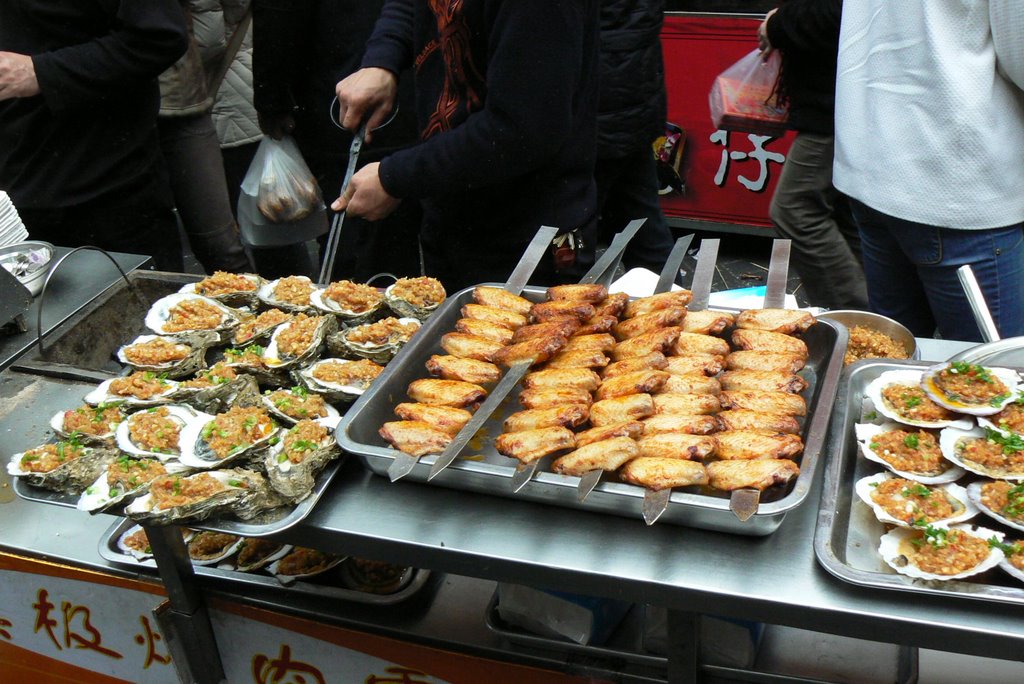
On to the food! The first picture was a surprise to me. I've never had them before, and I don't even think oysters are all that popular in Shanghai. It appears they're minced, mixed in with pork and onions, and then cooked on the half-shell? I'll have to try it, but first I'll have to work past my fear of food poisoning - street food stalls aren't the most hygenic, and even on a cold day I hate to eat foods which aren't being cycled through quickly. Oh, there's also some barbequed chicken, that's probably the most commonly seen food on this street.


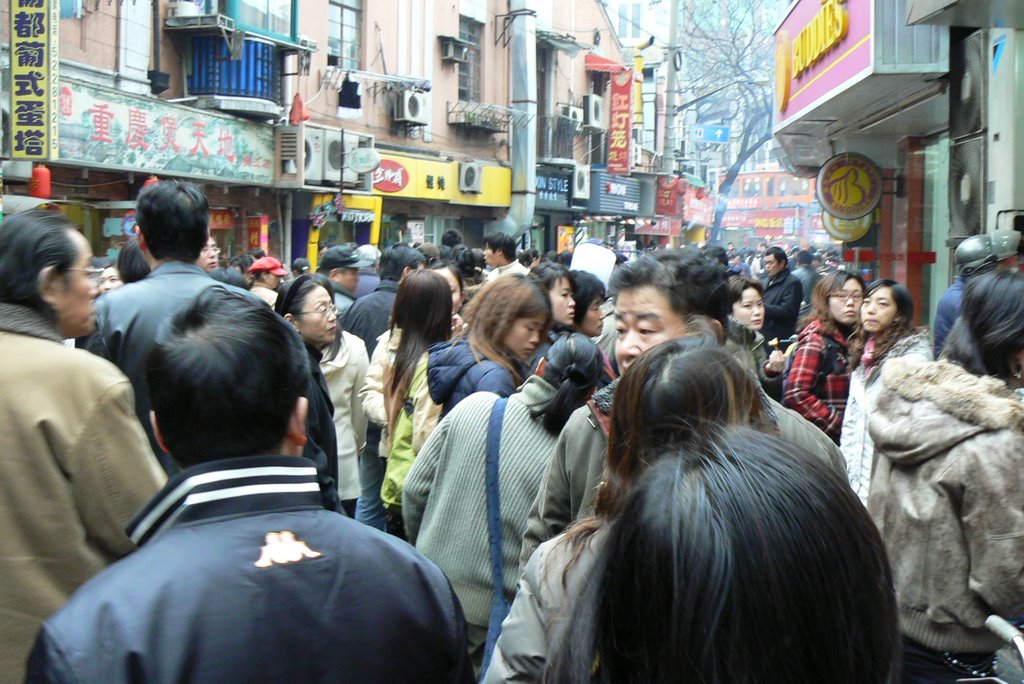
Coconut Milk! Looking back, I wish I had bought one of these. I've never had it in China, truth be told. You can see this is just being sold from a large cart. As crowded at the street is (just click on the picture to the right, if you don't believe me for whatever reason), she manages to push her way through the crowds, coming to a full and complete stop when making a sale.


And the infamous Stinking Tofu makes an appearance. The taste is OK and surprisingly mild, but the smell is literally something like a sewer's.


There's not only food along this stretch of road, as my pictures might be suggesting. People are still selling clothes, bootleg DVDs, and various knick-knacks. Also, to the side of the streets are small street-side restaurants. They're generally casual snack restaurants. They're either sit-down, or more often places with the option of taking the food to go. Some of them are extremely popular, and have crowds lining up outside. You can see one such place in the background:


And on the more casual side, here is a guy selling roasted sweet potato and corn, from a oil-drum barbeque. You see this around Shanghai, they're actually pretty tasty.


Anyway, that takes me to my final destination: Xiao Yang's Shengjian. It's really popular, there's actually two of them, standing right next to each other. The food is sold as quickly as it gets made, and you can see two lines: on the left is for placing the order, and on the right is waiting for the food. There's some tables, but not many, and most people get it to go.


Shengjian are something like a fried xiaolongbao, a doughy outside with a soupy-meat inside. Instead of being steamed, they're fried in a pan. You get the shengjian right off the pan, and with the soup inside, they're incredibly hot. Just plucking one in your mouth would result in serious first degree burns! The normal way to eat them is the punch a hole in the top to let the steam off, and drink the soup, first. My preferred (if unusual) method is to get them to go and then take them home. It takes 10 minutes or so, and by that time the soup is merely hot, rather than scalding.


It's fun to see them being made: the volume is seriously high, and it's somewhat of a factory line affair, with a huge quivering mass of pork-meat being stuffed into the wrappers. It seems like a case of too many cooks in the kitchen, but even though everybody is in constant motion, it seems to always work out smoothly. Here's a short video of the proceedings, I think it's pretty cool! But I'm afraid the Internet link between China and the rest of the world is still seriously frayed by the Taiwanese Earthquake. If it doesn't load, check back later.

Monday, December 25, 2006

A Very Plate Lunch Christmas

This isn't about my actual Christmas in Shanghai, but about a small but important subset of my Christmas experience: the popular reaction to the food I prepared for a party.

A little background information: I invited about 10 friends, all Chinese, to come over on Christmas Eve. These are people whom I've gone out for food with plenty times, and about half of them I've been to their place for food. None of these people particularly cares for Western foods, and although I haven't really talked about it with them, I have the impression they think it is all very simple and bland and involves eating a lot of bread.

Deciding what to cook was a challenge. I hadn't cooked a single proper meal since I arrived in Shanghai a year and a half ago, and had forgotten such simple things as what I liked to cook. My apartment lacks an oven or microwave, I only have two stove tops and a rice cooker. I didn't want to attempt anything Chinese, I knew I would be out-classed at it. Finally, a lot of the ingredients I'd like are impossible to find, or perhaps only to be found at a ridiculous price. I ended up with a kind of weird list of foods that would read like a Hawaiian plate lunch menu. That's not as bad as it sounds; one of my more absurd dreams is opening a Hawaiian plate lunch stand.

Corn Chips and Salsa
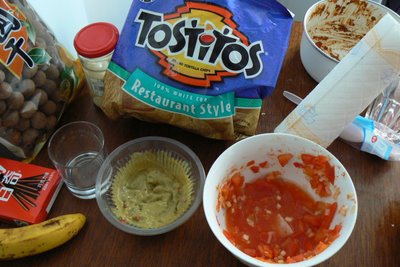


If potato chips are to be found on every city block of Shanghai, corn chips are a weird foreigner-only thing that you pay the exorbitant foreigner-only price for. $6 or so for this bag, although I also saw cheaper ones. I was strangely excited about this, considering I've never made salsa before - chopping up the tomatoes, onions, and so forth. I ended up thinking it was very delicious but it didn't go over well at all - people had one bite, and pronounced it weird. Raw vegetables are kind of a pariah, maybe having to do with a suspicion of the hygenic standards of Chinese produce. One person liked it, the two of us scarfed most of it down.

The pseudo-guacamole was canned, a sweet green paste manufactured in Scotland. Really disgusting, I don't know why I didn't toss it. I wanted to make real guacamole, but even the ugly looking avacados at Carrefour were selling for $3 apiece!

Pickled Onions with Chinese Vinegar
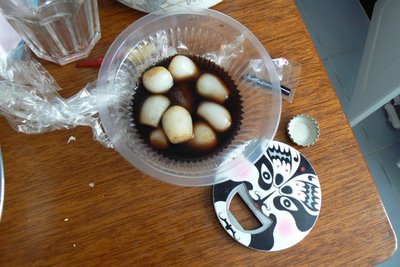


Pickled Onions are kind of a local specialty, although they're very bland to my tastes. I bought a jar and added some Chinese style vinegar - it's brown and flavorful, not having been distilled like American white vinegar. The results are seriously delicious, and even if pickled onions are kind of an odd snack, I'd recommend anyone to try this. I thought this would go over well, being kind of local and all, but nobody even touched it!

Brie Cheese


I have fond memories of a Japanese friend who would go crazy with disgust at just the sight of cheese. I don't like cheese so much, but I went to a French-branded grocery store and saw some cheap French-branded cheese for $2, and took the plunge - mostly just curious if it would inspire the same reaction. A few people tried it, just once. They didn't care for it, but in all honesty it wasn't all that great. I'll have to re-attempt this experiment in the future, with a higher grade of cheese.

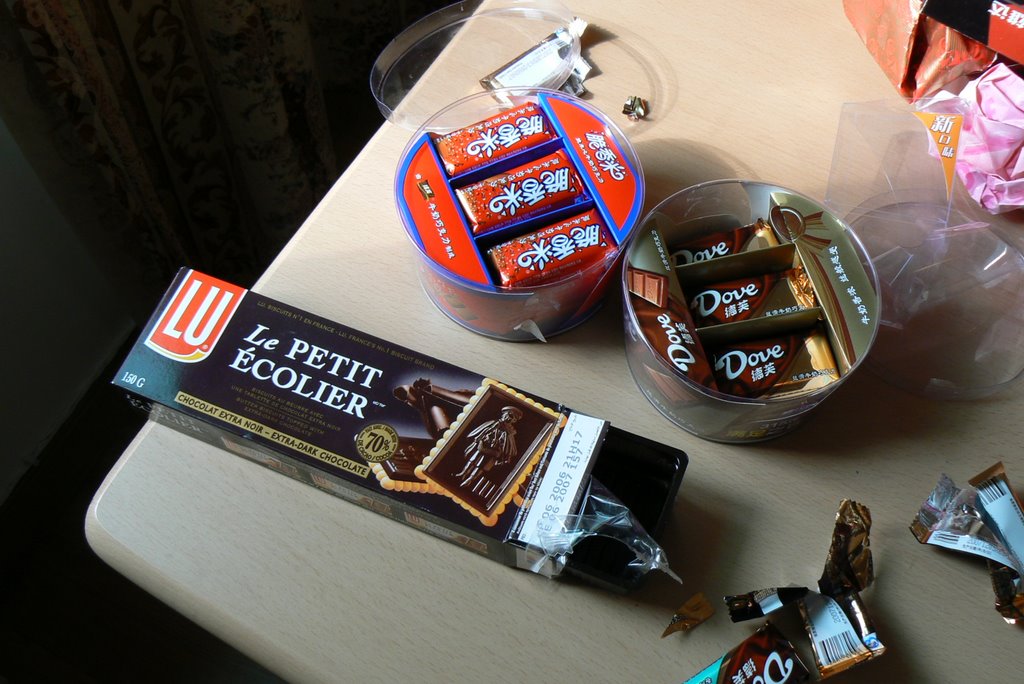
Chocolate
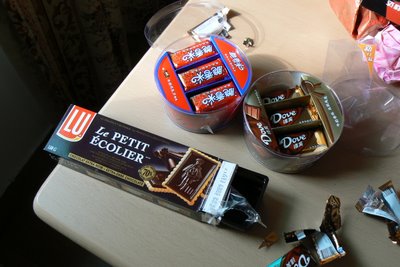


A lot of people brought over chocolate, this is just part of the take. We didn't even open most of it, and I ended up with enough Dove bars to make up for spending Halloween on a plane to Bombay.

Fruit and Kettle Corn
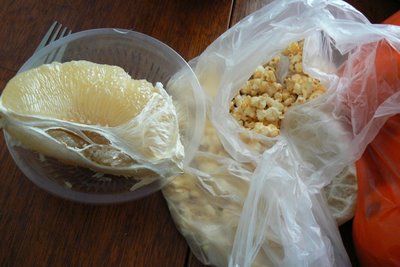


If you've been paying attention, you see my snacks didn't go over so well, people tried a little bit and then gorged in on fruit and popcorn. A friend bought the popcorn off the street, I had never had it before, although I see people making it all the time. It's higher cooked and heavily sweeted, like the kettle-corn Hawaiian style popcorn. Anyway that's all well and good, but at $6 for a bag of tortilla chips, I was a little nonplussed that people were hovering around sweetened popcorn, I can't deny. Oh, and the citrus fruit shown is one of the examples of the dozens of variations on citrus fruits that I had never even seen in the US, but are commonly available all around Shanghai.

Anyway, on to the main meal:

Kalua Pig


Kalua Pig is a tender pork flavored with salt, shoyu, and copious amounts of liquid smoke. It's supposed to be made in an oven or even an underground pit, but I don't have either in my apartment. Actually I was pretty impressed with the results from stovetop cooking. It's undeniably simple, but the flavors are strong, the extremely soft and juicy texture is unique, the liquid smoke flavoring was something new to all the guests, and in general this recieved very favorable comments. And no that isn't my picture above, I didn't make one-tenth that much!

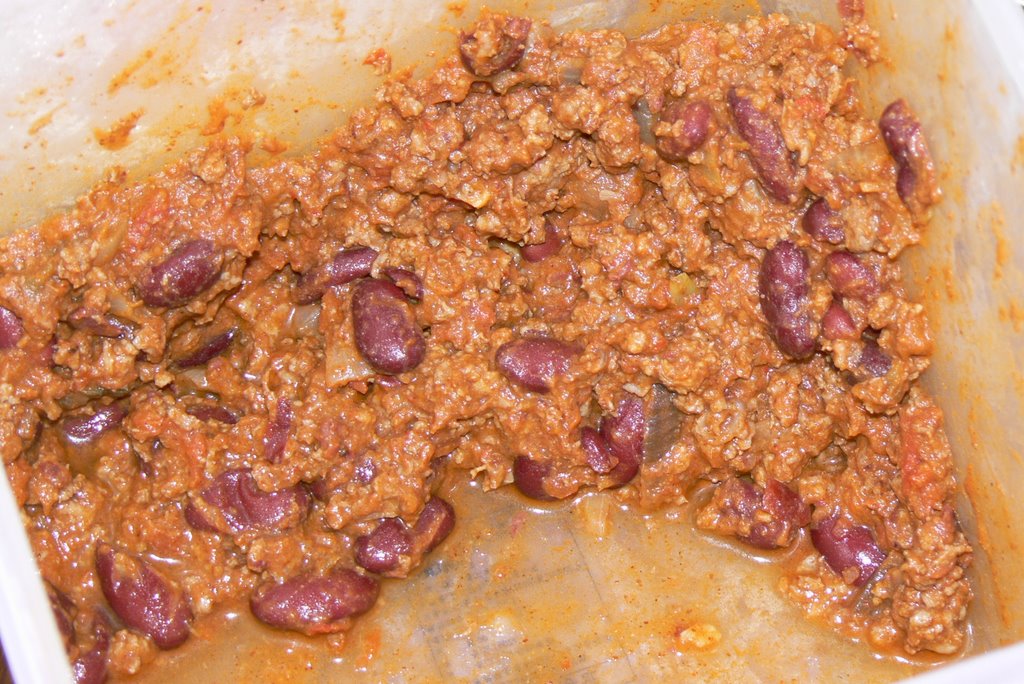
Chili on Rice
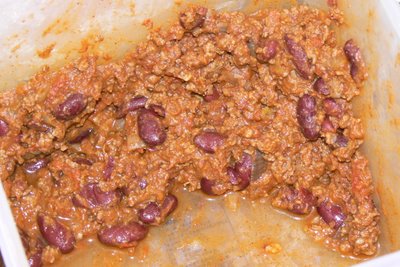


The central meal has no place at Christmas: Chili on Rice. For me it's an everyday food and not so special. Still, I had a lot of fun preparing the dish, randomly adding things that were lying around my kitchen until I was happy with the taste, including lime and tequila, lots of garlic, and every hot sauce I ran across - I like things on the spicy side, and most of my guests were born in the Szechuan area, so no problem there! Nobody else there had had it before, or anything like it, and everybody really dug the strong flavors and the complexity of the final taste. I definitely made some converts to the cause - unfortunately the only restaurant chili I've tried in Shanghai has been seriously boring and over-priced, which is about standard for Shanghai's expat-oriented restaurants.

Hawaiian Style Macaroni Salad
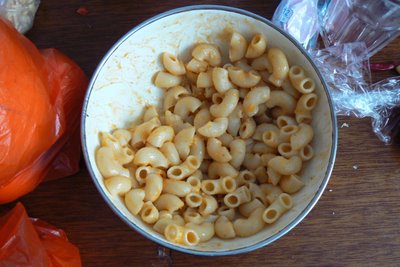


Actually I toned down on the mayonnaise and added some self-imported Huy Fong Sriracha Sauce to this one, I knew the genuine style wouldn't go over that well and maybe I pushed the boundaries of authenticity. Still this wasn't very popular, even if people ate it. "Too bland" was the universal comment. In a formal plate lunch the blandness of the macaroni salad acts as a counterpoint to the central dish, but here I admit it was kind of an odd duck. I also had some vegetables. Not having enough stovetops or time to do anything interesting, they were just there out of a general belief that one should eat vegetables.

Cocktails
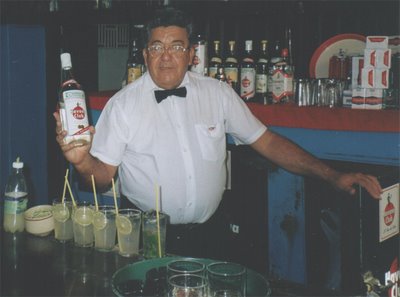


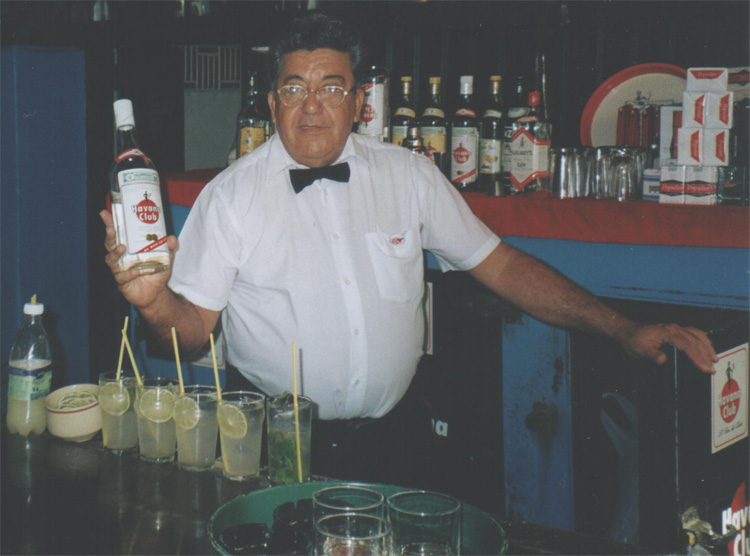
As a crazy cocktail enthusiast who doesn't know anybody here who likes to drink cocktails, I was kind've trying to push these on people, also making the sweeter drinks that the amateurs go for. Results were poor. Drinking anything other than a beer or two at a casual social dinner is out-of-the-place for the crowd. Some cocktails were had, but people found them too strong, and watered them down to the point of oblivion. One person got pretty into a Rum drink (Cuban Rum, the same brand as the weird picture above! But that's a topic for later), well anyway that's something. A Sloe Gin Fizz, a Whiskey Sour, and a Margarita, each made with fresh juice and top-shelf ingredients, all recieved low marks.

Anyway if the summary lists more negatives than positives, it was a fun night with a cool group of friends, and the central food was extremely popular, keeping my strange dream of opening a Shanghai Plate Lunch Stand alive! All in all it was a great Christmas Eve, even if I didn't spend it con mi familia. Christmas was just another day at work, and studying Chinese...anyway Merry XMas to all friends and family who are reading this!

Tuesday, October 03, 2006

Pulled Noodles

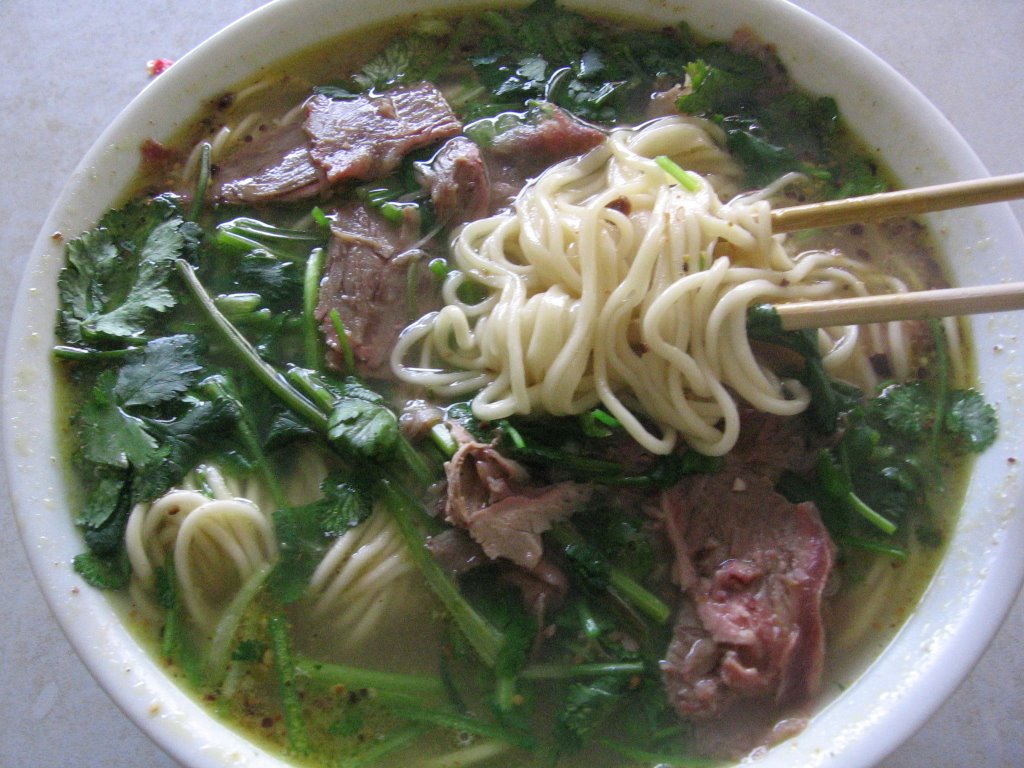
A quick update on a favorite Shanghai food: pulled noodles!


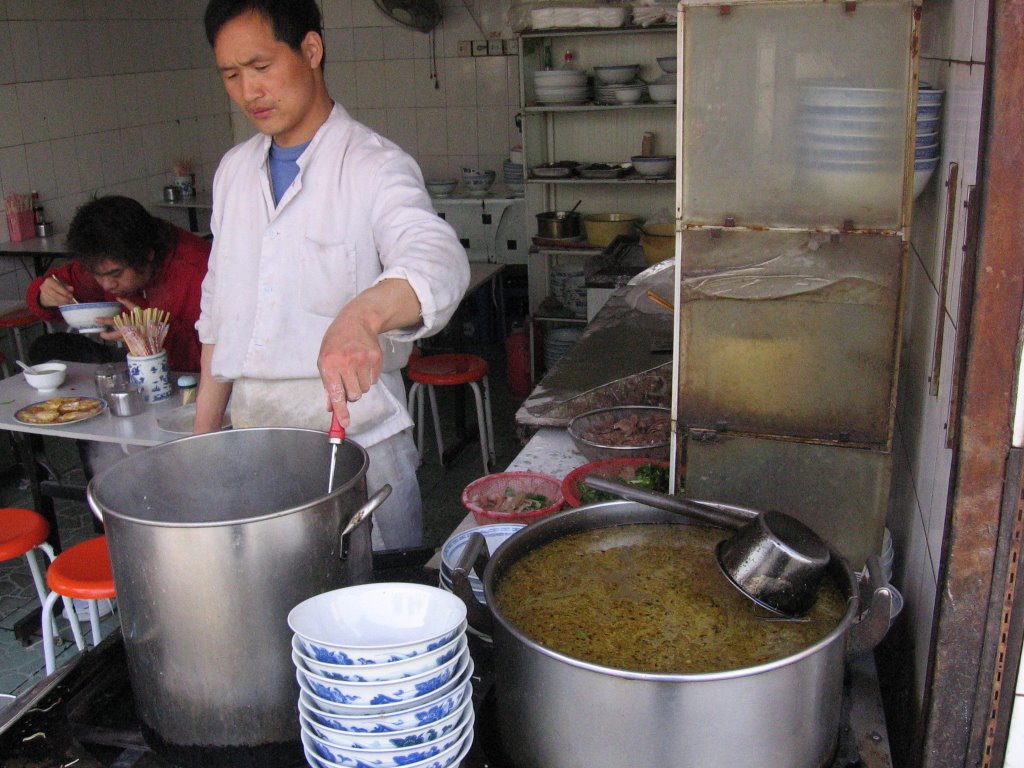
Pulled noodle stands are located all around Shanghai, offering a bowl of noodles (among other less popular dishes) for half a dollar. I'm not the biggest fan of noodles, and generally I think noodles in Shanghai leave a little to be desired. Pulled noodles are the exception. Even if they're nothing amazing, they're dependably delicious. There's a rule, one that I've confirmed with a number of people: the more dirty or hole-in-the-wall the restaurant, the better it is. Another good sign is if taxis are parked outside, with cab drivers rushing in for a quick bite.


It's interesting how the noodles are made: a rectangle of dough is stretched to a full length, then folded over, and re-stretched, with flour added to keep these folds from re-joining. Eventually it forms one really long noodle strand. By the end it gets wild, with the noodles being swung around and even slapped against a board! I'm still trying to get a good video of that, but maybe it's a high-impact version of those pizza chefs who throw pizza dough around. Finally, the long noodle is boiled in a broth, with shavings of the beef added.
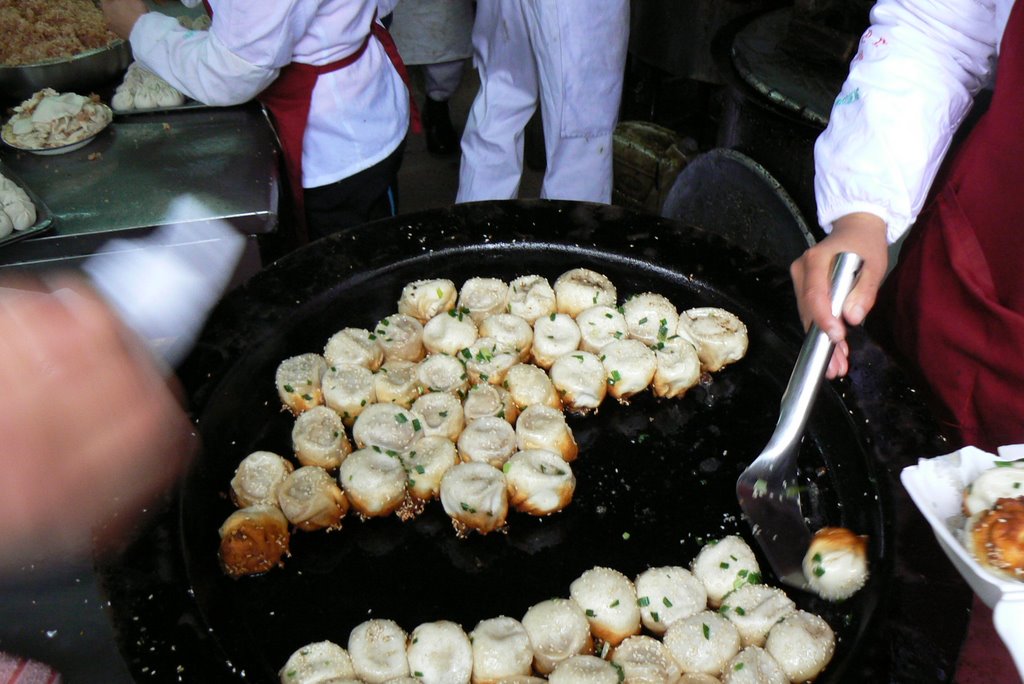


Additionally, here is a video uploaded by reader Ka, many thanks:


Most of the noodle stands are operated by Muslims, often they seem to be families, and are wearing recognizably Muslim clothing. For obvious reasons, these restaurants won't serve pork, China's most common meat - it's mostly lamb and beef. The signs will often have a picture of a Mosque on them, and references to Lanzhou, a city that served as the Eastern end of the Silk Road, and I suppose is the mythical source of pulled noodles with beef.