Showing posts with label Neighborhoods. Show all posts

Wednesday, April 01, 2009

East of the Old West Gate

If the title of this update sounds poetic, or perhaps the name of a Kung-Fu movie, it's actually just a description of the area – the West Gate of the old city walls was torn down long ago (along with the walls, for the matter), but the name is retained, and Old West Gate Station is a subway station of line number 8, two stations south of People's Square.

I happened across the station while visiting the very touristy, very corny Dongtai Lu, and knew I had to be back! The station is on the Western edge of my favorite part of Shanghai's old town – the area of the city that existed when Shanghai was just a small walled fishing village, and foreigners hadn't yet converted it into a large port city.

Actually, most of the traces of the truly old are no longer around, what remains is generally lower-quality housing from the early twentieth century. Still, the houses have a certain beauty to them:


These traditional houses don't have much privacy to them, and in a way I feel bad walking through and taking pictures of an area that is somewhere between a public street and private home. It's still a fascinating voyeurism of people going about their lives in a style unique to Shanghai, even when it's just normal everyday kind of things, like this outdoor kitchen, with a faucet in the background.


And although of course I'm not secretly peeping into people's bedrooms, a lot of the houses have doors opening directly onto the street, I'm reminded of when I walked through my college dorms:


It's also interesting, many of the streets, particularly directly north of Fuxing Road, are thin and narrow and dart every which way, very strange!


With these smaller areas, it's mostly private homes, although there are a number of smaller stores, generally selling snack foods, cigarettes, and very basic cooking items:


And there's a lot of commerce actually on the street: fruits, vegetables, maybe a simple bowl of noodles, cloths, that sort of thing.


And I don't want to forget, people getting a haircut, out in public!


There's a lot of wooden birdcages hanging from second story balconies, in addition some people keep pigeons:


It's just a fun area to look around, and now that the subway goes right near to it, it's an easy activity for an idle afternoon. As the title says, it's East of the Old West Gate Station, just a couple minute's walk. Take the #1 exit and head east, walking past Qinglian Lu - there's currently some construction going on. The southern border to this area would be Fuxing Lu, and the eastern border would be the large ugly apartment buildings alongside Henan Lu, which jarringly enough are decorated with a very large amounts of pseudo-Grecian statues. A few blocks past this road, and a little to the north, is Yuyuan Gardens and the related tourist stalls.

There's no real northern border – there's pretty much interesting buildings all the way up to Hongkou. However, the smaller alleys pictured here are concentrated in the area just a few blocks north of Fuxing Lu, the streets get wider and more commercial as one heads north – maybe the underwhelming Taoist temple alongside Renmin Lu can be considered the northern bordern to all of this.

Monday, February 09, 2009

Yuyuan Night Festival

Chinese New Year happened recently, it's the first day of Spring according to China's incredibly confusing, traditional Lunar-based calendar. Like the Western New Year, it's marked from the first day of the first month, however the actual holiday lasts for a week (officially), and often two weeks (with private vacation time) – more or less corresponding from the New Moon to the Full Moon, two weeks later.

To celebrate all of this, the shopping center surrounding Yuyuan Gardens, which is kind of Shanghai's equivalent to Pier 39, puts on a big display of lights. I don't have much more to say about this, so mostly this update will just be some pictures I've taken – some of the pictures were taken at last year's Year of the Rat celebration, some were taken at this year's Year of the Cow celebration, but really the two celebrations were pretty much the same.


The alleyways of the corny tourist shopping center were covered with lights, in a red paper covering that all looks stereotypically Chinese, there were rows after rows of them:


And there were sporadic parades through the grounds, with people dressed as traditional Chinese gods, or more commonly as silly Cow mascots. It was hard to get a picture of this, here's as good as I could get:


Even though the grounds are fenced up with an admission fee of thirty kuai (about $4.50), the place is still open for business, although business at most places, surprisingly enough, doesn't seem especially fast. I'll try to talk about one of these food stalls, Nanxiang Xiaolongbao, in an upcoming blog. Here's a small snack stall:


As stated before, the whole place was covered with lights. The nexus was the famous nine-turn bridge, right outside the actual entrance to Yuyuan Gardens. It was too crowded to seriously contemplate entering, but here's a quick picture:


Police were out in force, probably to keep an eye out for pick-pockets. They also did a lackadaisical job of driving away vendors selling things on the street - mostly the vendors sold silly light-up cow horns. When they saw the police, they would run the other direction. The police occasionally yelled at them, but didn't give chase. They could also be seen admiring the lights themselves:


I'm writing this all in the past tense, but the real last day of Chinese New Year's is tonight, so let me take the opportunity to wish all my gentle readers a happy Year of the Cow!

Sunday, March 30, 2008

Qibaozhen Old Street

Hongqiao is a district towards the outskirts of Shanghai, and one that isn't terribly convenient to get to. That also serves as a pretty accurate description of Qibaozhen, except Qibaozhen is even farther than that! Going to Qibaozhen district feels like visiting the suburbs, even though on a map it isn't all that far away. It's a testament to how convoluted it can be getting around in Shanghai. It might get a little better soon, with a subway line coming in sometime this year.

There's two reasons to go to Qibaozhen, and one is that you live there. The other is Qibaozhen Old Street. I had heard about it as a "Water Town" within Shanghai. "Water Towns" are a Shanghai-area tourist attraction, nearby to Shanghai there's a lot of small cities, or districts of cities, which are built around small streams,and even when I lived in the somewhat down-scale Caobao Lu Subway Area, I'd cross a few small bridges on my way home. Some of these districts have kept the old buildings and become tourist attractions - Zhujiajiao is a prime example. Qibaozhen seemed like an extension of the same, only I could grab a taxi there instead of having to bother with a train or tourist bus. But I'll admit I didn't think much of Qibaozhen's tourist center.

The district is named after an old temple. The grounds of the temple are very large, and I did see a large number of monks chanting, which is kind of interesting. It has a very long history, but the grounds all looked cheaply and recently constructed, and really the most interesting part was this silly statue, with a bunch of baby Buddhas playing on a larger Maitreya Bodhisattva.


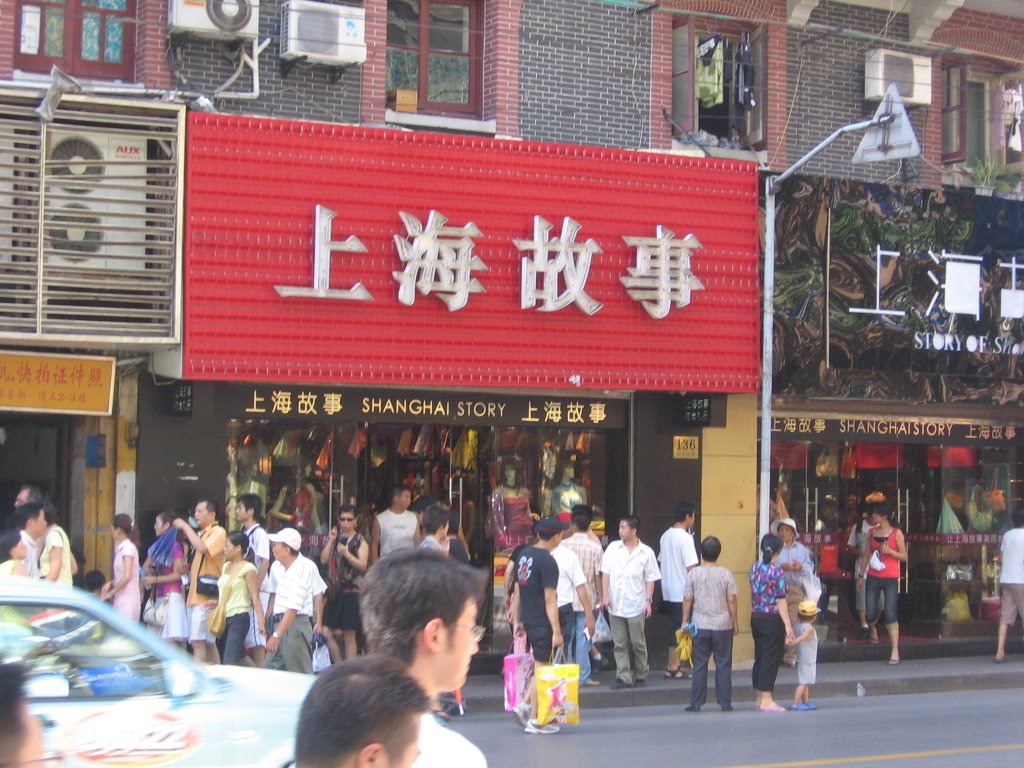
The surrounding neighborhood is a bunch of corny tourist shops, just about the same stuff it's possible to see surrounding the otherwise excellent Yuyuan Garden, or a touristy Chinatown in the US for that matter. They're crowded and they go on and on, for a surprisingly long time. They were interspersed with snack shops with some unusual specialties that looked decent, unfortunately I had eaten my fill before I go there so I didn't try them. Kind of strangely, a very large number of nearby buildings had been torn down. I can only assume that the old buildings were being torn down to make way for tourist-oriented shops. Since it advertises itself as an "Old Street" and the entire point is to check out an old-time district, it makes no sense. That's just how Communist Planning Committees roll!


As I walked past the shops I assumed there would be a big payoff, and I'd eventually come to some really interesting site. It's like waiting in a long line at Disney, just on the assumption that there has to be something good at the end of the line. Well this is it:


OK that probably looks impressive, and it would probably be fun to have a cup of tea alongside the water. But really there's only a couple blocks of this, and after all the shops it felt kind of anti-climactic. Maybe once the subway come in, right around the corner, it'll be worth it for commuters popping by to go out and have a look. As it is, it's not worth the hassle.


And for those keeping score, this blog (and the rest of blogspot) is once again being censored within China.

Thursday, November 29, 2007

A Street Vegetable Market

Vegetable markets are very interesting, and yes my standards of excitement have been lowered by living in Shanghai for more than two years! But this market is more than that: who wouldn't be interested in markets selling live ducks, chickens, and pigeons! If nothing else, being in Asia and in close contact with poultry violates several US Government recommendations for citizens abroad - I like to live life on the edge.


The particularly keen-minded of my readers may note that ducks, chickens, and pigeons are not actually vegetables. However I still call it a vegetable market because it was about 95% vegetables for sale, aside from a couple places with poultry and one with the local crab (it's basically all shell). Most places just had the basic vegetables, however some of the vegetables were rather exotic, at least for the time of the year.


Most of the vendors were selling right off the street, actually "on" the street would be more accurate. Often the vegetables were in bags, although sometimes they were just laying on the ground. This goes a long way in explaining the Shanghai taboo against salads and raw vegetables - you'd want to wash the vegetables thoroughly and then cook them thoroughly, before eating them.


The vegetables sellers are side to side with each other, the streets are narrow and winding, second stories look like they're about to tip over the first story, and laundry is hanging everywhere. It gives the area a very cool, somewhat hectic feel to it. This is made even more so by the area it's in, the neighborhood is a very scenic collection of old style brick houses and winding alleys - the picture on the right is a of a nearby brick house of about the same era and style. For me it's a good opportunity to look around such a neighborhood without feeling like I'm trespassing private property! This picture is near the entrance where there's a little more room to maneuver. It all gets a lot tighter, farther into the market.


This vegetable market is behind Zhongshan Park south of Suzhou River, a little off Wanhangdu Lu, and I'm guessing only operates on Weekends.

Tuesday, July 31, 2007

Old Shanghai

Shanghai isn't purely a colonial city - it's existed as a smallish city for thousands of years. The area of the old city remains interesting - it was modernized during the colonial era, but has mostly avoided massive re-development since then. So the area remains a look back at what much of Shanghai looked like in the first half of the century. Even though it's in a central area of Shanghai, it's very easy to ignore - there's no subway there, there's not much in the way of major streets, and there's not many obvious attractions. An exception is the very impressive Yuyuan Gardens. There's a bunch of really corny shops nearby, they sell Chinese chotchkies in a collection of Disney-cized buildings. The picture in the upper right was taken in the line to Nanxiang Xiaolongbao, a famous snack. They're OK, if not worth the hour-long line.

It's easy to ignore the nearby neighborhood. This area is mostly composed of old row houses and two-story buildings called shikumen. They're a collection of very small apartments, with communal areas, something like "Kung Fu Hustle." They're made from brick, generally populated by old people, and they invariably have laundry hanging out front.


It's hard to imagine living in a place like this. There's no privacy, I wonder if the people there come to view their neighbors as always in each other's business, or as some kind of extended family.


Not having individual water is an obvious problem. There's faucets in the courtyards, so walking at night you can see men in swimsuits bathing themselves in the street, I think most people use a sponge bath. Disgustingly enough, the apartments are forced to use chamberpots, walking around it's pretty common to see people carrying their chamber pots around, there's special areas to dispose of that. There's a chamberpot in the bottom of this picture:


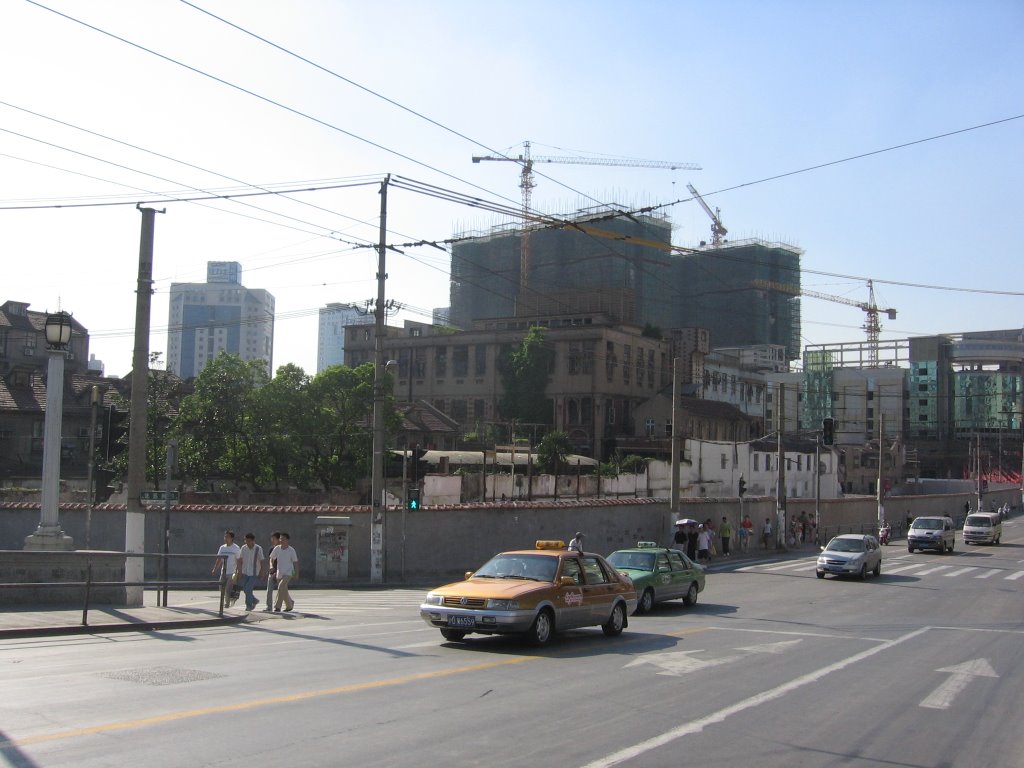
Most of the streets in the area are narrow, and not very long. Walking around gets repetitive, it's street after street of these small buildings. There's a lot of bikes on the road, but there's very few cars, and there's not any buses.


There's a lot of small shops scattered about, here's a bunch of steel beams to use for small-scale construction projects:


But more common is this, just about every single block will have a fruit & vegetable market or two. There's a bored employee up front, reading a book, which is a definite requirement for these sorts of places.


I'm a big fan of photoethnographer Karen Nakamura, who has a few excellent shots of the same area on her blog. I'll also have a little more to say about these buildings in the next couple days.

Monday, September 25, 2006

North of the Bund

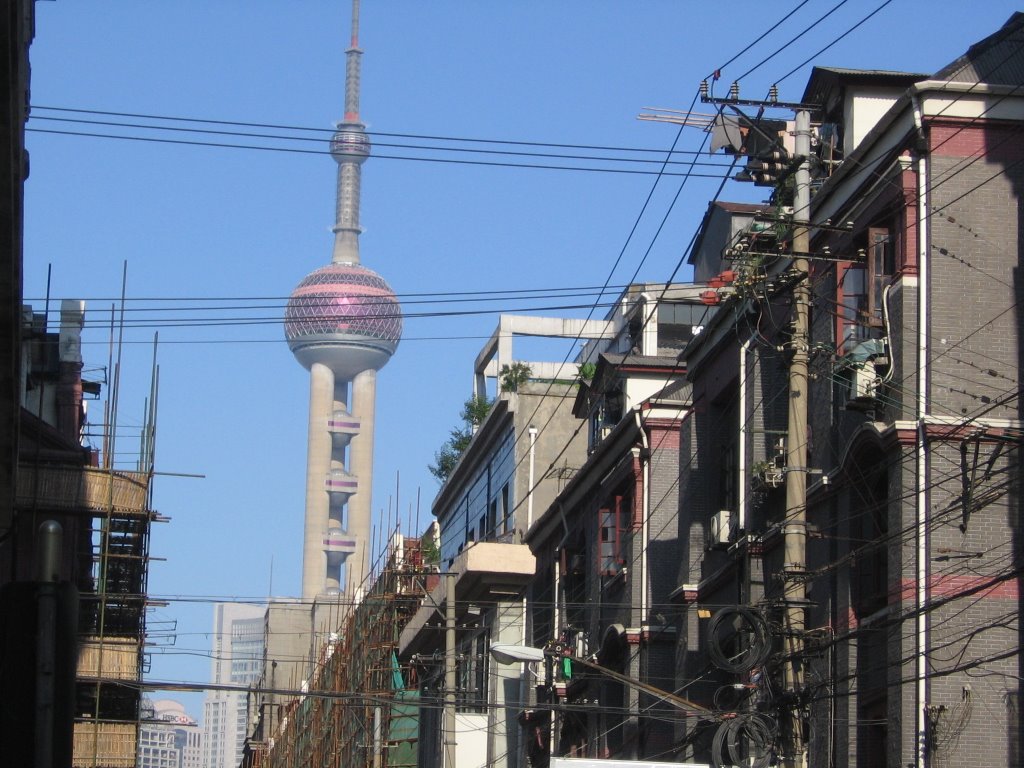
The side streets north of the Bund are my favorite place to wander in Shanghai. There's nothing grand about them: if anything, the area's most striking characteristic is how low-key it feels in comparison to the nearby shopping street of Nanjing Lu, or Pudong just across the river. You can almost forget where you are, and then suddenly you catch a view of, say, Lujiazui's crazy-ass TV tower.


The Bund, and Nanjing Lu, are Shanghai's most-visited areas, with ritzy restaurants, nice hotels, and chic clothing stores. The Bund has sweeping views of old Shanghai on one side, and Pudong's very new, very tall, very weird buildings on the other - including what's going to be the world's tallest.

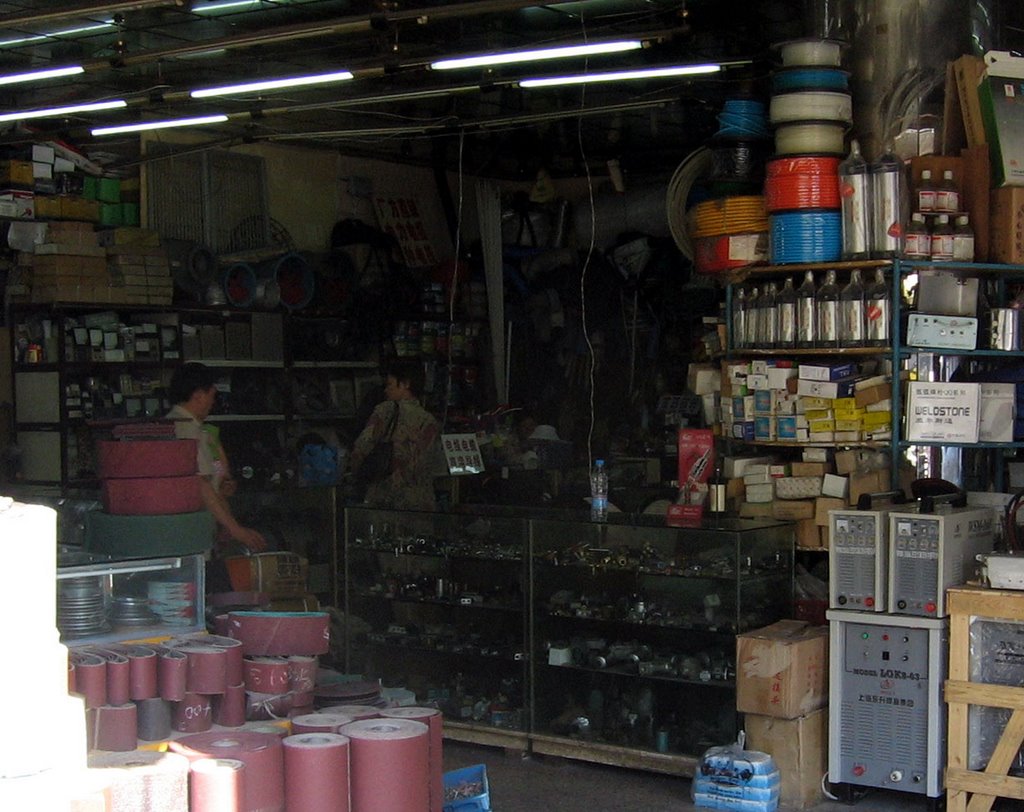
On the other hand, North of the Bund is defined by the machine shops along Beijing Lu:


It has a lot of older brick buildings, generally four or five stories tall, with shops on the first floor. I've never been inside, but from the outside they look charming:


The area also has an unpretentious feel, something like the distant area of Shanghai I used to live in, but a lot more crowded and fun, without all the Soviet-style buildings. It has a lot of street food and hole-in-the-wall restaurants, I think the restaurants and snacks in this area are pretty much decent, plentiful, and cheap. Here are some Shengjian, frying in a pan.


While there's a subway on Nanjing Lu, it gets to be a bit of a walk for a lot of the area, and the streets are so small that the bus isn't very fast. Bicycles are the way to go, the area is extremely crowded with them:


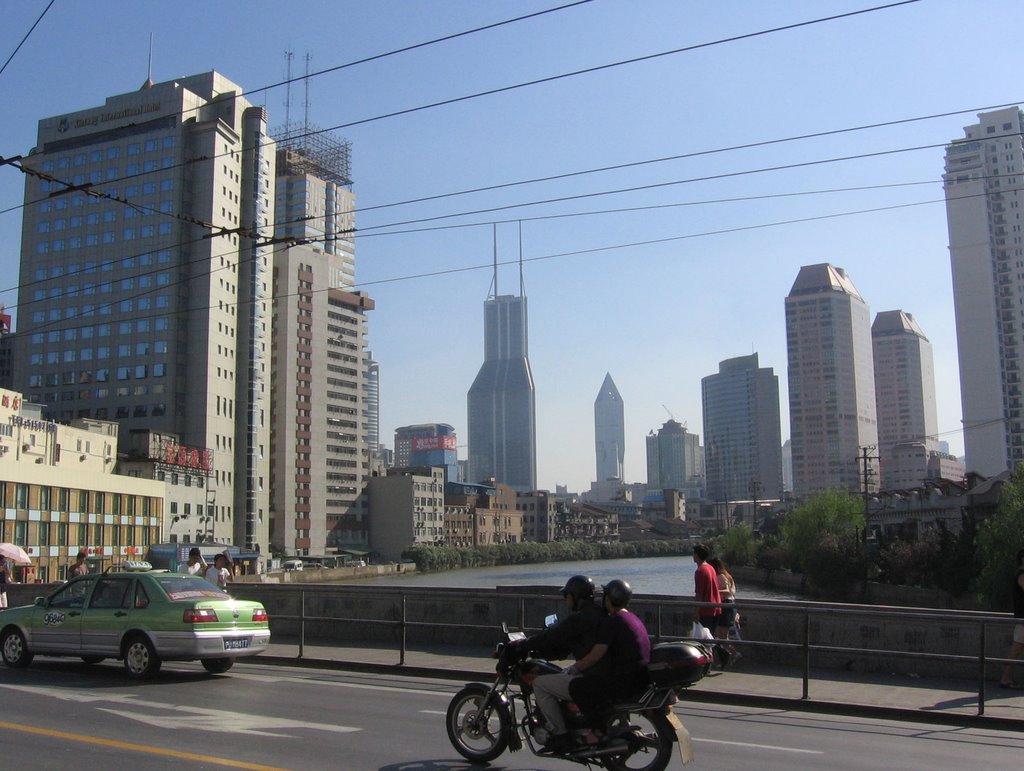
The area contains the most scenic part of the Suzhou River, not just the large downtown buildings in the background, but older ornate buildings such as the central post office and the Russian Embassy, built to take advantage of the view:


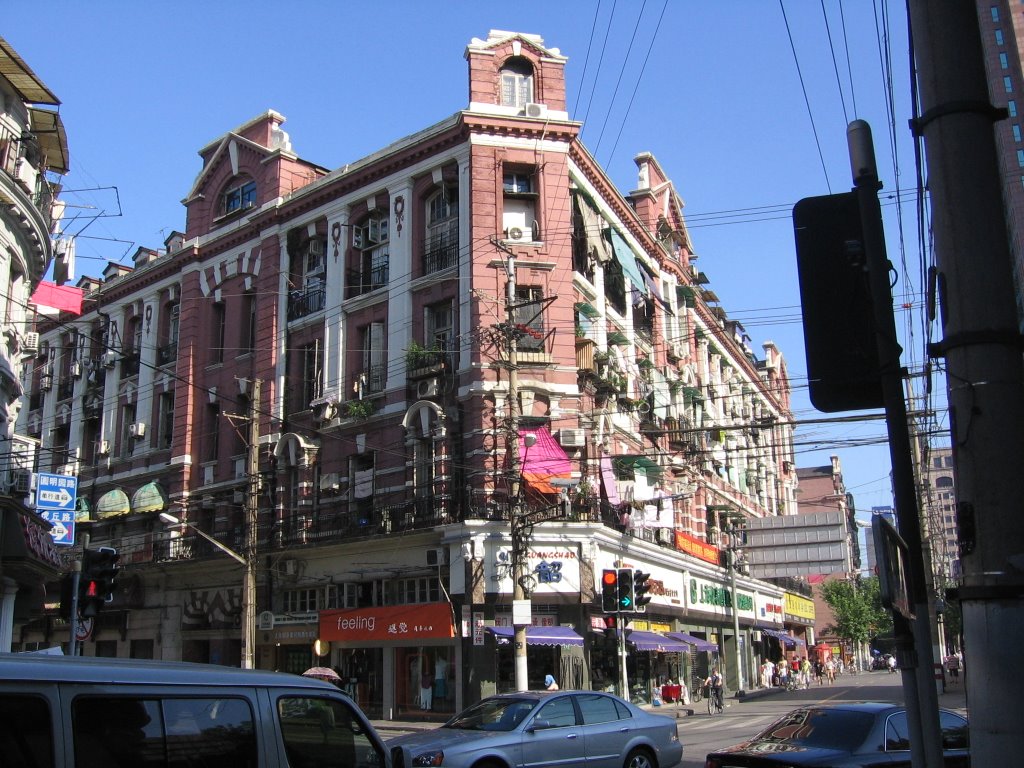
I'm no expert on the area's history, but I believe the brick buildings just north of the Bund are of a generally higher quality due to their proximity to Nanjing Dong Lu, and also because some of the cheaper brick buildings were knocked down to put in modern buildings. The area has a more permanent feel - unlike a lot of Shanghai there's not so many new buildings coming up, and it doesn't feel like many new buildings will. But as you get more North, the area feels more in flux. There's a lot of decrepit buildings standing right next to top-quality apartment complexes, in Shanghai you have to believe that situation won't last very long.


Especially right near the Suzhou River, you can see a lot of buildings getting knocked down, and huge apartment complexes coming in to replace them. In all honesty I would love to live in an apartment in the area, and one of these new apartment building complexes would probably be the only way - snagging an apartment in one of those old brick buildings is impossible. There's the obvious paradox that the character of the neighborhood is being sacrificed to make way for these high-rises.


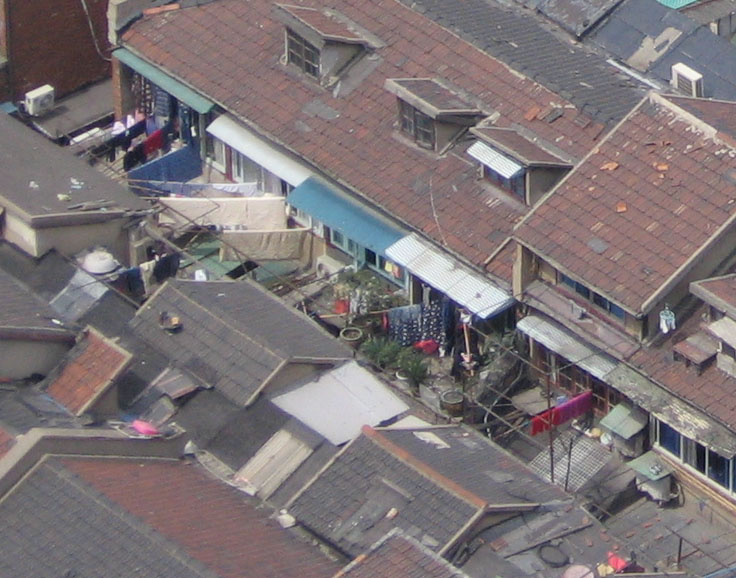
I went to an apartment in a high-rise located just a little to the east, and took some pictures looking down, stretching on across central Shanghai and Southern Hongkou. It's funny, the area looks almost orderly when viewed from above.


I wish I had brought a better camera for these pictures - anyway, zooming down on the houses, you can see drying laundry and a miniature potted garden. It's about on course for any lanai in Shanghai.