Showing posts with label Daily Life. Show all posts

Saturday, December 27, 2008

Child Swapping

Going to People's Square on the weekends is a daunting prospect. There, they run “English Corners,” which seeks to match up Chinese people who would like to learn English but don't want to pay, to foreigners who would like to teach some English but don't want to be payed. Since there are a great many more people in the first category than the second, these corners will start aggressively chatting up foreigners walking past.

I don't go to People's Square on the weekends all that often, even if this area is nearish to the excellent restaurants on Huanghe Lu, Lao Kele and Jia Jia Tang Bao. Last time I did, I was surprised at how greatly the English corner had expanded. There were hundreds or perhaps even thousands of people in their older middle age, hanging around and talking. I noticed a number of them were holding up signs. I had a closer look:


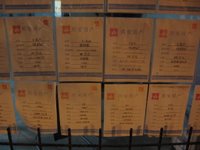
They actually aren't part of the English corner. The area has been overrun by parents who converge on the weekends to match-make for their children, it has the feel of a salesman convention. There's signs everywhere, often listing a short resume including their name, phone number, sometimes their pictures, their age, their height, their interests, and their schooling. There's no standard form, so different parents put up whatever would make the kids look attractive. I don't think I should put the information up on the web, so I erased some of the information in Photoshop, and then blurred it all, and I'll only include a couple of pictures with this update. Still, people looking for a Chinese boyfriend or girlfriend should definitely send their mother over!

Wednesday, December 24, 2008

Hongkou Street Fair

Hongkou Stadium is in Northern Shanghai, it's the place to catch soccer games and perhaps the occasional Jay Chou concert. Despite having a few foreign-language schools in the area, it's not the normal place for foreigners to be, although with the new subway line #8, it's only a 4 station commute to the centrally-located People's Square. I think the area has a lot of life, and a fun example is the street fairs located in the stadium's surroundings.

The time of these street fairs is irregular: they happen on a lot of summer weekends (and I have to admit that's when these photographs were taken), but they also happen on holidays, or occasionally for no apparent reason. While there's probably some schedule somewhere, I've asked a couple locals and they have no idea, so it seems o be a very mysterious process. Anyway, despite the lack of advance notice, these fairs can get busy with people. One of the attractions is makeshift alleyways of tents, each offering various street foods – in the foreground here is Japanese takoyaki:


And unlike with most street food in Shanghai, there's tables set up, for people to eat at:


Here's another picture of the foods. I don't want to give the impression the stalls are all Japanese style, but here it's a mish-mash of mochi-based sweets:


There's also a lot of clothes being sold, it's always low-end, everyday sort of clothes, and they never have anything nearly my size – I recently saw 6'0" listed at XXL! So I don't have exciting pictures of that. Here's a picture of some of the knick-knacks being sold. They often have an ethnic focus to their products, which I guess goes along with being operated by the ethnicity in question – I believe this would be Yi, or Dai?


And more rarely, there's things like massages, hair stylists, and product demonstrations, often operating with headset-type mics hooked up to amplifiers, and generally being annoying.

Monday, January 28, 2008

Walking in a Winter Wonderland


The picture above says it all - it's snowing in Shanghai! My god! I realize it's nothing compared to living in the American Midwest or something horrible like that. It's actually a little hard to even see the snow here, without blowing up the picture. But I've only seen it snow a handful of times in my life, and never to the point that it leaves anything on the ground.

There's not much remaining on the ground - on the street it just melts right away, so I have to search down parks to take pictures. In a few places there's dirty slush, it's difficult to walk on. Really it's pretty miserable - temperatures are already stuck somewhere around freezing, and for the past few days, when it hasn't been snowing, there's been rain or sleet. And it's supposed to stay that way for another week!

That brings it up against the start of the Chinese New Year's, when everybody jumps on a train and heads back to their hometown in the country. Right now trains are being delayed by the snow. If that situation doesn't improve by Chinese New Year's, wow, things are going to be ugly. Also, vegetable prices have spiked while availability has lowered - my friend estimates the prices are twice as high as normal, although I don't know if it's that much. Either way, it's coming on top of the already-existing Food Inflation.

In conclusion, I've decided that snow is kind of fun for fifteen minutes, after that it is a pain and we should get rid of it.

Update February 25th: It got much worse over the next week or two, here's a couple more pictures:


Tuesday, April 24, 2007

Buddha Box

A friend from America recently asked me to get him a Buddha Box. What a cool name, in Chinese it's called a prayer reading machine, and that's just what it is: a cheap plastic device that plays out one of several Buddist chants through an internal speaker or headphone jack. Here's a ten second video of the song one of them plays:


The Buddha boxes are for sale alongside Changde Lu, a little north of Beijing Lu, they cost from one to four dollars. There's a Buddhist Monastery there, although it's generally closed for visitors.


I remember there's also a lot of religious shops near the Jade Buddha Temple. There aren't these kind of shops right near Jing'an Si, though, maybe it just doesn't fit the image. Plastic Buddha icons take up most of the store, the Buddha Boxes are in a shelf on the right.


There's other stores nearby that have cooler Buddha Boxes. But I did like this other blue Buddha Box, mostly because it's cheap and about the size of a pager (remember those?).


It all sounds pretty inoffensive and maybe even interesting, until one realizes these walkman-like machines only have a few loops that are only about a minute long, or even a few seconds! To wit, the lady who lives upstairs from me used to just blast the music out. It was definitely annoying, but she would quit it after fifteen minutes or so, and I just laughed it off.

Then one fateful day she had been listening for a long time, and I was having a lingo teacher come over to my apartment. I went up to complain, it was an old lady, she only spoke Shanghai dialect - Shangainese is about as related to Mandarin as Spanish is to French. While I'm an incredibly kind person, I think the experience intimidated her a little, and I haven't heard her play the chanting since then. I feel kind of bad, it's probably not doing her karma any good.

Friday, February 02, 2007

Street Music, Part 1

I'm mostly going to let the videos do the talking in this update. Suffice it to say that Shanghai has a fair number of street musicians. Perhaps not as many as in San Francisco or New York, but they're common enough to see in areas that are crowded, but not too crowded. I guess the police keep them away from performing inside the People's Square Station, or the central shopping district of Nanjing Lu.

The following three videos were all taken in the tunnels leading to Jing'an Station. I'll start off with perhaps my favorite.


Pretty talented! Compare and contrast to the following fellow, who as far as I can tell isn't actually playing a song, just making loud noises. On the other hand his tone is OK and I wonder if he can actually play pretty well, and just makes these loud nonsese sounds due to having only several seconds to attract people's attentions as they walk past.


Here's a longer video of an erhu player whose talents lie somewhere between the first two. I've heard him play better, but I wasn't getting it on tape!


Most of these street musicians are blind. Perhaps it's an expected profession for the blind, and they don't recieve government assistance or have much infrastructure to help them. Another common thing to see is street musicians being led down the street by a partner, such as this example from near Beijing Lu. It usually looks like a husband and wife partnership, but I have no idea if that's really the case - I'll talk about it in a future update.


The large majority of the musicians are playing the erhu, a two-string violin-type instrument, traditionally with a snakeskin base. There's also the occasional college kid playing guitar, or other traditional instruments being played, such as the Souna (a sort of bugle), the Xiao (a kind of flute), or the Sheng. That last instrument is a really complicated mouth organ, as shown below, with a video taken near Zhongshan Park:


Oh, and a few notes. First off, the videos are hosted on tudou.com, a Chinese imitation of youtube.com. Please let me know if there's any problems viewing them, it's no bother to mirror or move the videos onto youtube.

Also, a lot of the videos, and some of the recent pictures, have been taken with my new Canon Ixus 850 (SD 800), an ultra-compact that I take with me everywhere I go! I wish it had manual controls, but I'm otherwised very pleased with the camera.

The tagging system is new, it should make navigating content a lot more manageable than posting several year's of content by month. I'd appreciate any recommendations on that.

Finally, about this update, it's an area that interests me greatly! I won't follow-up immediately, but expect some more posts on the subject over the next several months.

Thursday, September 14, 2006

Finding an Apartment

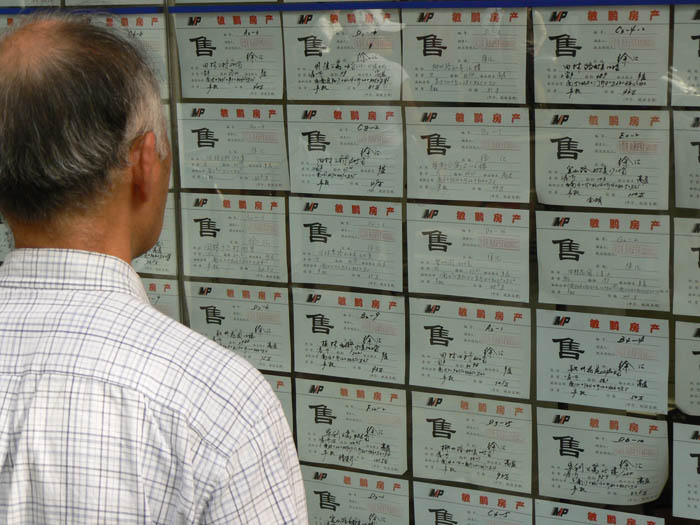
With my first apartment I moved in with somebody who had an extra room, they took care of all the details - when I moved out, I still didn't know what my landlord looked like! With my current apartment I wanted to live by myself, in a busy part of town. This involved some footwork. You can rent apartments off the Internet or a classified, like with the US, but the normal way to do it is through a real-estate office:
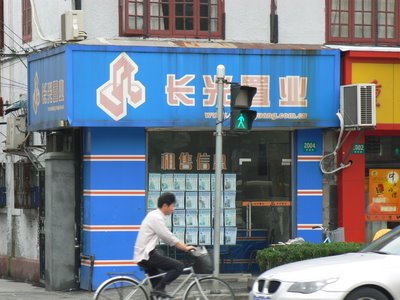


I just wandered around - first I found the neighborhood I liked, and then I wandered around until I found a real estate office. There's lots of them, all around, so if I wasn't happy with what they had to offer, I just went to another one.

Some of the offices look upscale, but a lot of them have the feel of back-alley black markets. They're not particularly clean, office furniture looks like it had been rescued from a dumpster, people sit around gabbing. Even now that I'm not in the market, sometimes I look at the signs they have posted in the window, or on A-frames, listing apartments to rent or buy.
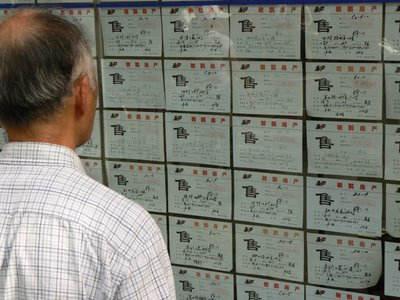


They make money from taking one third of the first month's rent. There's limited leeway to bargain - in my case, two different real estate agents has listed my apartment, so the person helping me was able to play the two off each other, and get a discount. And, the rental price of the apartment can also be bargained. Again, I sat back and let the person I was with take care of that. I'm out of my league, trying to bargain in China!

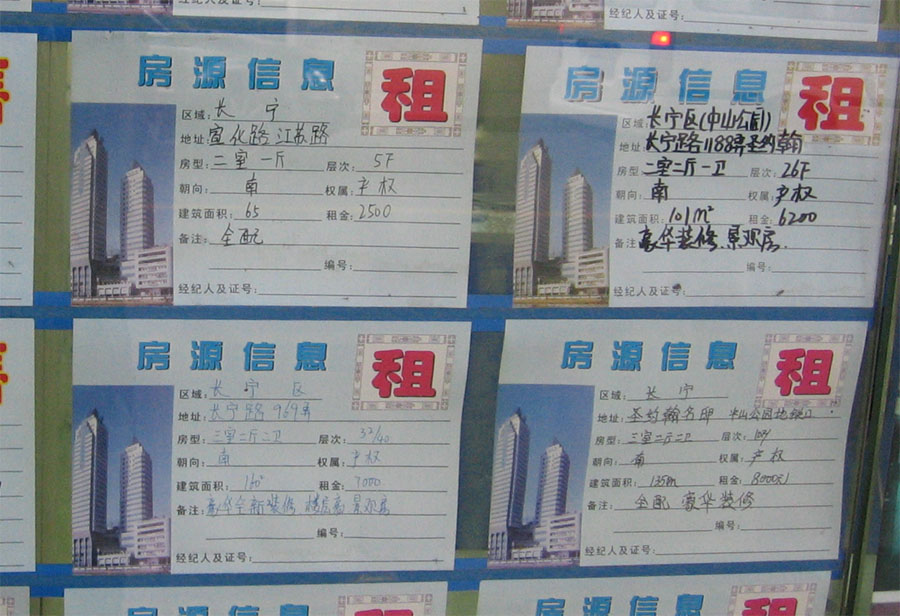
How are the apartment prices? Top business publications rate Shanghai as one of the most expensive cities to reside in. Living in a prestigious foreigner-owned apartment complex is going to cost at least as much as living in the SF Bay Area. The apartments listed below are cheaper. They probably house a lot of foreigners, but aren't quite in a prestigious part of town. They are listed by the RMB (eight RMB is about one US dollar) and by the square meter (one square meter is about eleven square feet). For example, the apartment on the bottom right is $1000/month, but is 1400 square feet.
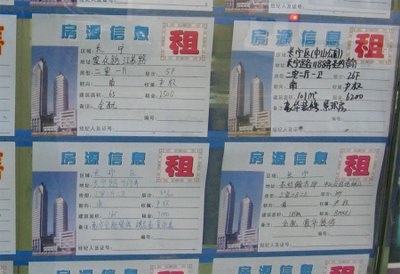


My furnished apartment is about a third of that, and I consider it very nice, near the subway, and in an upscale part of town, although it's a little small. On the other hand, most of the young and fairly well-to-do Chinese people I know rent apartments that are around $200 or $250 per month. They're every one saving up to buy a house. Owning a house is important in America, but to people I know in Shanghai, it's even more so - generally people won't get married until they own a house.

It's kind of a surprise, but while most of the real estate operators are independent, Century 21 has a small presence here. They mailed a brochure to my apartment so I might as well show it here:



The houses below range from $90,000 for a 500 square foot apartment, to $250,000 for a 1,300 square foot aparment. Both are in a nice and central part of town.
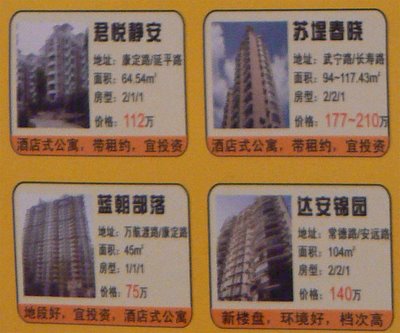


To be honest, at the premium to own rather than rent, I'm not sure it makes sense to buy an apartment, except as an investment. And I'd be suspicious of Chinese real estate as an investment - there's certainly good opportunities, but there's a significant chance that Shanghai real estate is in a bubble, and the government has shown a willingness to suddenly apply relevant laws on a whim - last month suddenly adding a capital gains tax, last year suddenly regulating mortgage rates, etc.
Just as with the US, real estate in Shanghai and a few other cities is drastically more expensive than living in the countryside. Chinese cities don't really have a suburbanization movement, and I consider that ideal as I really don't like suburbs. On a drive to the airport, you do catch the odd glimpse of foreigner suburb enclaves - I hear these rentals are massively expensive, and the buildings are in a thoroughly Western style, you could forget you're in China.

For many Chinese people, having the apartment be brand new is one of the most important factors. I don't think newer apartments are necessarily any better, although as a general rule, older apartment buildings tended to be built in a more utilitarian manner - for example, they may be missing elevators.

Friday, July 28, 2006

Reflections After One Year in Shanghai

I've been in China for more than a year now, unbelievable! It hardly makes me an expert opinion but I'll use it as an excuse to ramble on some about some observations:
- Chinese is difficult. I work on my lingo skills very hard and I thought after a year I would pretty much be talking it fluent. Instead my level is casual conversation, and I couldn't dream of understanding the newspaper.

- Food is boring. I eat out every single meal, the bland food has gotten so tiresome. When you do get a good meal it's a matter of luck - go to the same restaurant and order the same dish the next week, and it'll taste half different. It's not a question of meeting American tastes, I flat out think the Chinese food in Oakland's Chinatown was better. With the caveat that I would miss all the street foods and snacks.

I should mention that unless I'm meeting friends I eat entirely meals that sell for a dollar or less, or fast food when I'm jonesing for something non-Chinese. May sound stupid, but the more expensive restaurants aren't any better to my mind. Oh, and the non-Chinese style food in Shanghai is terrible and wildly over-priced, although sometimes I eat at this one Thai place that is OK.

- People are pretty chill. I don't think I've chatted with anybody who I didn't think was at least pleasant. I would definitely say that some of the people I've met are really cool and very friendly and a lot of fun to kick it with. On the other hand, meeting new people is difficult, the language barrier is no small part of that. And people here are unlikely to have a wide range of experiences and interests.

- Shanghai's night life is sorry. Despite Shanghai's reputation as a crazy decadent city, there is a serious lack of luxury money being spent. The music scene is incredibly small, for instance, and the best bands would be lucky to open a show in the US. The bars are very boring and entirely oriented towards foreigners - nothing wrong with foreigners obviously, but a larger range would be fun.

- The streets are something druggish. I don't get it. I realize on an intellectual level that they're busy, but in reality I just slough my way through without noticing. All the same I can't imagine going back to the empty sidewalks of the US. All the hustle and activity excites my dopamine receptors on some subliminal level.

- Shanghai is either a lie or a desperate gamble.
How can a city that is a majority wildly poor and doesn't seem to have a strong capitalist streak or a particular economic reason to exist also seem to work so smoothly, to be growing so quickly, and to have areas that are so obviously impressive? I'm not qualified to do more than observe and wonder.

Wednesday, March 22, 2006

Spray-On Ads

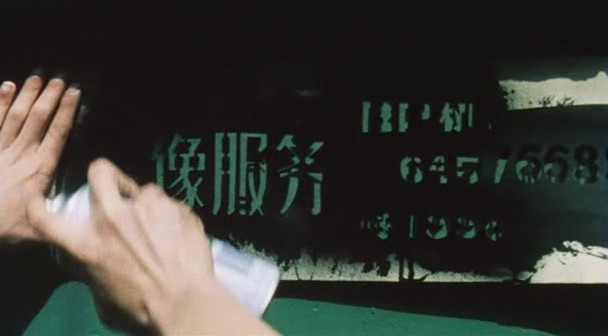
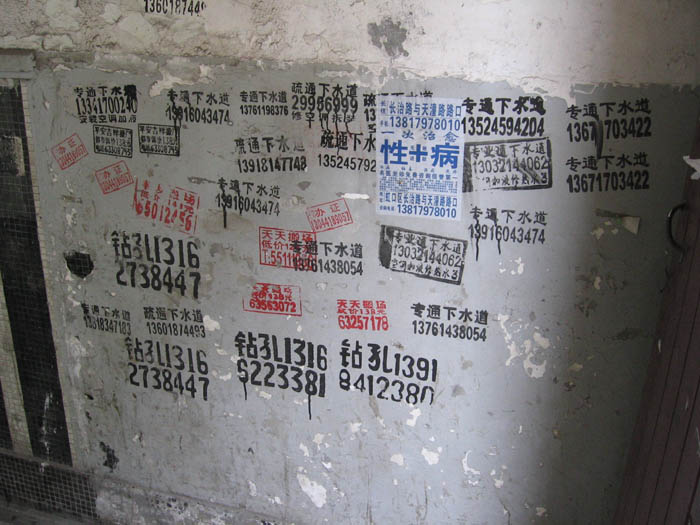
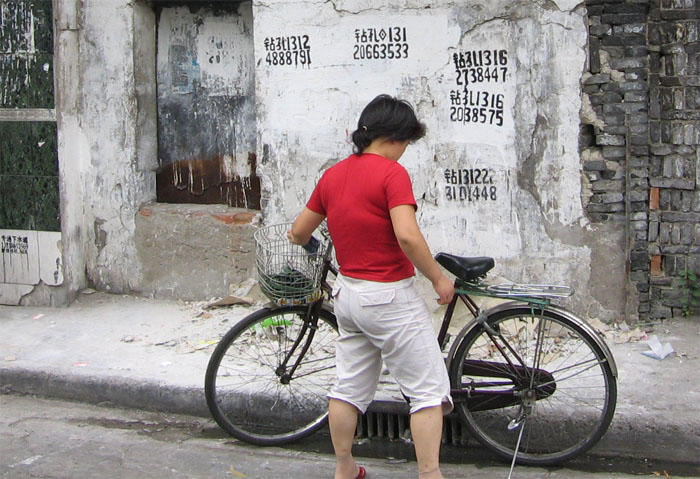
Spray-on ads are one of the two or three things I correctly anticipated about living in Shanghai. They figured prominently in the movie "Suzhou River," where the videographer narrator is shown spray-painting his stenciled advertisement. Earlier on this blog, I mentioned that these ads were a little rare in most of Shanghai. I now realize my perspective was warped by living in a cheap hotel off the very center of Shanghai. While they're rare there, the more residential areas, particularly the more lower-class areas, have these advertisements everywhere. As an extreme example, this was taken from a stairwell just a few minute's walk north of the Bund.


There's no videographer ads, though. As far as I know, all the sprayed ads are for hourly workers who want to do construction, or heavy-duty housework. Shanghai has an extremely large class of poor migrant hourly workers, it's very interesting and I will talk about this in the future. In the meantime, it's enough to pass on a very rough estimate I read that Shanghai will seasonally have up to 5 million migrant workers. Most of them work construction jobs, in support of Shanghai's construction boom - which is the largest ever, anywhere. In the last year, the government has tried to rein in the boom a little bit, so perhaps it's lessened since the estimate I read - either way, it's still a very large sub-society to Shanghai. I guess it's still a competitive market, if people need to advertise for what I'm guessing is a few hundred dollars a month.

I've talked to a few locals about it. They told me that the hourly workers who would post such a thing wouldn't do a very good job. I don't entirely understand why they said this, as they have no experience hiring people for construction projects, but I heard this from different sources so maybe they know what they're talking about. Also, I had thought that some of the ads were using a graphic slang for sex, but I asked a couple people and they assured me that my mind is stuck in the gutter.

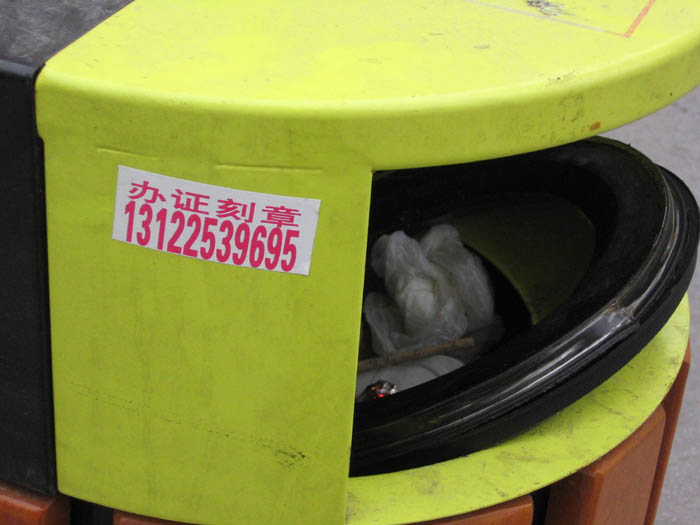
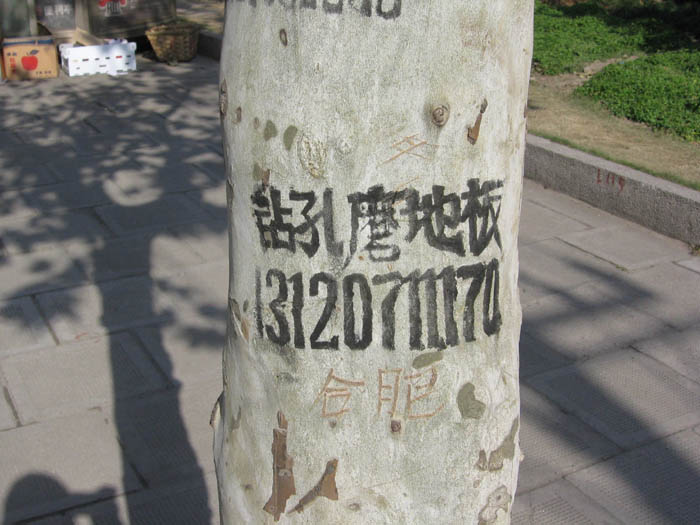
It isn't just sprayed on signs - you also see stickers for such work, for example this one is on a corner garbage can. It's very enterprising, especially considering the city does a good job of taking the stickers off quickly, as well as painting over or removing the signs when they're on public property. However, they come up just as quickly, I've seen week-old walls with a number of such ads. Spray-painting the ad on a tree isn't at all common, but I can appreciate the whimsy of the act:


Always eager to help, I offered some people my radical idea for cutting down on this sort of crime. The police could call the numbers, pretend to be be employers to arrange to meet with the workers, and then give the workers a fine. I was told it would be illegal for the police to do that, interesting.

Wednesday, December 07, 2005

Like, the Mall

I mentioned earlier about the preponderance of people selling things on the street. OK it's very common, it's fun to photograph, and it sort-of goes along with the whole "slums of shaolin" motif, but I hope I didn't give the wrong impression of the city. Shanghai has a mall culture only a step or two behind California's.

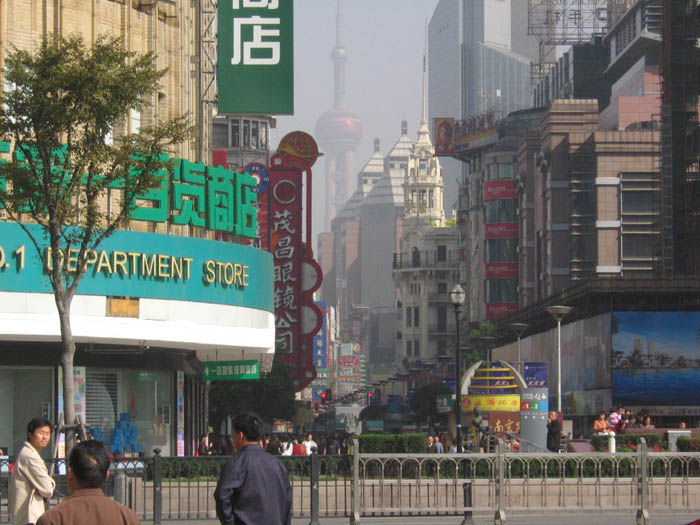
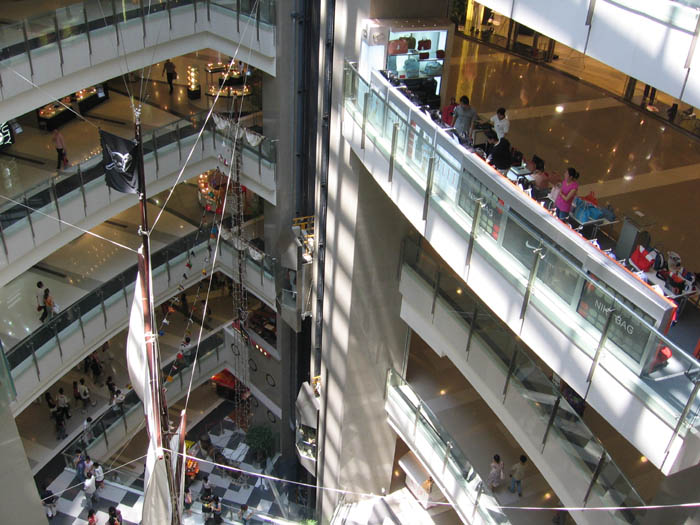
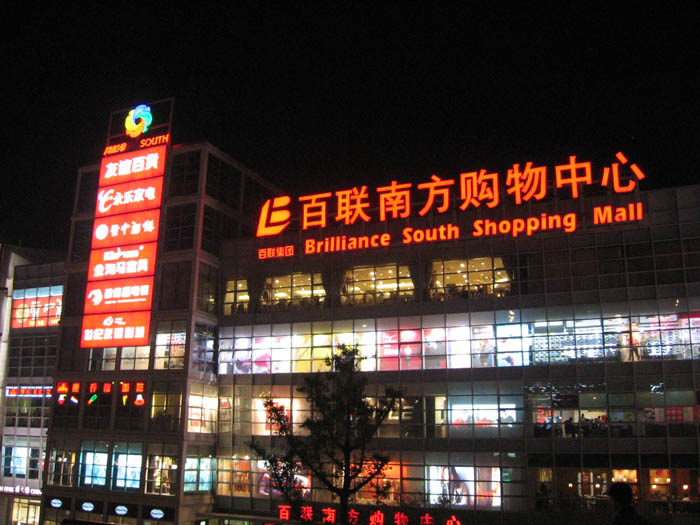
This is most apparent along Nanjing Lu, which is one large mall after the other. I think even a Californian would be surprised at their scale, these are often seven or eight floor monsters. And there's a lot of them - in the picture below, malls and shops keep on going all the way to the Pearl Tower in the distant background, with the brief interruption of the Huangpu River.


The malls extend just as far in the other direction on Nanjing Lu, cutting halfway across the length of Shanghai! However while the large malls basically fit a super-sized version of what you see in the United States, the smaller shops are a little different - they often contain the crowded bustle you associate with Shanghai's side-street markets.


The malls themselves may be one massive department store, or more commonly, a large department store sharing the space with smaller boutique shops. These boutique shops are often European or Japanese clothing labels. American boutique stores aren't as common, but you do see some, such as this Nike chain store. Starbucks is very common in malls, and the New Brands Mall even has two of them, two floors apart. Fast food is also very common at malls.

The malls attract a lot of window-shoppers, but I've heard people don't buy so much at them. Personally I often shop at the malls because the price is set and I'm at such a loss when it comes to bargaining, with no idea what a fair price might be. Regardless, malls try to increase their volume by having discount stores in the basement or on the top floor, or by having food courts. These food courts are often interesting - the "restaurants" are really stalls gathered side by side, you charge a card at the beginning and pick out what you want, the card works anyplace. There's a wide variety of Chinese food to order. Unfortunately it's never all that tasty and there's always somewhere better to eat nearby. It's still a good concept and I made a lot of use of it when I first got to Shanghai - and I guess it fulfills its purpose of getting people to ride a seemingless endless series of escalators through the mall.


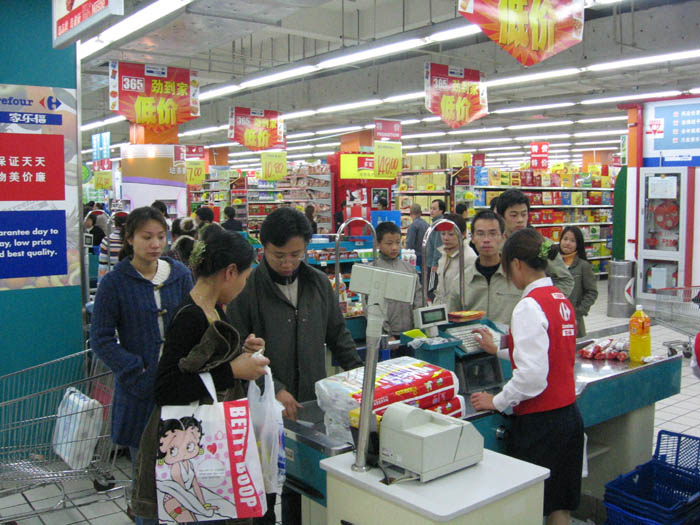
There's also a Wal-Mart in Shanghai, although I haven't gone and hear that it's pretty expensive. I instead go to Carrefour, a French chain with three stores in Shanghai. It's huge and you could probably make use of it for every single shopping need, if you really wanted. I'd love to wax eloquent but there's not much to say - imagine Target opening in a 99 Ranch and you've got it!

Tuesday, November 29, 2005

Cell Phones

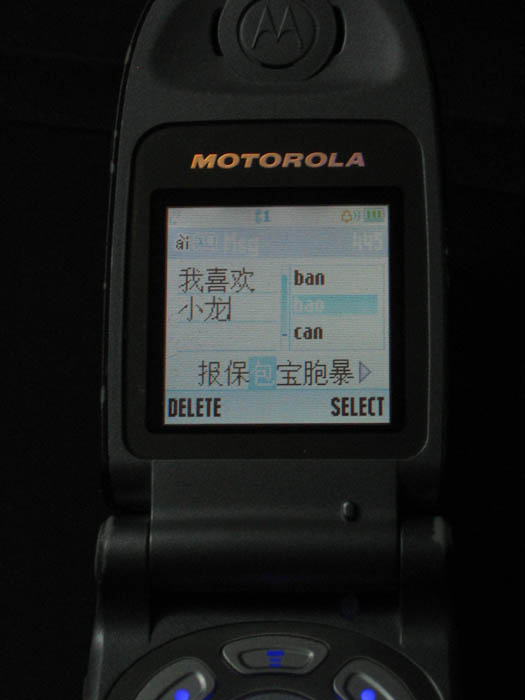
This update is about a subject very dear to the heart of Shanghai: Cell Phones. Just as iPods are the conspicuous consumption of choice in the Bay Area, cell phones in Shanghai are for showing off. And I can't help but admit, I've bought into the frenzy. I'm embarassed of my Motorola V188, and wish I was one of the cool kids with an Ericsson Walkman model!

Plan-less cell phones, and other electronics for that matter, are surprisingly expensive in Shanghai - there's a big markup from what they cost in the United States, even though everything's manufactured in China. My phone was on the cheaper end, still costing about $90, whereas the cool-kid Ericsson model costs $400. With the much lower wages and cost of living most people have in China, this price is totally obscene. Perhaps to show it off, people seem to prominently display them on their subway rides.

To be fair, the cell phones are also watches, just like in the US. Also, sending SMS messages is extremely popular over here, even though it can be difficult to do with the Chinese language. First you choose the english reading of the character with your keypad, and then you scroll through the list to choose the correct character. Just one character can be a very large amount of button presses.


Getting a cell phone in the first place was a little difficult for me. The cell phone system here won't work with US cell phones, you need a new one. So you either buy a cell phone with a plan, as in the US, or you buy a cell phone without any plan, then buy a chip that gives it a phone number for another $20 or so. What's cool about that is I didn't even need to write down my name or show ID to get this phone - the policy has since changed, though, to cut down on SMS-spammers and other criminal activities.

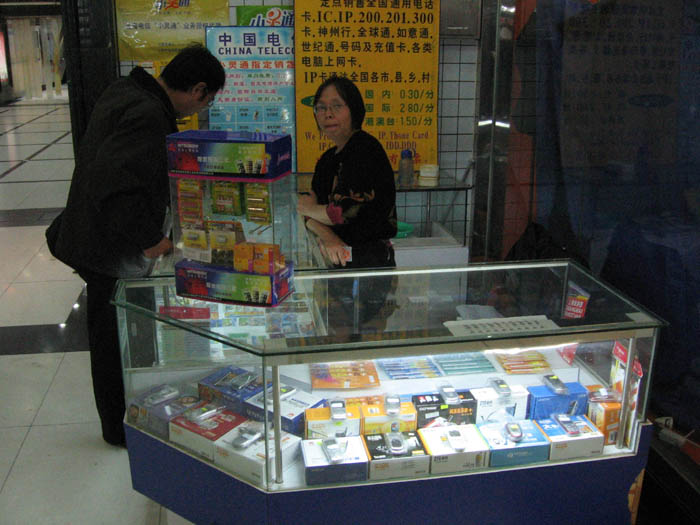
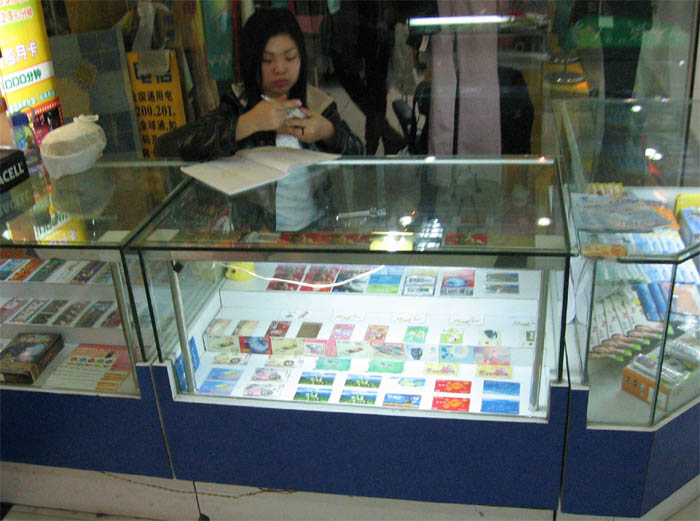
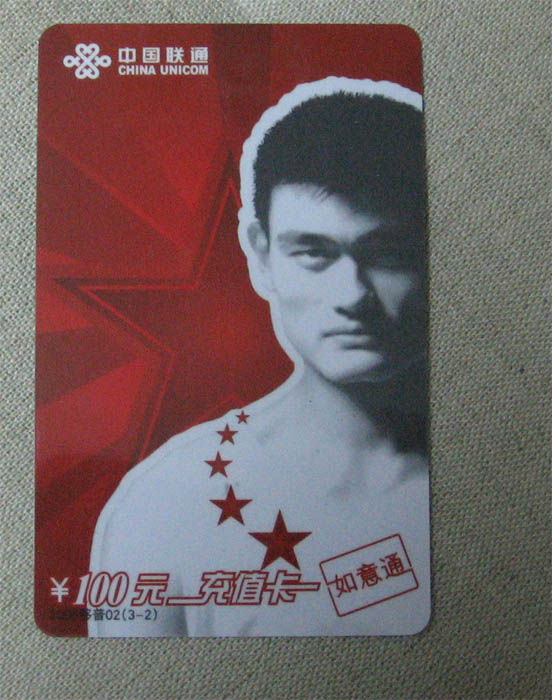
If you don't have a plan, you have to buy cards that allow you to charge up the account of the phone, in multiples of 100 RMB (about $12.50). One minute of a local call is 8 cents, one SMS is 1 cent. I bought this card on the left, it has Yao Ming's picture on it, he was a local basketball star before getting big in the NBA. These cards have scratch-off systems like you're playing the lottery. Instead of winning a prize you get a series of numbers, which you enter after calling a special number.


The price for long distance to the US over these is $1/minute! So instead I buy special long distance cards, each can call the US for 40 minutes. The trick is, even though they're also marked at 100 RMB, the price is negotiable. I buy them off the street for $5, although now my roommate can hook me up with the cards for $3.50, he knows somebody. Skype is still five times cheaper, but the quality isn't so great with outgoing calls.

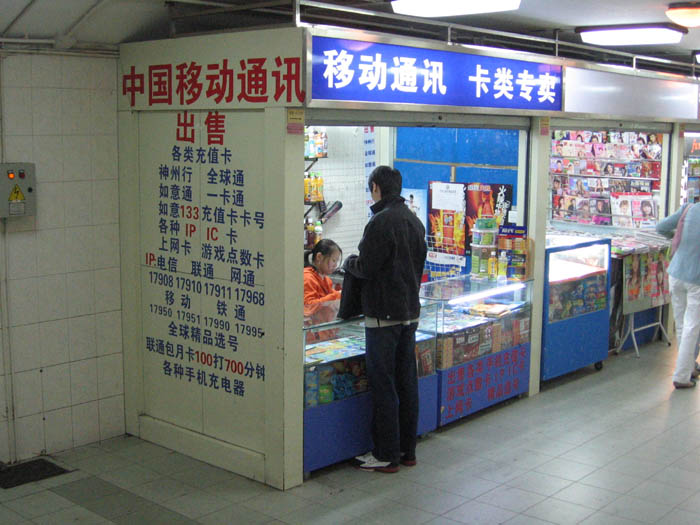
Shanghai is supposedly the biggest cell phone market in Asia, and it shows. There's advertisements everywhere, and everything from the largest department stores to small side-street shops will sell phones, chips, or the various charge cards you use to activate them.

Tuesday, November 22, 2005

Parks in Shanghai: A Sentimental Recollection

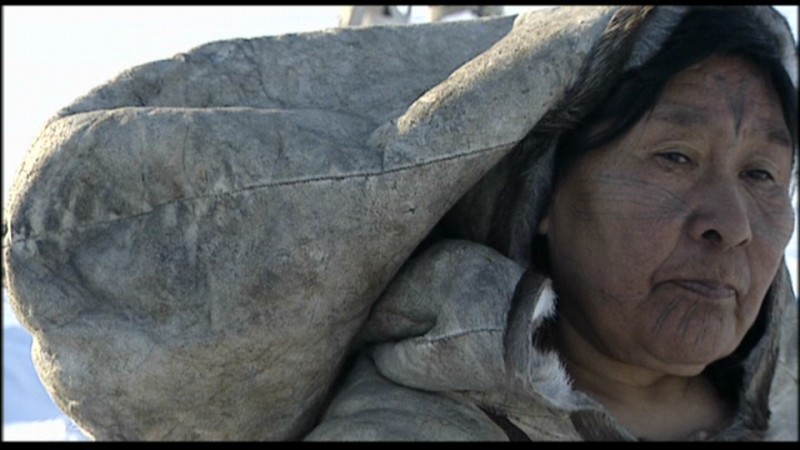
I love the Eskimo lifestyle. Atanarjuat: The Fast Runner and Nanook of the North are two of my favorite movies. At the same time, I never had any plans to go to the frozen wastelands of the far north.

I regret to report that the frozen wastelands of the Far North have come to me. Some could accuse me of a certain lack of fortitude. It doesn't actually snow in Shanghai, for instance. I've heard that can be rough. And I haven't had to buy my first scarf yet, either, or my first pair of gloves.

Still, it is with a wistful melancholy that I look back on my pictures of sunny days spent at Shanghai's parks. I've had my word on the eccentric Fuxing Park, but parks serve a larger set of purposes within Shanghai. Not least important is to absorb the heat and pollution from the extremely crowded city.

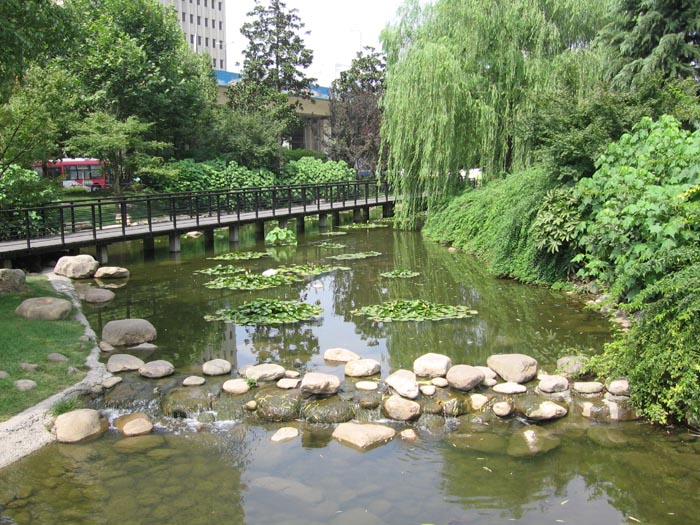
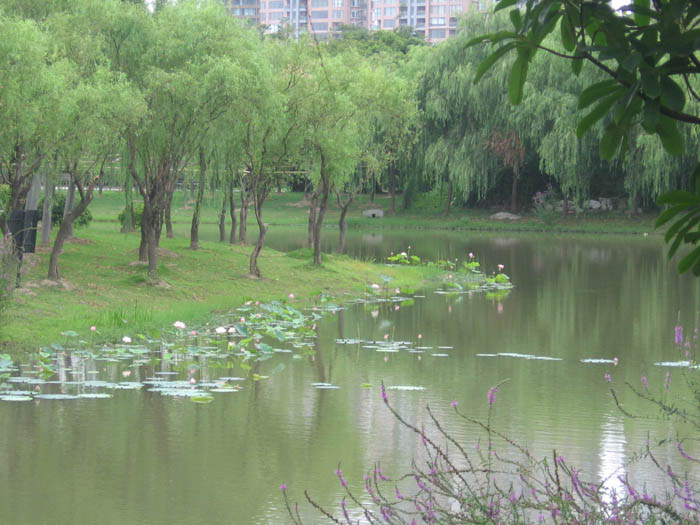
But of course they also offer a respite from the surrounding. Yan'an Park is in the center of the city, a minute or two walk from the downtown on one side and the large shopping streets of Huaihai Lu on the other, but the lilies and the willows make you want to kick back and have a picnic.


Although to be honest, you'll probably have somebody motion you off the lawn if you did try to do that. The free parks have a strict no-romping-about policy. It's pretty much stuck to, leading to the strange sight of large green empty meadows, with people sticking to the concrete pathways. The parks have a set of rules, most of which are pretty obvious, but some that are weird:


Rules against teasing cicadas or fish? I took a picture and had a laugh. Although it didn't seem quite as odd when I saw this lady apparently doing just that - she was picking up some fish or something with her umbrella, then putting them back in. Odd.


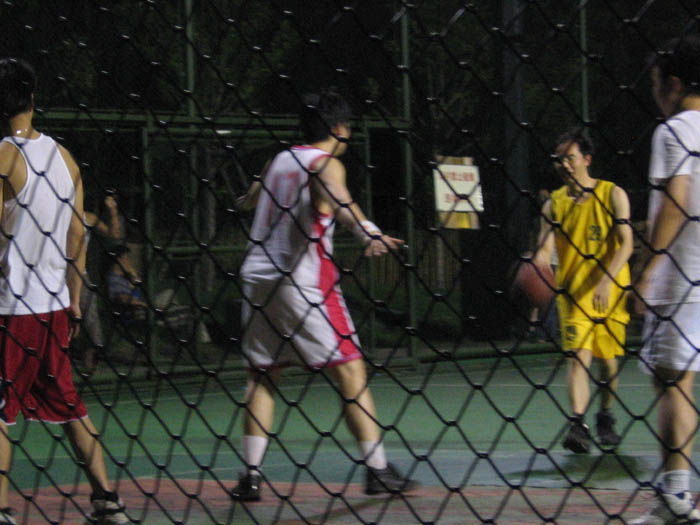
The parks are also popular places to exercise - you'll see people playing basketball, working out at the outdoor gyms (mostly stretching), or even working on tapdancing routines. The basketball players are pretty good, and the sport is very popular in Shanghai. At these courts near the center of town, it's impossible to get a empty hoop until they turn off the lights at 9 pm.

Century Park is an example of the pay parks they have in Shanghai. It's in Eastern Shanghai, the Pudong district, otherwise known as the boring part of town. There's a few other such parks, all around Shanghai. The park costs $1.25 to get in - most parks in Shanghai are free, but these are very large, and allow you to sit on the grass. As shown on the left, this park anchors the neighborhood, and on a nice weekend, will get really crowded. To me the area seems like a bad place to live, but I've heard the apartments are extremely exensive. There's frequent meetings at the park, and for one picnic I had there, we were surrounded on both sides by the face-to-face meetings of online dating services!


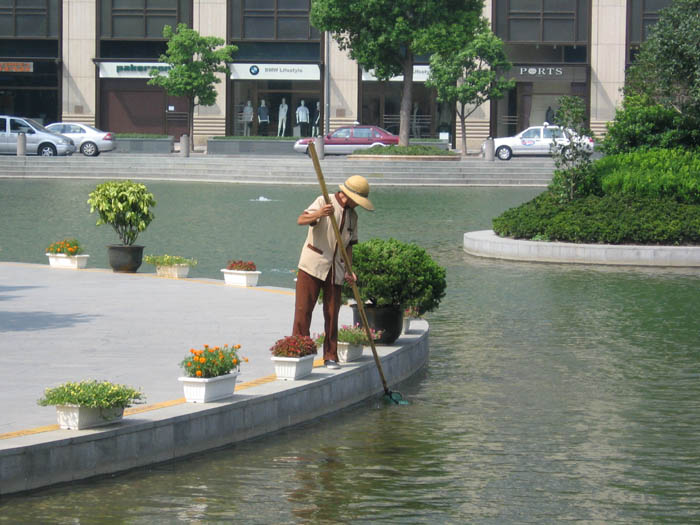
The parks are all well kept up, both the pay and the free ones, with workmen constantly keeping the park in the best condition.


Even small parks usually have spaces set aside for the kids to play. Usually it's a playset, but People's Park has a fountain to run around in.