Sunday, November 13, 2005

Not for all the Tea in China

Tea in Shanghai is not what it is in the US. I don't mean to say it's made from something weird, but that it occupies a different niche than what you'll get in Chinese restaurant back in the US. Most of those places in the US, they'll give a nice pot of tea, with some minced-up leaves that settle at the bottom of your glass. I believe that's a perfectly authentic Cantonese style of drinking tea. But it doesn't jibe with how it's done in Shanghai.

Here, if you go to a normal Chinese-style cafe, you'll be given a glass of incredibly hot water, with some leaves in it. These leaves float on the surface, flavoring the water. The idea is that as the water cools, the leaves will sink down to the bottom. With the higher-quality teas, they'll rise and fall a few times, before eventually sinking to the bottom. However in practice the leaves never all agree to head to the bottom of the glass. There's a certain art to drinking the tea without getting any in your mouth - an art I haven't quite mastered.
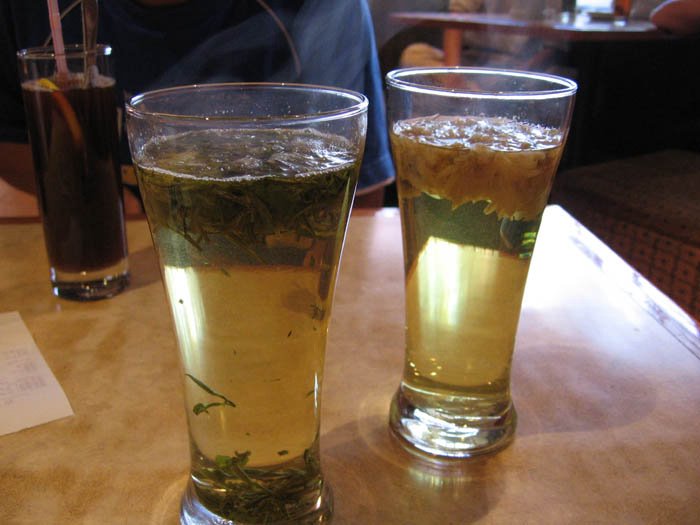


Note the two teas, which are probably the most popular ones in Shanghai: on the left is green tea, it was delicious if I recall. On the right is flower tea, it's a bunch of dried white jasmine flowers. Jasmine tea's taste isn't my favorite but it does look really cool. Once you've reached the bottom of the glass, somebody will re-fill it with more incredibly hot water.

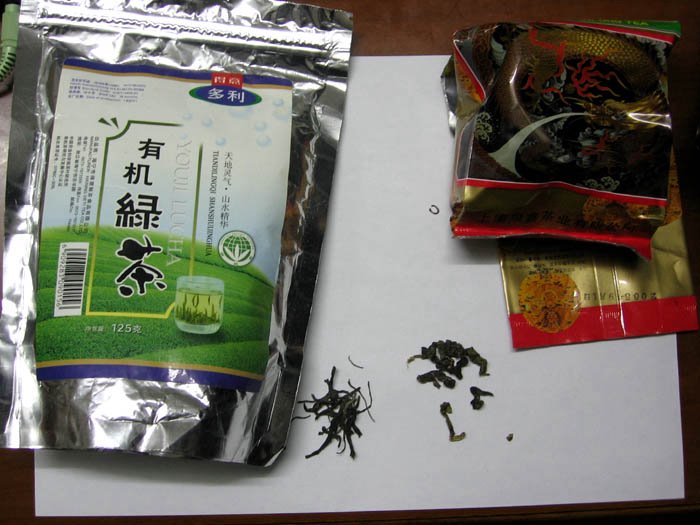
The tea starts out life a little uglier. Here is some tea in my apartment, right out of the bag. It's green tea on the left, and Oolong tea on the right. The leaves look like something from under the sofa, until they're soaked in water for a bit. Even a small grocery store or convenience store will have dozens of these dried teas for sale, and premium tea stores are pretty common.
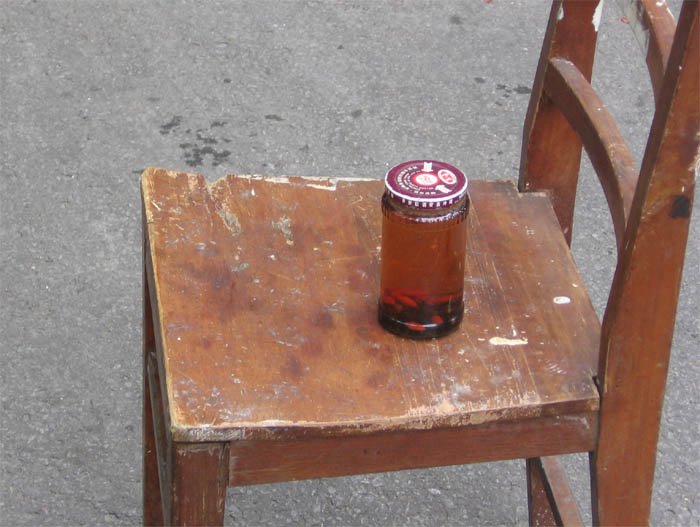

But of course tea is consumed in other ways, you can't get away from it! A large amount of people will carry around thermoses of tea. Partially the tea sun-dries and partially there's hot water easily available in a lot of places. Sometimes these thermoses have a little of this and a little of that, it's strangely artistic, although I have no idea how or why you'd want to mix up the various kinds of tea.

And of course pearl milk tea drinks (with sweetened milk mostly overwhelming the flavor of the tea) are found on nearly every block. They'll cost maybe a quarter or fifty cents, and are often served warm or even hot. You can also find iced tea at convenience stores, but they're all lightly sweetened, which I find repulsive.
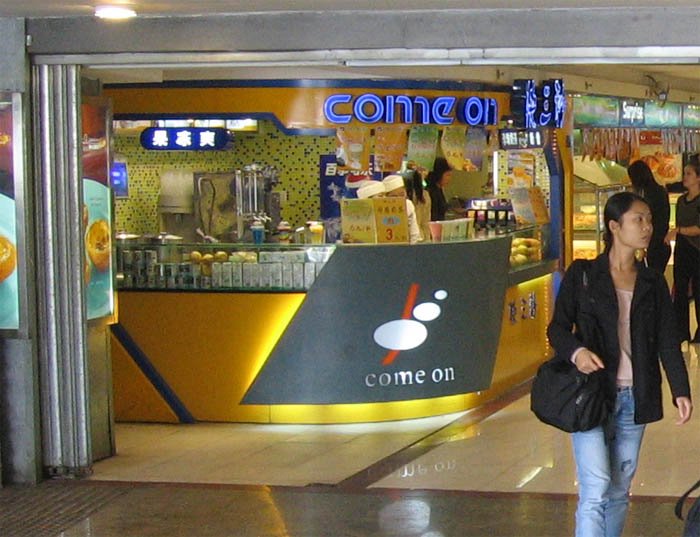


Surprisingly, most local restaurants I go to will not have tea available. Instead, the liquid comes from ordering a light soup. If they do have any drinks, it'll be soy milk, or a juice, or a milk tea (with or without the pearls).

And you do see teabags around, I'll notice them in offices or situations where free leaves would be too messy. They're also available at the cafes you'll see in the more Westernized areas, which attract a certain kind of clientel:

Saturday, November 05, 2005

Happy Avenue-Rock Music!

Given the choice, I'd go to a concert every day. Not just for the music - I like the possibility of seeing something unexpected, I like scoping out the hipsters, I like talking story with friends before and after, I like kicking it for a bit before going.

In the Bay Area I average at least one a week. When I'm really feeling the spirit, I probably catch more than two a week. In China, I've only been to a few. A very few. I hate to say it, but the music I've seen has been pretty much god-awful. 80s cover bands (usually imported from the Philippines) play at even the most prestigious clubs. I was beginning to get all analytical, wondering if the comparative difficulty of finding any CDs beyond Celine Dion and the top HK pop stars indicated a general distaste for pop music in China - perish the thought!

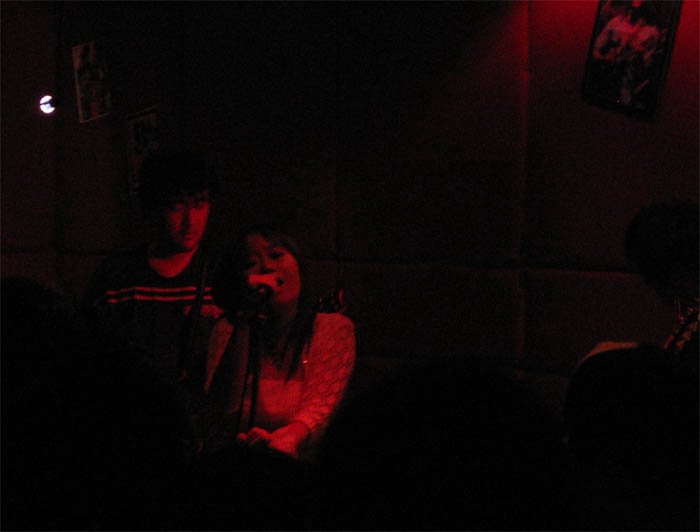
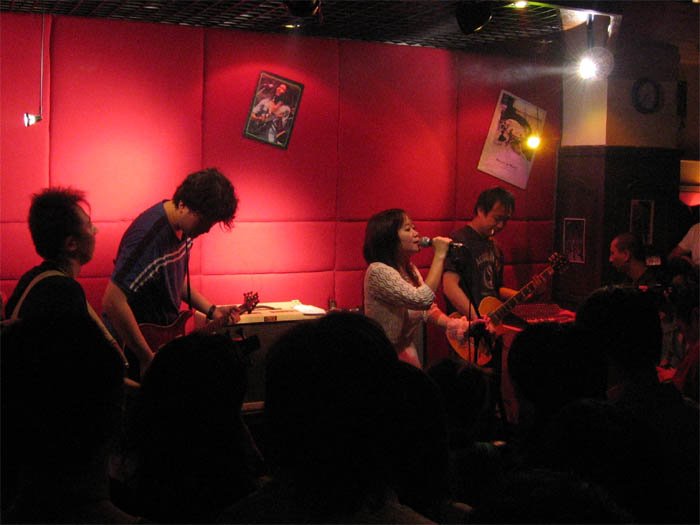
I'm not qualified to do anything more than muse idly, but I was happy to run across a cool band and a cool club on Friday night. The name of the band is, unfortunately, Happy Avenue. The club is alternatively called Club 288, or the Melting Pot. Neither name really fits the club but I like the first one better. It's located at 288 Taikang, an address that took a couple of native Shanghainese quite some time to find on the map.


The club itself is small and cozy and dark and dominated by the color red. That more or less exactly fits my demands for a perfect bar - although it is hard to photograph, so I cheated on a couple pictures here, and used the flash. One unusual thing is the music started at 7:30, ending around 9:30 or 10. That's around the time bands start in San Francisco. It means you have to rush there after work, you can't chill out before, and the concert is the start of a night rather than the end. However, the bar is a little on the small side, and it got packed full. It was hard to move, and it got pretty hot. Perhaps living in Shanghai has numbed me to that, though. And in response to what my sister asked, I held the camera up to take these pictures, I'm not two feet taller than everybody else in the club.

The band was fun! Their first few songs reminded me of the Talking Heads. The singer's vocals were crazy, although mostly a different form of craziness, with strange sounds, and vocals being used as an instrument. Perhaps if I spoke the lingo better, the art-school vibe would have been more distinct - the website mentions some prestigious literary university. My main comparison was, the rhythm section was really on-point and funky. I was also impressed by the guitarist who inserted stylings that at first seemed to clash with the rest of the songs, but quickly grew on you. After the first half of their first of two sets, I was ready to follow them around like the Grateful Dead.

However they didn't quit keep it up. Their music progressed towards slower songs that almost resembled an annoying rock ballad or even a Canto-Pop ballad, yuck. What kept it going was the occasional oddball guitar solo and the singer inserting weird vocal flourishes into the ballads.

There were a few demographics you couldn't help but notice. The band was 10+ years older than the average audience member, who knows why. Also, the audience was 10-20% white people, a huge percentage, mostly they hanged out in the back and drank beer.

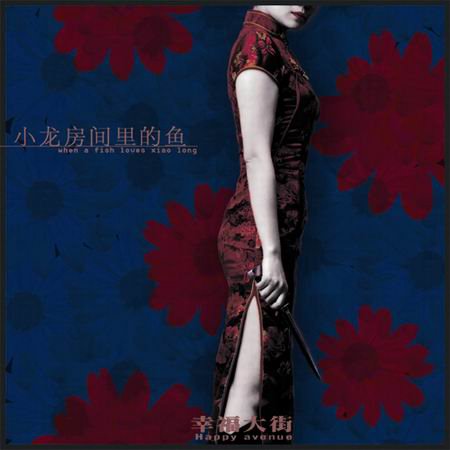
When the concert ended I picked up a CD. I like to support the scene and it's all that much easier when a CD goes for $2.50. It's a good album, but maybe I'd prefer a bootleg of the concert. I did like the weird blue-and-red album art, predominated by knives and qipaos.

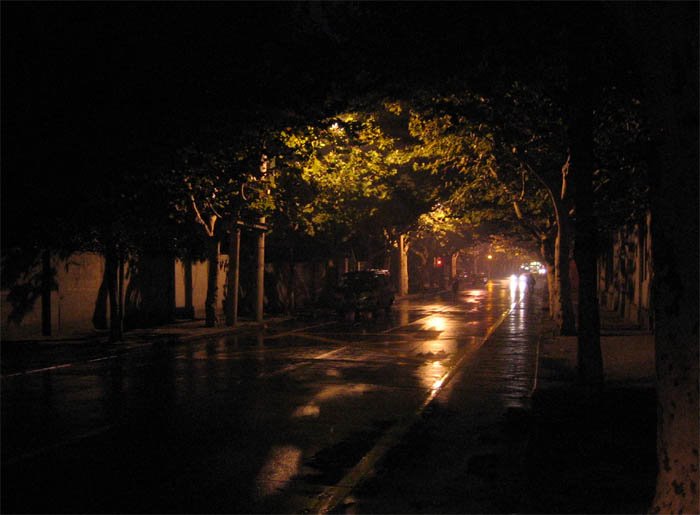
Finally, on the way back I walked through the French Concession. It's nice, I wish I lived there!

Friday, October 21, 2005

I am a Tourist: Suzhou

It's turning into Fall, and I'm worried about the Shanghai Winter. People tell me it's just horrible, all cold and windy. So I'm trying to take full advantage of the good weather while I have it. Last Thursday was a nice day and I didn't have any work or school, so I decided to take a trip to Suzhou, a famous tourist city that's about sixty miles from Shanghai - it's no relation to the Suzhou River I mentioned earlier.

I decided to take the bus there, and the train back. The bus was no problem, no matter how much of a bother it was to get to the Jiading. The bus ride was about an hour long. The only real hassle was, right after the bus got going, I was called about going to a job interview later that day! I was able to schedule for Friday and I consoled myself by watching the oddball movie "Once a Thief" on the TV screens - we only got to the halfway mark, though.

Looking out the window on the way there, you notice that Shanghai doesn't have the extensive suburbs that California has, and almost immediately outside the city you come across farming villages. A lot of these small cities seem to be built around canals, even though Shanghai doesn't have much of that.

Suzhou has two million people, and six million people in the metropolis area, but it still felt more like these smaller towns to me. I walked a couple miles from the Southern bus station to the tourist area, and it was mostly smaller-scale buildings, with much fewer people on the streets than Shanghai. Canals and rivers are all about, the water generally seems pretty clean, and the houses are often built up right againt the water.


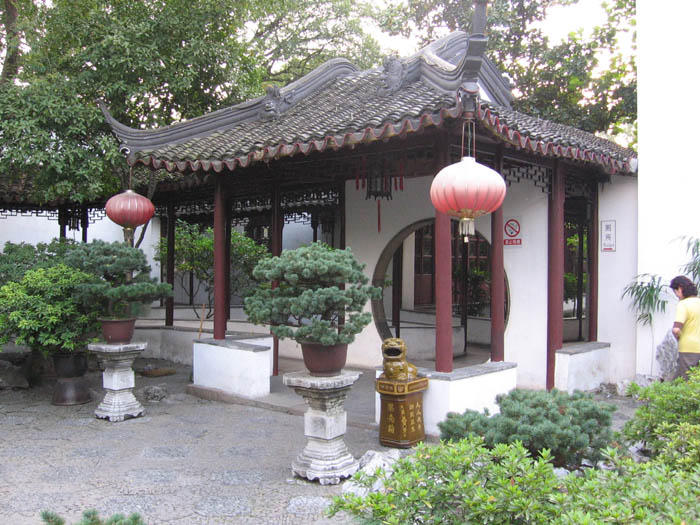
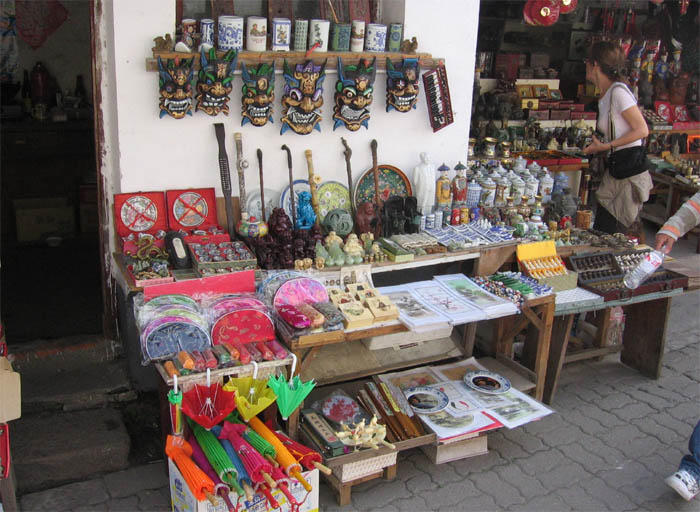
Suzhou is most known for the ancient Chinese Gardens. I decided to start at the Garden of the Master of Nets, which the Lonely Planet Guidebook and Chinese sources consider better than all Suzhou's other garderns, combined. Even though the garden was at the end of an alleyway, there was still the familar row of tourist stores.


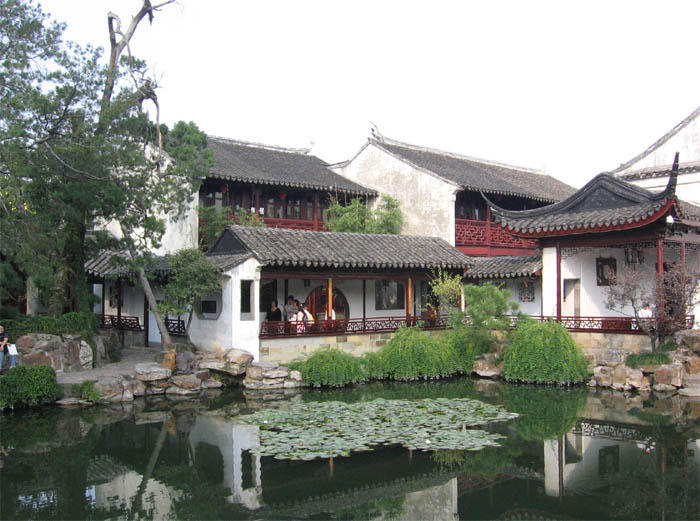
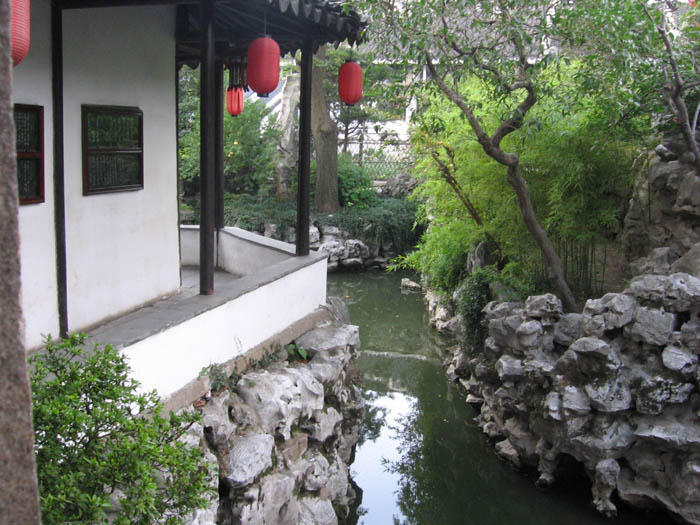
The initial view of the garden was a small lake, looked over by traditional-looking buildings. It was small but everything felt very well-placed.


Also the garden had a cool collection of weirdly formed rocks. Some of the rocks here look like they're multiple rocks glued together or something. This and a similar sense of whimsy is common to Chinese gardens.


But I must admit I didn't so much care for the garden. Maybe it was too small, or maybe because all the internal halls don't hold much interest for me.

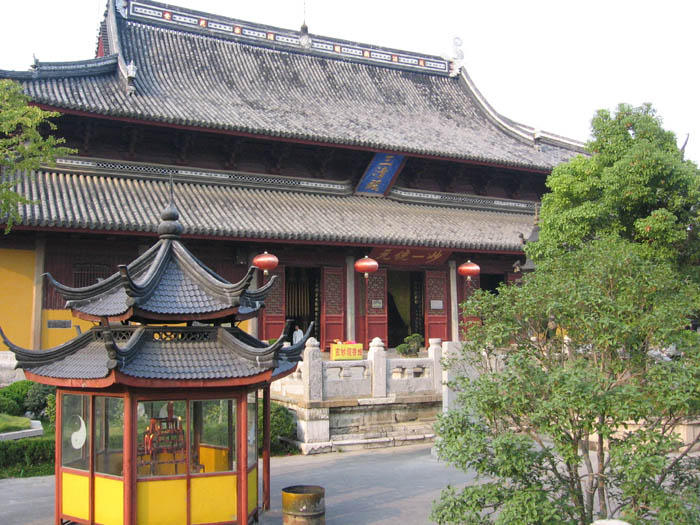
Compared with Shanghai, the streets of Suzhou look a lot more traditional and stereotypically Chinese, but perhaps the city is too large to be called charming. Like a US city, many parts of the main ways are dominated by car traffic, with pedestrians a little rare. It's a nice contrast to the international/post-modern look to Shanghai architecture, but it's not a city I'd want to live in. In fairness, though, there was a street scene around this massive Taoist temple.


From there I headed to the North End of the City. I had a look at another garden, the Garden of Harmony, which is a bit rococo in its multiple stylings. It was larger than the Master of Nets Garden, although there wasn't the sweet spot you look for in these gardens - points where you can stand, look around, and think the surroundings have been arranged, placed, and plotted with the care of a master painter. It did have plenty of nice smaller views, though.


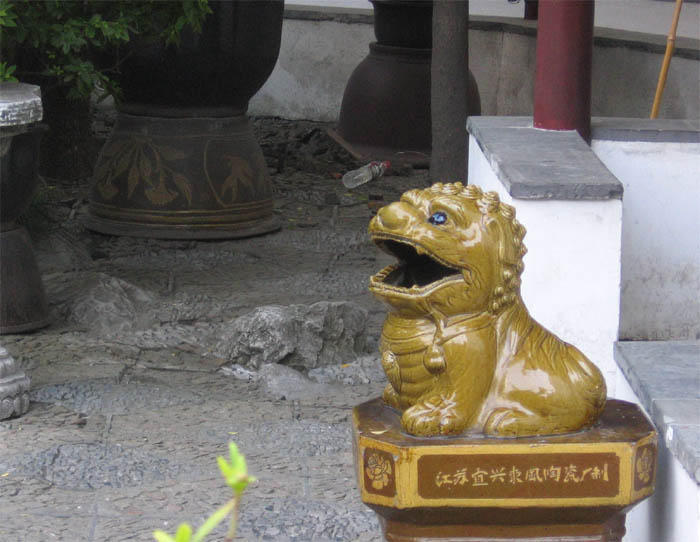
I also thought the Guardian Lions were cool-looking. I guess I'm not the only one who thought so, as they don't just guard the gates, but various random points around the Garden.


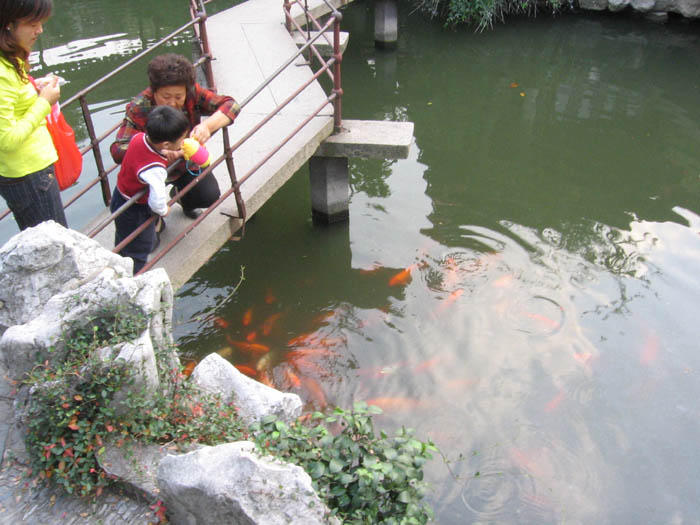
And I'm a sucker for koi fish. Some of the fish here were incredibly large. This kid fed them some rice.


Anyway it was too short a day-trip and there's still a lot of things I didn't see in Suzhou - I'll leave that for some other time! I finished off my visit by wandering around a waterfront park, and then I took the train back to Shanghai. It's the first time I've taken a train in China, and I thought it was very convenient and cheap, although the train-station was a bit of a madhouse.

Tuesday, October 18, 2005

Street Dealers

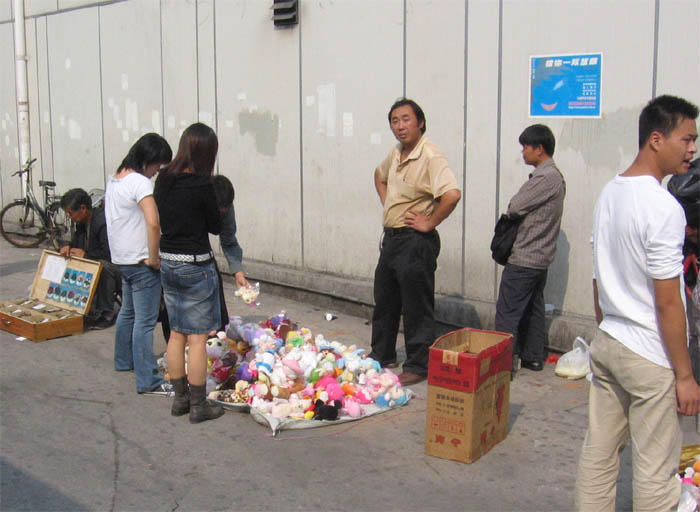
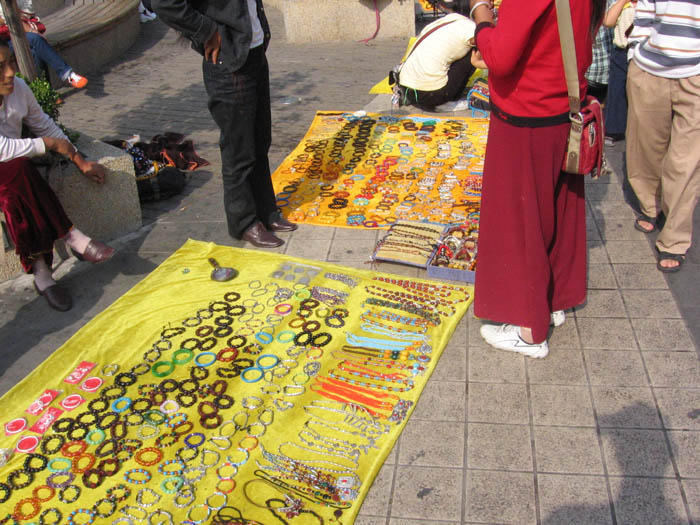
China has the least effective Communism imaginable. In Shanghai, along with the abundance of people around you at any given moment, or the construction happening all around you, you're likely to be surrounded by commerce. This isn't just from the shops that line the streets in residential and commercial districts, but also from shops that overflow onto the street, or set up on the sidewalk, or stake a position inside the walls of my apartment complex (yes it does have walls - a concession to traditional architecture I guess).

All sorts of things are being sold. Some of it reminds you of what you'd buy on Telegraph Avenue in Berkeley, little trinkets like bead necklaces. The difference is that instead of being sold by hippies in Tibetan clothes, it's being sold by Tibetans in Tibetan clothes. In this case, though, I believe the lady on the far left is Uighur. They're Shanghai's most visible internal minority, Muslims hailing from North-Western China.


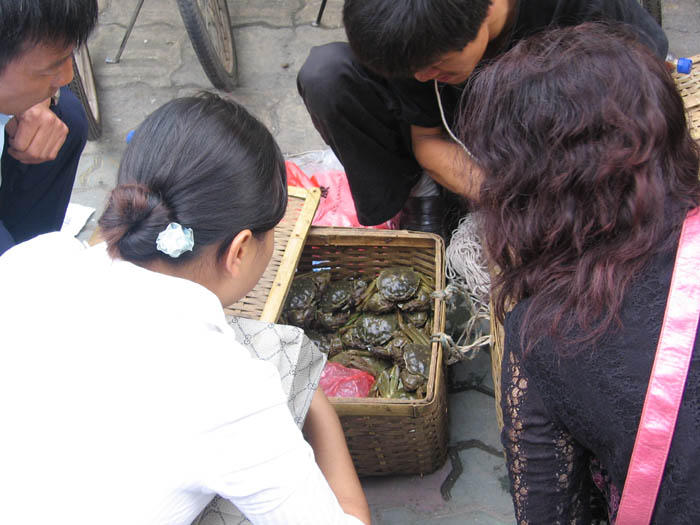
Other things couldn't be bought on Telegraph Avenue. It's currently Blue Crab season in Shanghai, and this dealer has staked out a position on a major street, not all that far from a subway station. The crabs are still alive and are constantly in motion, sometimes crawling out onto the street before he nabs them. When you buy one, he'll tie it up, still alive, for you to take home.


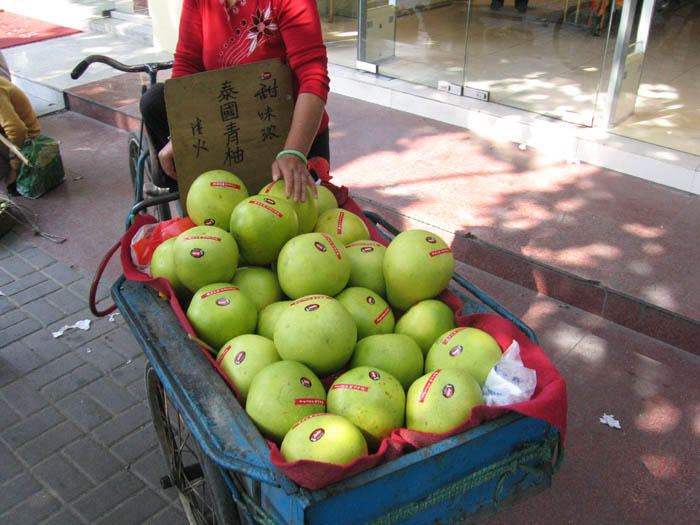
A lot of the dealers sell seasonal fruits. They're a popular snack, although a good percentage of the time I'm not so familiar with the fruit, or haven't even seen them before! Some of the time when I try them I realize I have had them before, but the Western versions are a little different. Some small green-skinned citruses looked vaguely like limes but turned out to be Tangerines, aka Mandarin Oranges. These dealers are everywhere and a lot of the times the stalls are portable, stopping off at a popular spot for a few minutes, and then going somewhere else when street traffic dies down or business slows. This lady, for instance, sells from the back of a bicycle cart.


To me it looks a little feudal, but you'll more commonly see people carry baskets of fruits on their shoulders, with the backets connected by a pole. This seller sells peaches - note that they're indivisually packaged, and tastier than anything you'll find at Albertson's. Usually, though, one basket will contain one kind of fruit, and the other basket another.


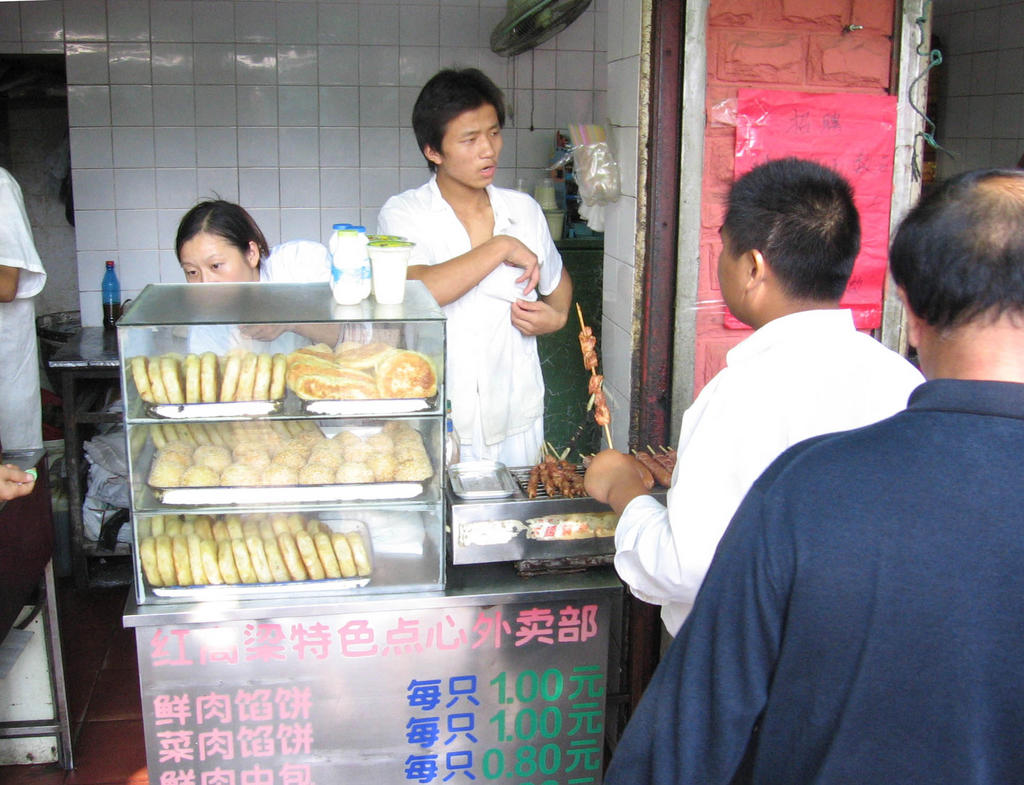
Some other popular snacks are kebabs, usually sold by Uighurs. They're more commonly sold from barbequeus on the street, not a shop-side-stall like this. This place is also selling Uighur-style breads. Side-stalls like this are the normal place to buy manapuas and various steamed breads. They'll also sell sweet Soy Milk, which is a Shanghai specialty.


Of course all kinds of things are being sold. Some popular items I won't show photographs of include newspaper stalls (there aren't newspaper boxes, like in the US), bootleg DVDs, and dealers selling fake Rolex watches - although they supposedly take you to a back alley-shop, and don't actually sell on the street.

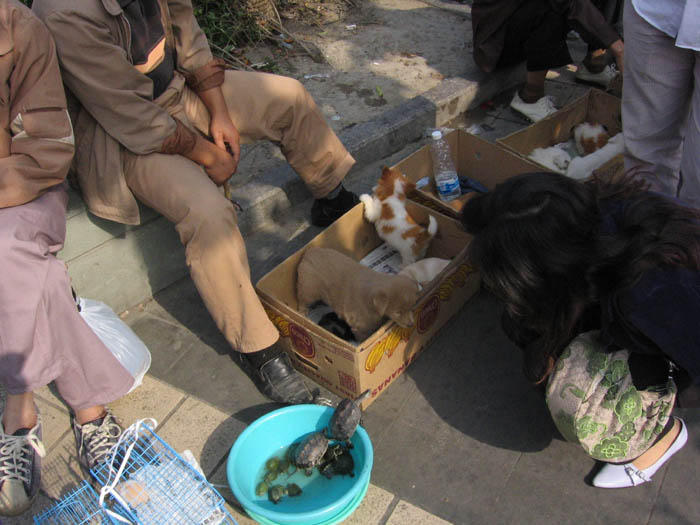
A recent trend in Shanghai is pets of all kinds, with small dogs and cats being the most popular. I've heard the pets are often abandoned, people not knowing what's involved in raising a pet. It's true you see stray cats in parks or around the neighborhood. The pets I've seen have always seemed overly pampered, though.

Saturday, October 15, 2005

American Fast Food

Yes of course they have McDonald's over here.

I'm in China and I guess I'm supposed to be experiencing the famous cuisine as often as possible, but that hasn't quite happened. Going out to eat can be a little intimidating over here, where the menus and talking to the waiters are all entirely in Chinese, I don't know all the foods on the menu, and people expect you to order at right about the time you sit down. Also I must admit, it's very easy to find a good meal for $2, but I'm having a hard time finding a great meal no matter how much I pay. So in the end I'm settling for fast food a couple times a week.

Fast food is common to Shanghai. Depending where you go - around the city center or the Xujiahui shopping area, fast food is everywhere, literally one after the other. On the other hand, the crowded residential area I live in has plenty of restaurants and stores, but only one fast food restaurant, a KFC about a 10 or 15 minute walk fom my apartment.

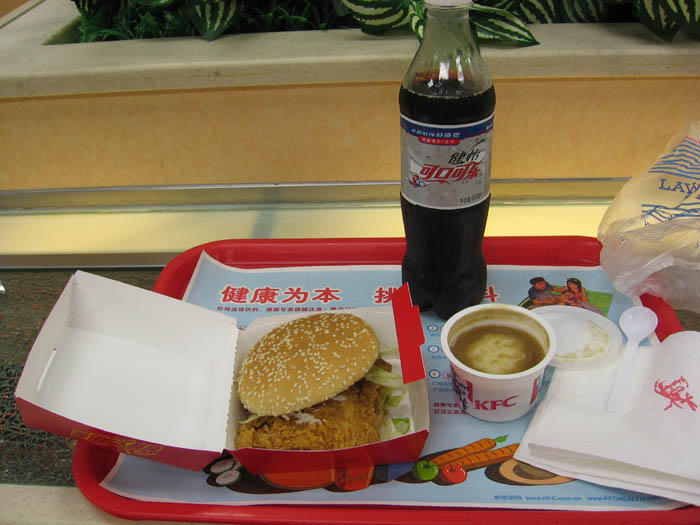
KFC was supposedly the first to arrive in China, and is by far the most popular fast food over here. It costs about half as much as in the US. The emphasis is on the chicken burgers rather than fried chicken, and it has some traditional Shanghai breakfast congee or something, but it's mostly the same as KFC in the US. The portions aren't always the same size though - this cup of mashed potatoes isn't much larger than a shot glass. They don't serve Diet Coke, and I've lost my taste for normal Coke, so I'm forced to drop by a convenience store beforehand - life is hard.


McDonald's is #2 in popularity, and seems to have an almost exclusively teenage following. Depending which one you go to, it can feel something like crashing the junior prom. The concept is the same but the menu is about half different from the United States - among other things they serve shrimp mcnuggets and triangular sandwiches. I don't like McDonald's and my only reason for going is that they serve poi pie. Or at least I call it that, it's really Taro pie, slightly sweet and chunky. But it still has the pleasant purple-ish grey color. A value meal costs about $2.00. Update Jan 14, 2006 - these are now available at McDonald's in Hawai'i as well.


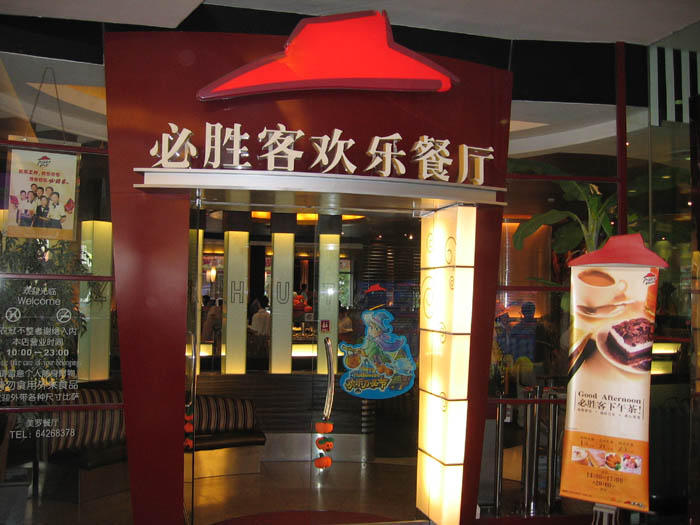
The other big chain is Pizza Hut, which I've never gone to. It markets itself as a somewhat upscale family chain restaurant, maybe the equivalent to an Olive Garden in the US. I've heard most Shanghainese think it's Italian, and maybe to play off this, the waiters dress in clothes that I guess are supposed to be traditional Italian clothes - really billowy pseudo-silk.

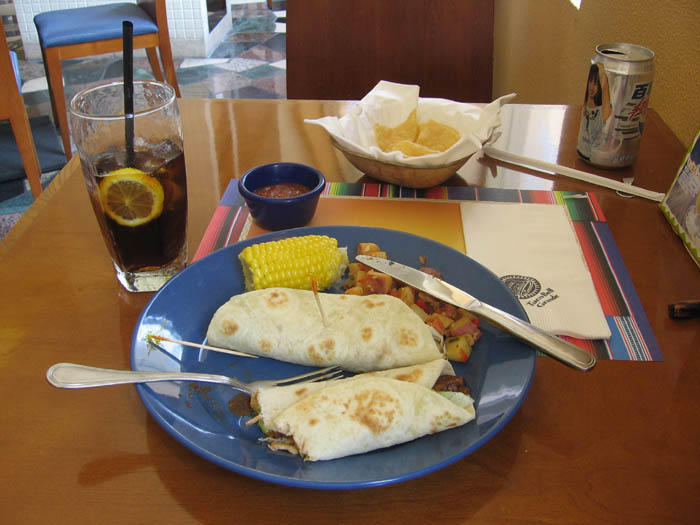
There's a few other chains that have recently put up stakes in Shanghai. They only have a couple branches but I assume they're testing the waters for more expansion. Taco Bell has gone the Pizza Hut route, and is the more upscale Taco Bell Grande over here. There's only a single location, but it's right near the City Center. It's actually a decent place, and pretty much the only game in town if you want passable Mexican food. The $7 price tag for lunch keeps me from going regularly, although it's almost worth it to see the Chinese waiters wear their goofy attempts at Mexican clothes (including brim-less sombreros), and greet customers with a friendly "Hola!"


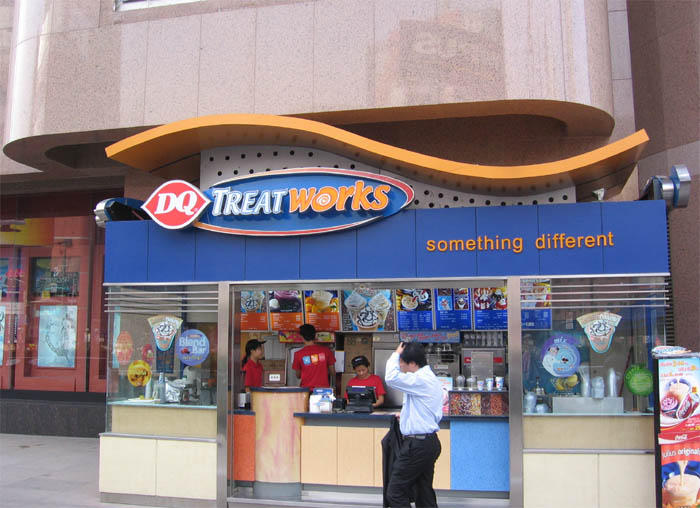
Orange Julius/Dairy Queen has a couple of chains around town. I hadn't been to Orange Julius in years and years and forgot that they're actually pretty good. On the other hand, for the same $2.50 their Julius costs, I can get a 4-course meal at a local restaurant. So I only go when I'm feeling my most Capitalist. And Burger King opened in Shanghai just recently, and has two locations that are both pretty convenient, and exactly like the US versions. It's my favorite American fast food restaurant.

One surprise is that as popular as American fast food is, there isn't really a Chinese take at it, the way France has Quik Burger, or Japan has Mos Burger. There's plenty of local Chinese-food chains, I go to the Taiwanese chain Yong He Da Wang more than any burger place. I also have favorite crack seed chains and manapua chains. But If you want hamburgers, they're pretty much only sold at McDonald's. That's probably a good thing.

Sunday, October 09, 2005

I am a Tourist: Jiading


I very much enjoy Shanghai. Really. I'm committed to living here, with no plans to leave. And I genuinely appreciate Shanghai's transportation system, where the subway is easy, and taxis are a cheap supplement when you're headed to the outskirts of town, or when you're just feeling lazy.

At the same time, three months of never venturing more than a mile from a Shanghai Subway Station was getting to me. From what I understand, there's more to China than just that. So with the week-long National Nationalist Holiday and all, I decided to make a quick day trip to a neighboring town. I decided against the booming neighboring cities of Suzhou and Hangzhou, which are historically famous tourist destinations - they're a little too far, and probably far too packed with Holiday tourists. So I decided on visiting the city of Jiading, just 12 miles Northwest of Shanghai, along with my apartment-mate. Jiading is not particularly a tourist destination for either Chinese or foreigners, and that was part of the attraction.

It's my first time taking a bus in China, and I'd love to report it's vastly efficient and got us there in record time. Instead, it took about an hour and a half to reach the destination. A little arithmetic gives a speed of 8 miles an hour, or a pretty slow speed for an express bus. To be fair, it was during a holiday. But I think the problem is China doesn't quite share America's system of large highways going every which way. Most of our journey was on side streets (competing with the pedestrians in the road), or on stretches of farm road with a 25mph speed limit, where the older tractors on the road used a lever system to turn left or right, a little like a Model T. If the bus had actually stopped for red lights, it would have taken even longer - instead the driver just leaned on the horn and plowed through, without slowing down.

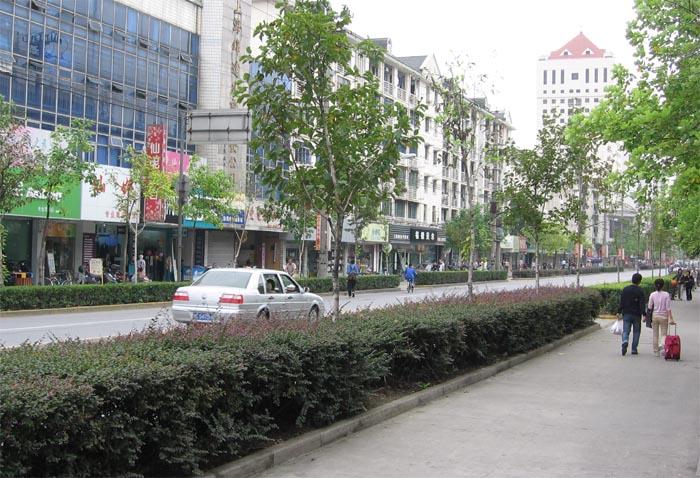
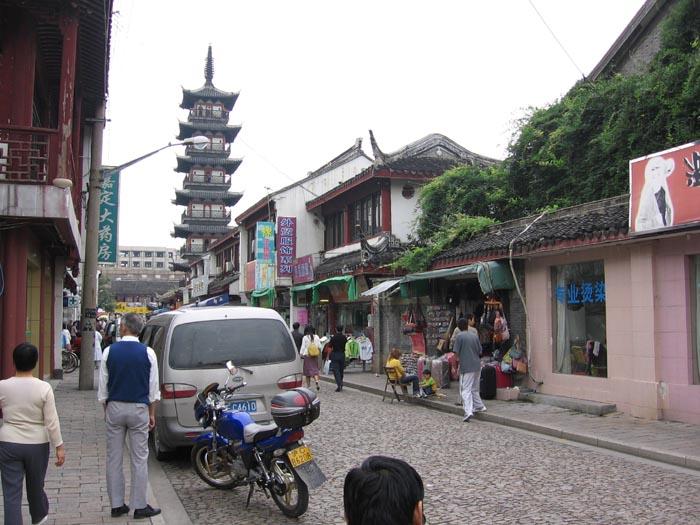
On the other hand, this transportation-isolation does allow Jiading to maintain its own identity, instead of being absorbed into Shanghai. Streets are wider, and have a more laid-back feel than anywhere in Shanghai, with enough space to accomodate pedestrians. This is particularly true in the historic center of town, which is cented around a large pagoda and bordered by a canal.


We ended up going to Wei restaurant, a Japanese-Korean place. Like every other good Korean restaurant I've been to, the service was slow and slightly odd - when I ordered some Katsu, they went down to the market to buy some pork! Afterwards we wandered the area. The Canals are criss-crossed by a number of bridges, and the whole area is host to a lot of restaurants, shops selling clothes, and street vendors selling jewelry or snacks.


A lot of the traditional architecture remains. This includes Shikumen, a traditional style of brick apartment complex centered around courtyards, placed right against the canals. To me it seems like the area should be prime real-estate, but a lot of the houses are poorly maintained.


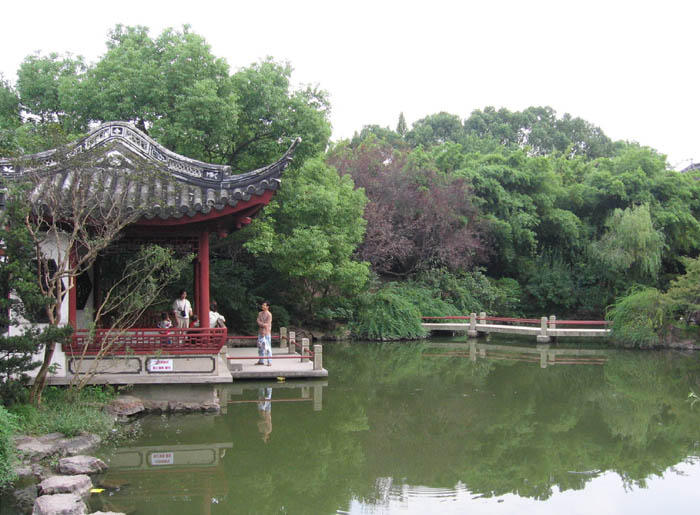
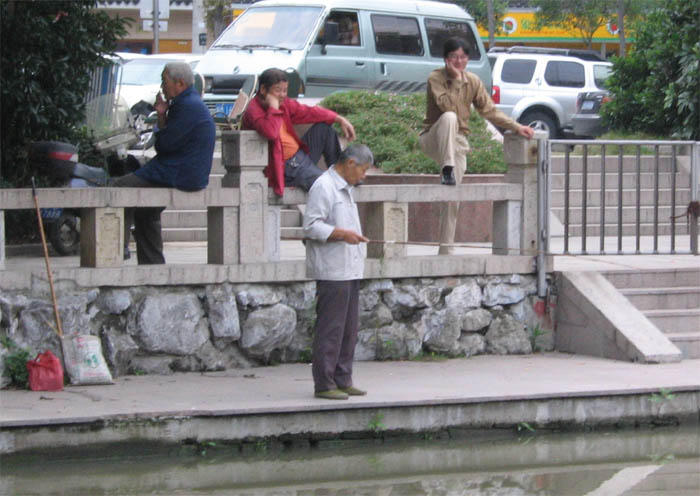
Finally I wandered the Dragon Meeting Pond, a 450 year old Garden. Although we walked in to a couple taking their wedding photos, the garden seemed to be mostly empty. It has a central pool and is generally very likeable - Yuyuan Gardens in Shanghai might be nicer, but all the tour groups there bug me. The people at Dragon Pond seemed to be taking it mellow, with some kids playing and adults fishing.


We took the long bus ride back, arriving at the Shanghai Stadium just in time to catch masses of teenage girls lining up to get into the "Super Girl" concert, which celebrates the top 12 competitor's of China's answer to "American Idol." I didn't go, but I enjoyed taunting the un-talented, un-cute winner.

All in all it was a fun trip. However, the moral of the story is, next time I travel outside of Shanghai, it'll be by train!

A few other issues: First, please realize that if you click the pictures on this blog you'll see a larger, full-size picture. Also, don't believe the hype about Chinese censorship - it exists and it's terrible, but it's not a hundredth as bad as US Newspapers make it sound. More political blogging can be found in China. Also, my 510 number is now much, much improved, plus it now auto-forwards to my home phone or cell. Let it ring five or six times, though. Hope to hear from y'all - from California or Hawai'i it's best to call me at night, or use World Clock to check the local time.