Friday, January 12, 2007

Ruminations on China and India

Over the next several weeks I'll be talking about the nation of India, interspersed with my normal updates about Shanghai. Before I begin, I'll collect a few thoughts and observations about the relation between Shanghai, and China, with India.

First of all, one of those small things about Shanghai that I still find immensely amusing is that if I ever mention India, in any possible context, the automatic reaction will be "Indian women are beautiful." It goes alongside other memes like "Tibet is very mysterious, I want to visit" or "I don't like Japanese people." From what I gather, it comes from the supernaturally beautiful and glamourous actresses of Bollywood movies - India's famously singular film industry, where movies are three hours long, encompass as many genres as possible, and incorporate lengthy and elaborate music videos.

Indian movies aren't now popular in China, although the older generation still seems to have a sentimental attachment, and the soundtracks have a measure of popularity. In the 50s through 70s, though, Russian and Indian movies made up the bulk of the movies allowed to be imported into China. It's a little strange, as China and India were at war with each other. However India was positioned somewhere between the two sides of the Cold War, and economically and culturally shared much with Chinese Communism. For instance, the classic "Mother India" is a melodrama that's more fun than didactic, but with a firm Communist message of strong peasants being brow-beaten by their capitalist landlords. And even now, India has a very large number of businesses, small and large, that advertise themselves as being an economic concern of the central government:


If you're curious to have a look at Bollywood movies, here's an iconic if slightly old-school video, taken from the film "Dil Se."


I am a very passionate fan of Bollywood movies, I'm a little starved for them out here. Even with the largest DVD bootleggers, who carry the most obscure French art films or blaxploitation flicks, you'll be lucky to find even a couple modern Bollywood movies. The older ones aren't so difficult to find, though, especially on VCD.

Anyway, I admit dwelling on Bollywood comes off as a little trite, and I joked with Chinese people that that was the only thing I knew about India. They joked back that the only thing they knew was from "Journey to the West," probably the most famous literary work of China. It chronicles four Pilgrims (most famously, the Monkey King) who travel to India, all the way battling various monsters, to retrieve Buddhist texts.

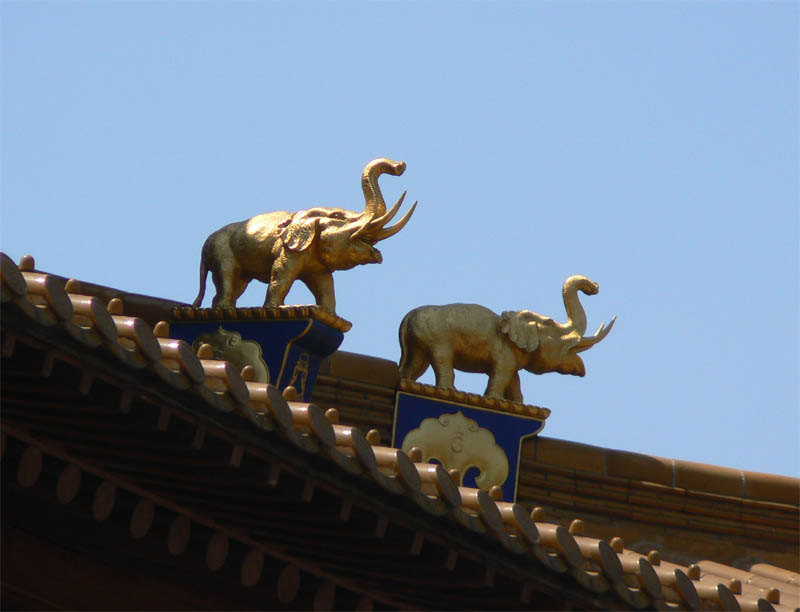
I've talked a little about Buddhism in China before, and I definitely will say more in the future. But as a quick look at an obvious difference between Chinese Buddhism and Western Christianity: even though Christianity comes from the Middle East, the Western European Jesus looks firmly Nordic, and various American Christian leaders claim America as a kind of chosen land. In Shanghai, on the other hand, Buddhism remains largely an exotic Indian religion, despite millenia of history, and being much more popular in China than in India. As a small example, this Jing'an Buddhist Temple is decorated with Indian elephants:


A few more things: from what I understand, ten years ago there were no yoga studios in Shanghai. Now, they're relatively common, and extremely trendy with women. I've heard it's most popular with the expatriate community, but I know some Chinese people who practice. Some of these studios employ Indians as the main instructor. Just today, my apartment building recieved a mailbox drop of brochures for a Yoga studio, one of them is pictured on the right. As far as I know, I'm the only foreigner in the complex, and the brochure is almost entirely in Chinese, although the part I show offers both English and Chinese writing.

Furthermore, if you look at very old movies of Shanghai, they often show a few Sikhs, acting as low-level police officers. This is also true of older Hong Kong movies - both Shanghai and Hong Kong were touched by the British Empire. The difference is that Shanghai's Indian community dispersed alongside the British Empire leaving, while Hong Kong retains a large, segregated Indian presence. I try to keep this blog in the first person, but Tales of Old Shanghai has some interesting historical anecdotes.


And, from what I understand, Shanghai's Indian restaurants are actually very good. Honestly I haven't tried them, it wasn't much of a priority for me as I generally believe foreign restaurants in Shanghai to be average at best. However I definitely will make it a point to try a few places in the near future.

But I don't want to overstate the case. I don't think India dominates the imagination of most Chinese people. When I told people I was going, the average reaction was of a poorly-hidden confusion about why I would choose to go there.

And now for the inverse! I did see a surprisingly large amount of things Chinese in India. It certainly didn't compare to being in Honolulu or Oakland, but I did run across Chinese stores and neighborhoods, I did see Chinese religious signs being used as talismans (most often the Taoist yin-yang sign, which I rarely see in Shanghai), and I did see a huge amount of Chinese food - both aimed at tourists and not. Not only are Chinese restaurants and snack stalls common, it seems every Indian diner has a large selection of Chinese food. The cooks are Indian and the food is localized, of course, with some seeming like a small variation, and some being unrecognizably Indian. I wish I had taken photographs so I could describe the food in detail, but I didn't! I did take a snapshot of this funny store:

Wednesday, January 10, 2007

A Pudong Construction Site

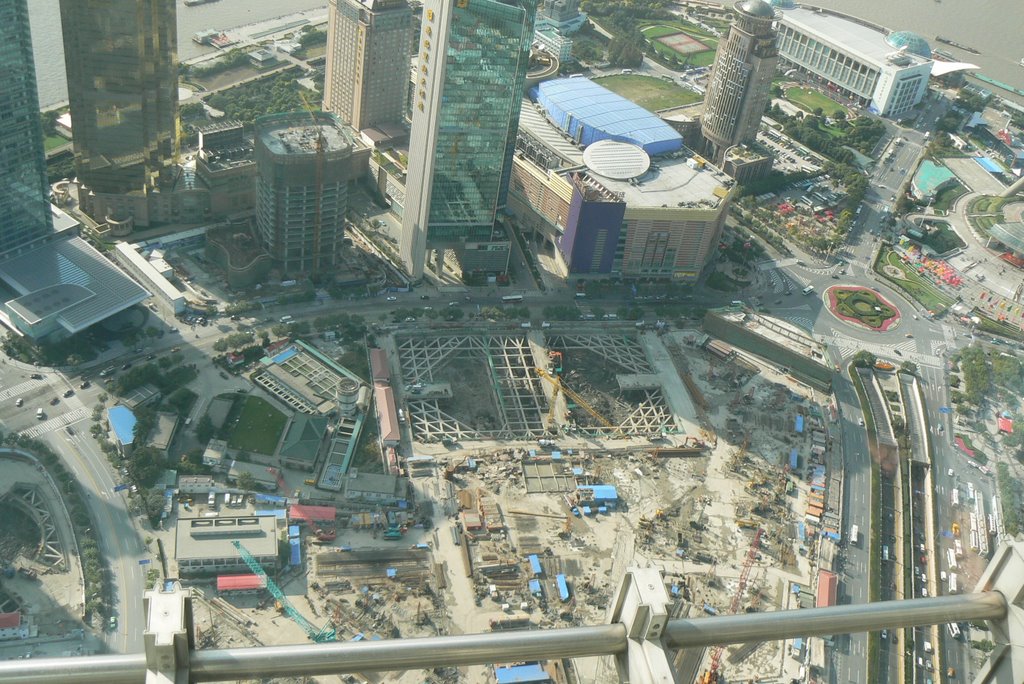
This is a short update about a construction project, using pictures again taken from my father. This will be my last update to use his pictures, at least until next time he visits! He snapped a number of shots of a massive multi-use complex that's going up in Pudong - upscale shopping and upscale apartments. The location is directly between the Jinmao Tower I mentioned in my last update, and the enormous Super Brands Mall. Actually none of these shots are my own, except for this picture showing the scope of the project. The image is pretty evenly split in halves. The bottom half shows the area being worked on, the top half shows a mall and six skyscrapers:


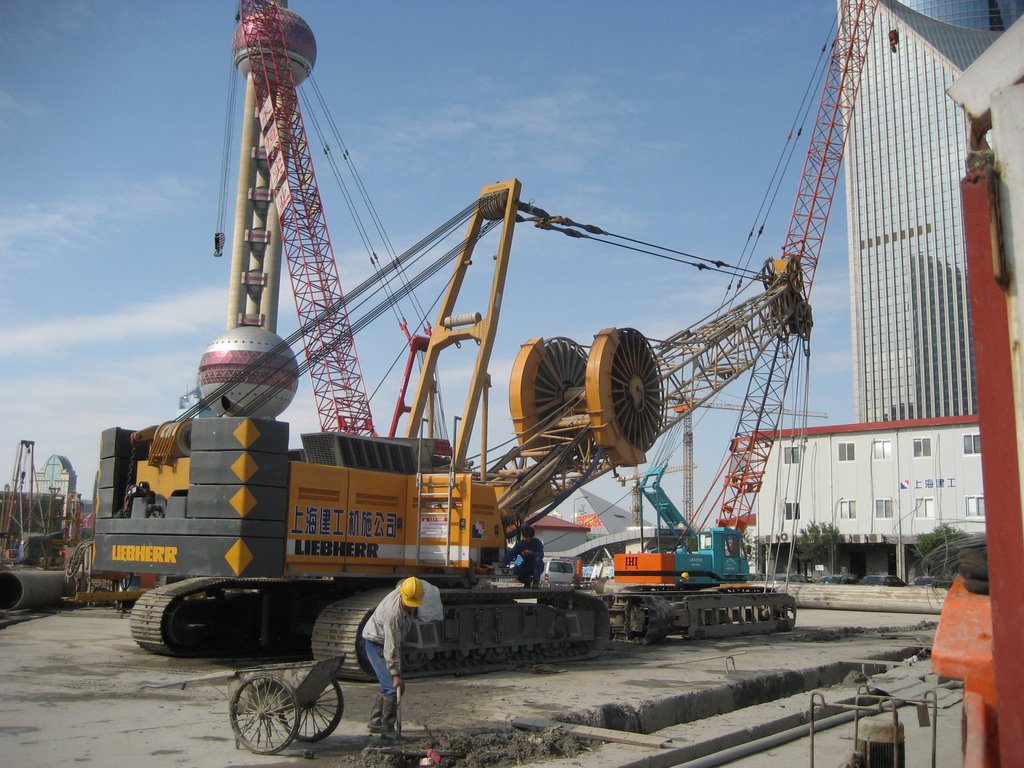
I've said it before, I'll say it again: there are construction projects everywhere you go in Shanghai, and everywhere I've been in China for that matter. I talked before about an apartment complex going up. This project is much larger, you can see it's one piece of heavy equipment after the next:


This project is a lot more modern than most you'll come across in China. For instance, much of the equipment looks brand new, and recently imported - Liebherr is a German brand, this site also features some American brands, although in general imported construction equipment in China comes from Japan or Korea.


But there's also equipment that looks like a relic from the Great Leap Forward. I'm not the expert, but this looks something like mining equipment. I assume it has to do with building deep foundation supports, a necessity given the Pudong being marshland and all.


Construction projects often have a fundamentally different look to them in China. There's less ready access to advanced machinery and skilled workers, but construction worker wages are extremely low and there's less safety regulations for workers. The end result is you see a lot of people doing things by hand, or a large crowd of workers working directly alongside the machinery. Honestly, this worksite is more modern than most, but you can still see oildrums being carted on bike, or trenches being hand-shoveled.


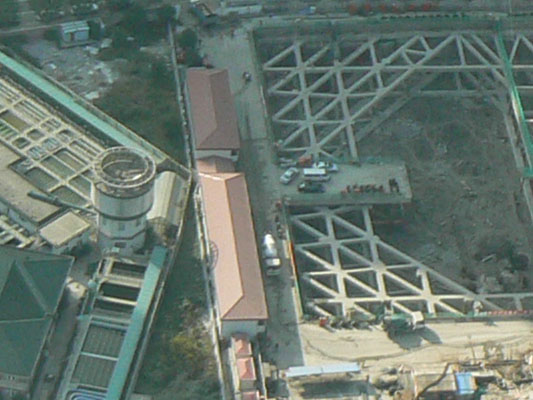
Many Shanghai construction sites feature on-site living for the workers, who are usually young men straight from the countryside. They're just tin-shack accomodations, obviously. I don't think this site features on-site living. Regardless, I enjoy zooming in on my top-down photo like it was a spy satellite, and I did come across this complex. While I'm pretty sure it's not on-site housing, have a look and judge for yourself:

Monday, January 08, 2007

A View From Above

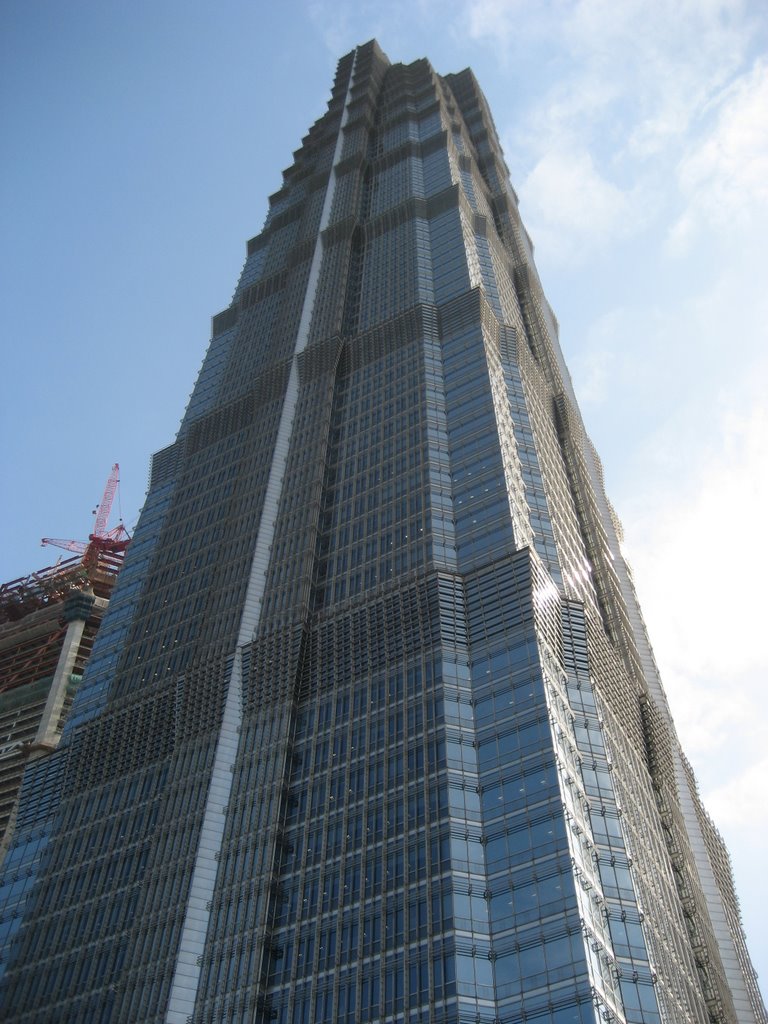
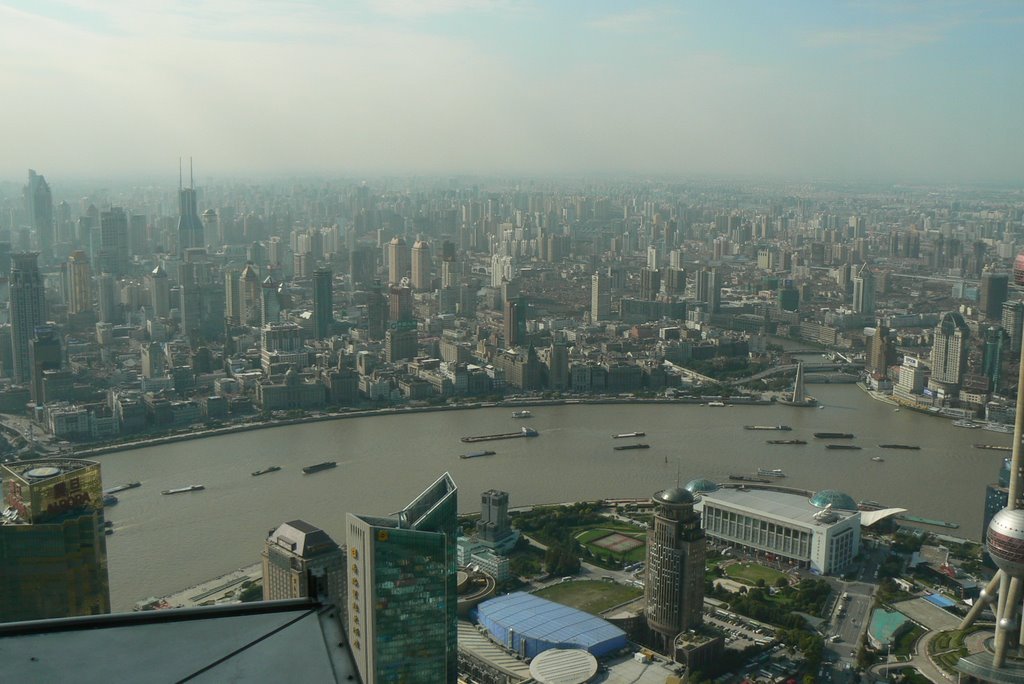
This will be a quick take on something that was more interesting than I thought it would be - a top-down look at Shanghai. Most of these pictures were taken from the Jinmao Tower, a very tall (one of the tallest buildings in the world), very odd-looking building in the Pudong district of Shanghai - you can see the massive steel girders on the outside, arranged in a step pattern. The location provides look over both the Pearl Tower, and downtown Shanghai:


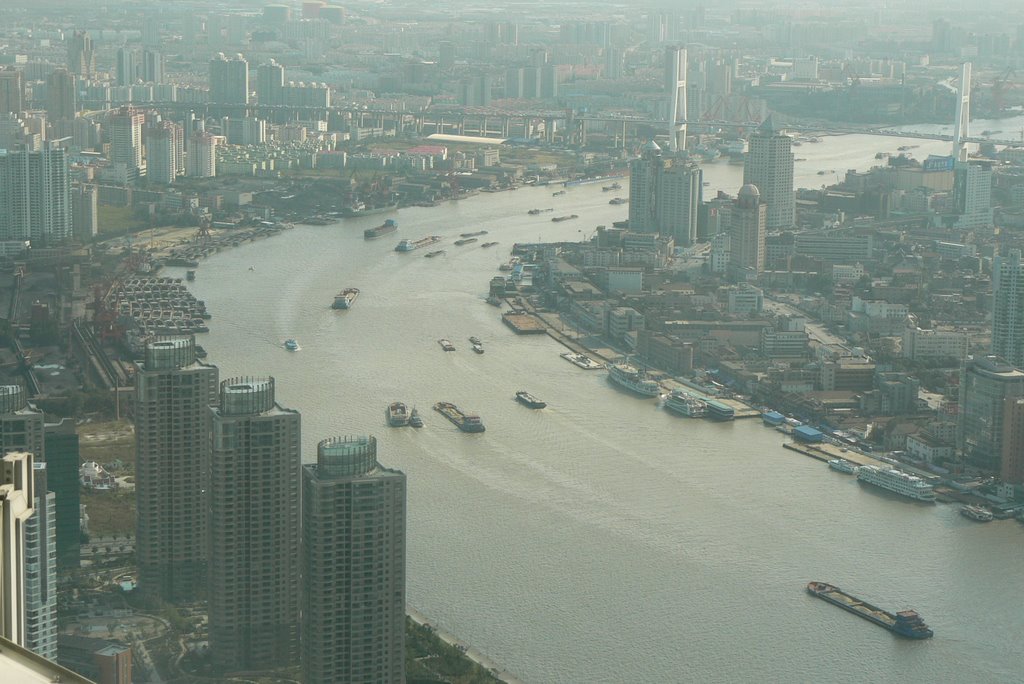
You can zoom in on the picture by clicking on the image, of course. Below is another view, slightly to the left. Some of these places will be familiar to the gentle readers of this blog. For instance, the central riverbank defines the Bund, the river flowing into it on the right is the Suzhou River, the area around alongside the Suzhou River could be call the North of the Bund Area, and the skyscraper with two immense prongs on top is located across from People's Park.


One thing that impressed me was the view of the Peace Hotel, the building in the below zoom with the pointed green roof. The road it's on is the shopping street of Nanjing Donglu, and the riverfront area is the center of the Bund.


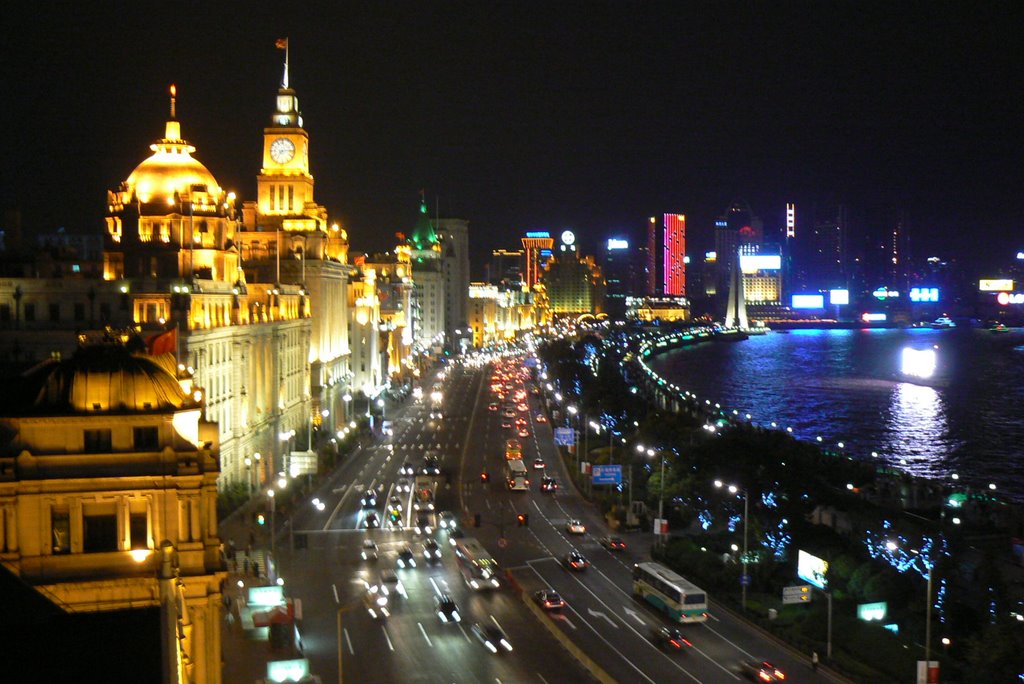
The Peace Hotel was built in 1930. At the time it was the tallest building in Asia. Now it's a small speck on the face of Shanghai city. Here is a photograph of the same area taken from Shanghai's well- regarded M on the Bund restaurant - you can again see the green roof of the Peace Hotel. Personally I prefer T8 to M on the Bund, if you're going for an elite non-Chinese restaurant - more on that in another update.


Even though Shanghai is located at the base of the Yangtze River, I had never given much thought to Shanghai being a port town, just because it's mostly out of site, out of mind - as opposed to living in Oakland, where I saw distant views of the docks every day of the week. Looking down from the Jinmao Tower, it came as a surprise to see the constant flow of commercial boats, making their way through the city:


I also got an interesting view on the construction of what will perhaps very briefly be the world's tallest skyscraper. It will be around fifteen hundred feet tall, as opposed to the Jinmao Tower's fourteen hundreed feet. Both will be dwarfed by a tower going up in Dubai, that's just a few feet short of five thousand, two hundred and eighty. Note the tract housing, immediately aside the skyskraper:


Simple economics doesn't ever necessitate building these kinds of buildings, it's especially true in Shanghai. Like other modern ultra-tall skyscrapers, propaganda and projecting an image of wealth is the largest part of the reason for its construction, rather than direct economic concerns. This is especially true with the location of Pudong, which is essentially over-loaded and receding swampland, expected to recede even quicker with the Three Gorges Dam now holding soil runoff. More scary is, these buildings lack adequate earthquake bracing.

On the other hand, perhaps the propaganda does what it's supposed to do, as the skyscraper boom has been accompanied by a wealth of elite hotels opening branches in Pudong, corporations re-locating their Asian headquarters to Shanghai, and hyperbolic magazine articles about Shanghai's Blade Runner-esque skyline.

Saturday, January 06, 2007

Jet Set Jeff Encounters the Terra-Cotta Warriors

In my last post, I found myself in the ancient city of Xi'an, ready to encounter what lay ahead: the clay statue remains of the ancient Qin Dynasty warriors!

As a very short history lesson, the Qin Dynasty united China 2200 years ago, and set about standardizing the written language, measurements, culture, and so forth. They also ruled heavy-handedly, and enacted a large number of expensive, fanciful public works - the secret Terra Cotta Warrior burial chamber, searches for immortality magic, and the unification of many smaller walls into the Great Wall were a few of them. Ultimately the dynasty only lasted twenty years, and the Terra Cotta Warrior Site never was uncovered. It was forgotten to history until its discovery in the 1970s, by farmers digging a well - the actual site lies in the rural suburbs of Xi'an city.


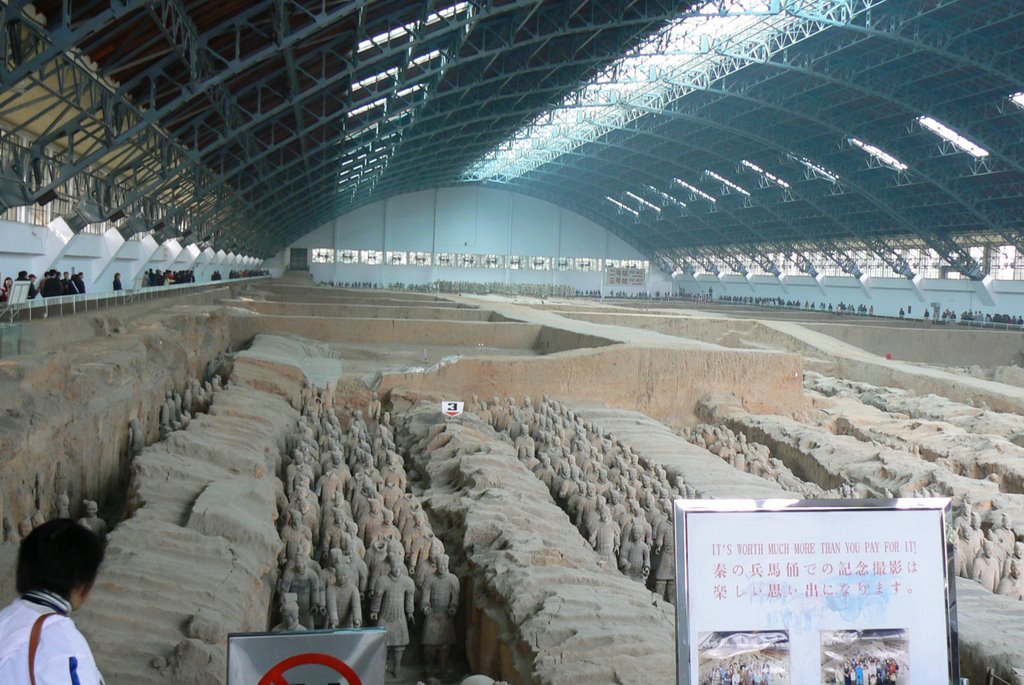
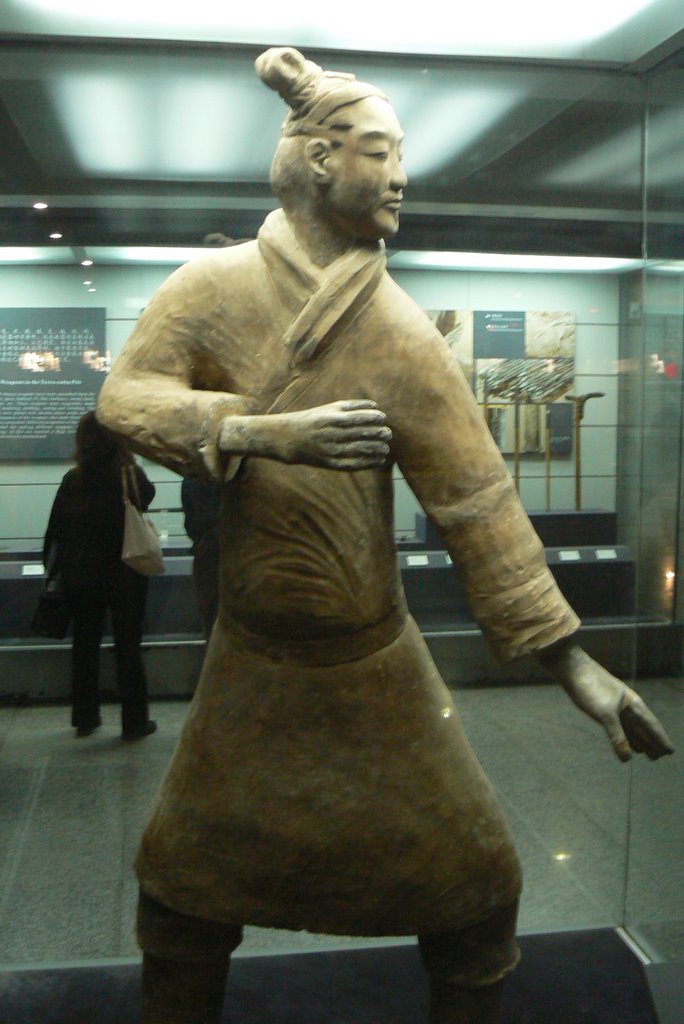
Again I'll talk about Imperial Chinese historical sites in terms of quantity: while the statues were memorable, individually made with a great skill, what most impresses in the scope of the project - the statues just go on and on, there's thousands of them. The first (and by far the largest) dig is located inside what seems like an airplane hangar:


You can see that that it's not only soldiers. Terra-Cotta Horses were also buried, they were carrying chariots that have long since decayed.


Behind the horses can be made out the outline of clay sculptures, still being assembled. As solid as the sculptures seem in the above picture, all the terra cotta warriors had been smashed to bits. Thousands of years ago the statues had been originally housed in wooden structures, the roofs have long since collapsed.


Bringing the statues back together looks like an amazingly painstaking process, and even now the large majority of the site is unexcavated - not only that, but there are other nearby Terra-Cotta sites that haven't even been touched yet! It's such a large job, with new sites still being discovered, that I don't expect the work to be finished in my lifetime.

Once outside the excavation sites, there's a huge industry of hawkers aggressively pushing small-scale Terra-Cotta Warriors, latching on parasitically, starting with high-ball prices and quickly dropping to prices so ridiculously cheap you almost wanted to get them as a whim. You can see them ahead...waiting...


Also! On the walk to the parking lot, there was a ridiculously lengthy procession of newly constructed one and two story buildings. They looked very plain, something like an office park or an off-market shopping center. They were all empty, except for people with tables out front, selling fruit and silly tourist junk. As the walk went on and on, it felt eerie, like walking through a ghost city. I'm not sure how they expect to full so many buildings in such a remote area, I imagine they hope future tourists will stay entirely in this complex, not even bothering with the trip to Xi'an proper.

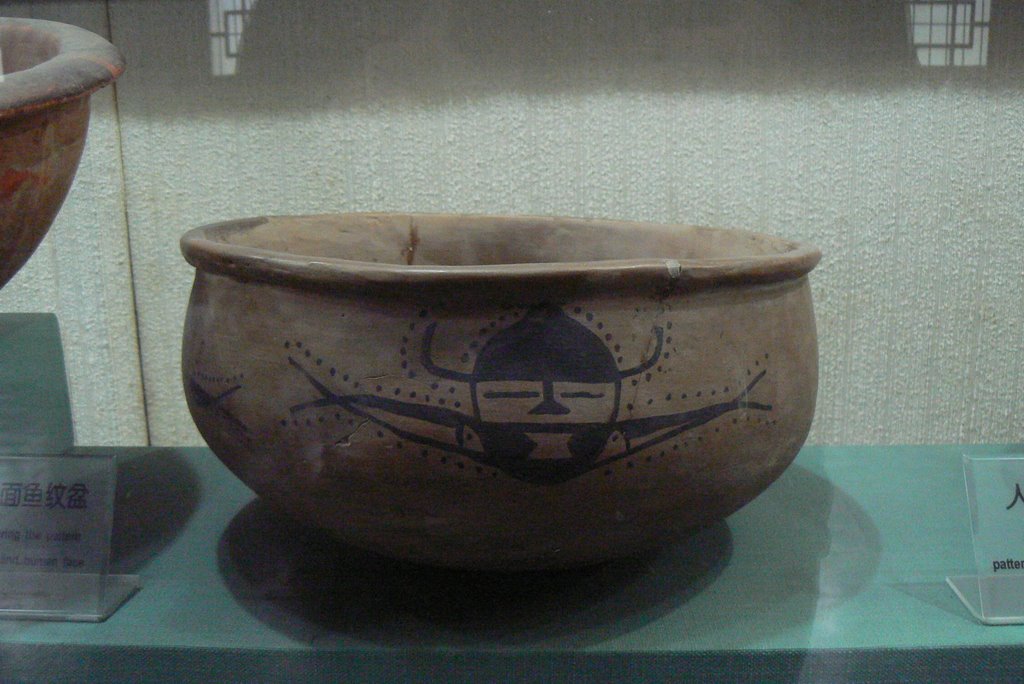
I also visited another excavation site, Banpo Neolithic Village. It's ancient, nearly six thousand years old, and naturally there's a lot less to see: a few clay pieces, burial sites, foundations of houses, etc. To my inexpert eye there seems to be some connection to a more modern China, but how they fit in exactly is unclear. As with the Terra-Cotta Warriors site, the excavation is still in process, they're less than half finished.

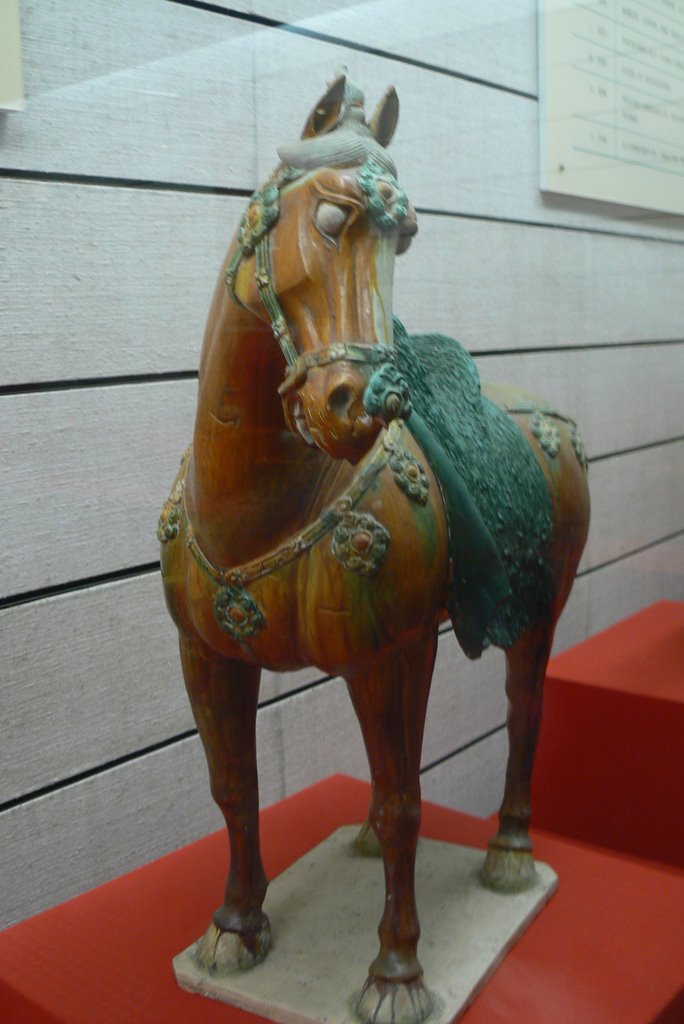
Finally, I had a quick look at Xi'an Shaanxi History Museum, where Shaanxi is the name of the Prefecture. I don't have much to say, other than that there were many interesting items:

Thursday, January 04, 2007

Jet Set Jeff Explores Xi'an

After visiting the city of Beijing, my entourage and I jetted off to Xi'an. Xi'an was the capital of China for around four hundred years, until about fifteen hundred years ago. It's famous for nearby historical sites, especially the terra-cotta warriors. However, on its own it's a very enjoyable city of seven million people, and this update will be talking about the city by itself.

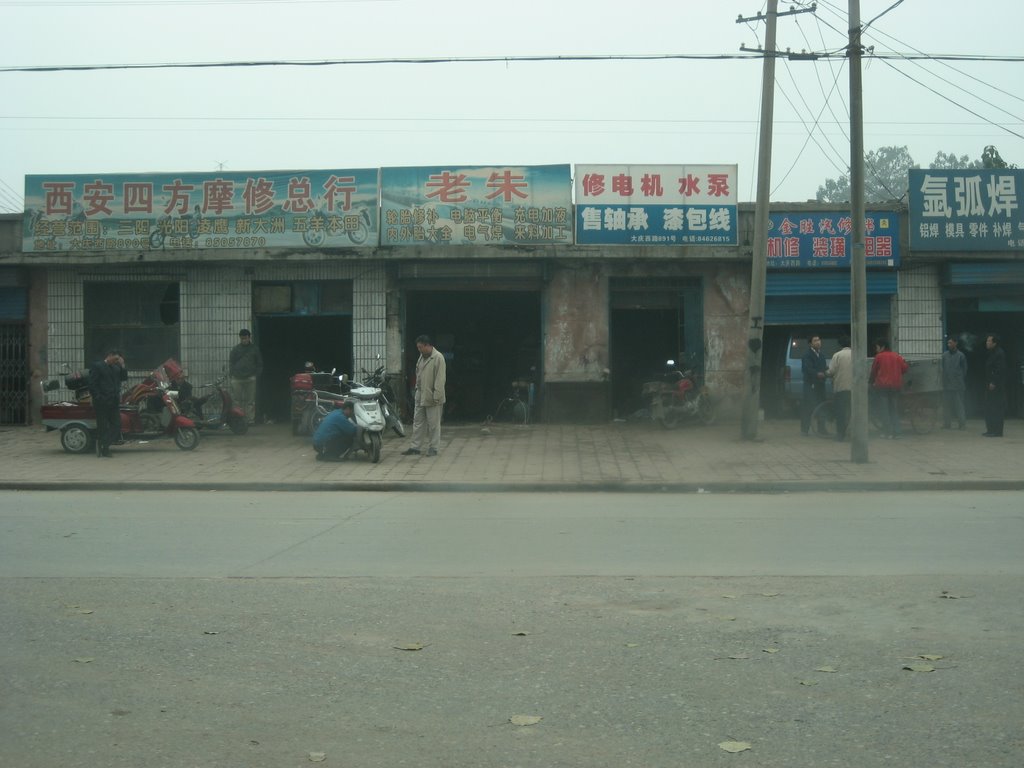
First impressions weren't that good. After arriving at the modern airport, we hopped in a cab and took the highway into town. The highway was dark, there were piles of dirt just lying around, there were coolies walking in the middle - the driver took the road at about 30 miles an hour. Days later, on the way back, I saw that the highway was literally in the middle of being constructed. Anyway the highway wasn't yet navigable all the way into town, so we got off early and found ourselves snaking through impoverished city streets. Surreal and difficult to describe, among other things there were miles and miles of shacks like this:


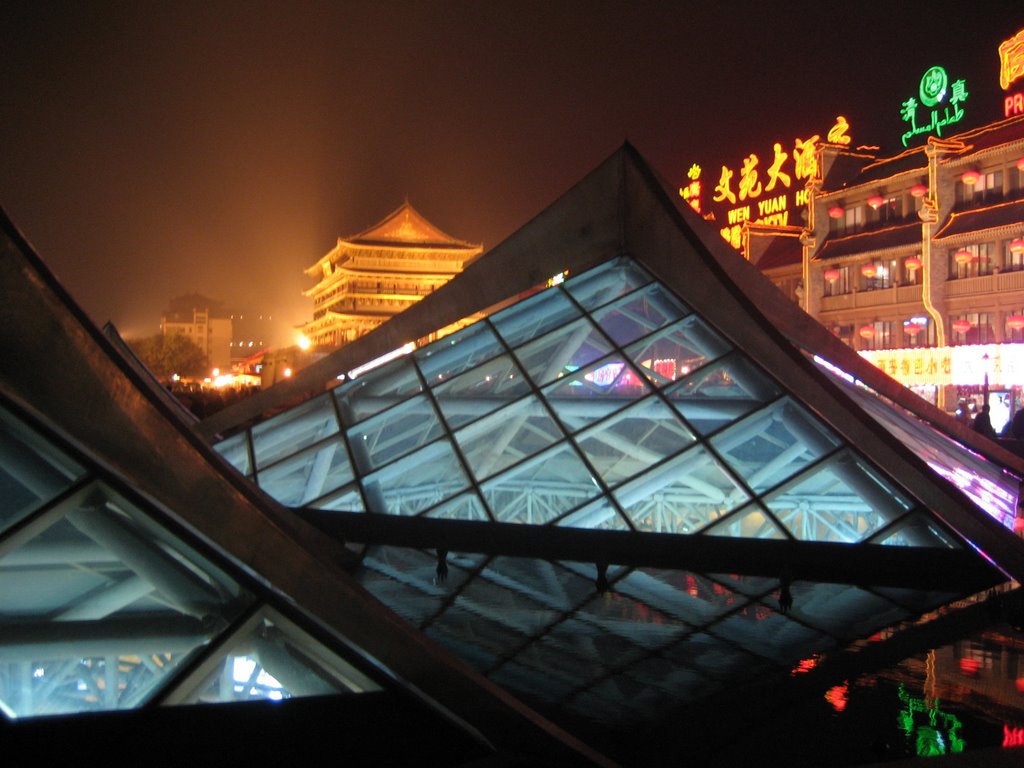
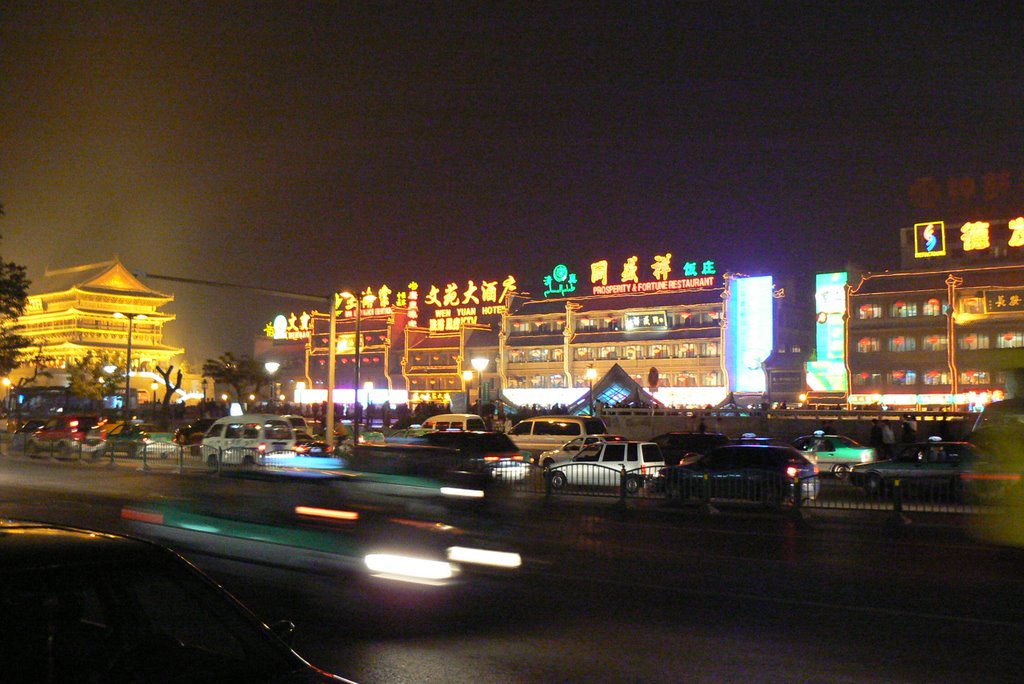
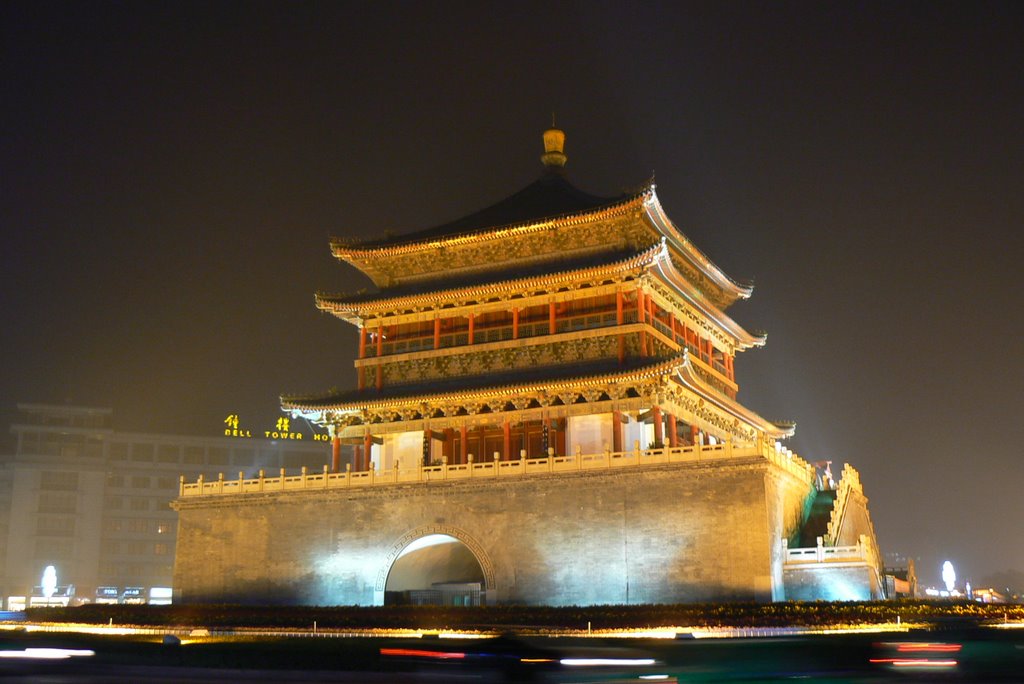
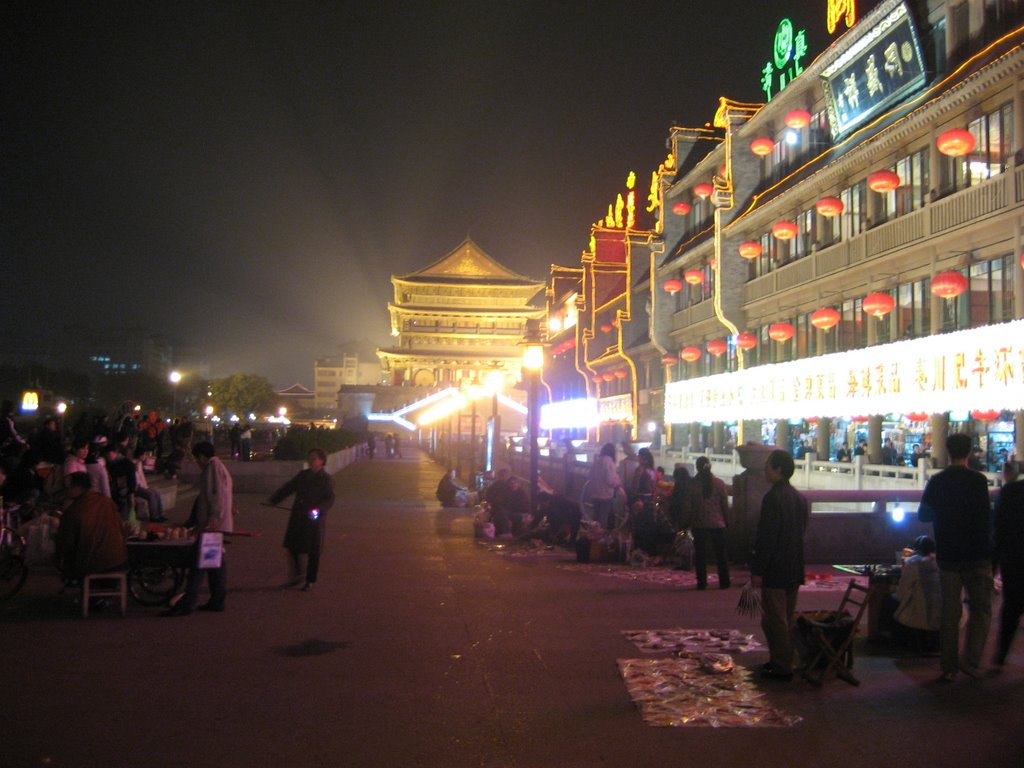
When we reached the center of town, there was a sudden and complete shift. Bright lights, wide boulevards, shopping centers, and immense restaurants, all anchored around beautiful ancient buildings. You can see the drum tower and the street restaurants in the picture to the left, underneath is a picture of the 14th century bell tower:


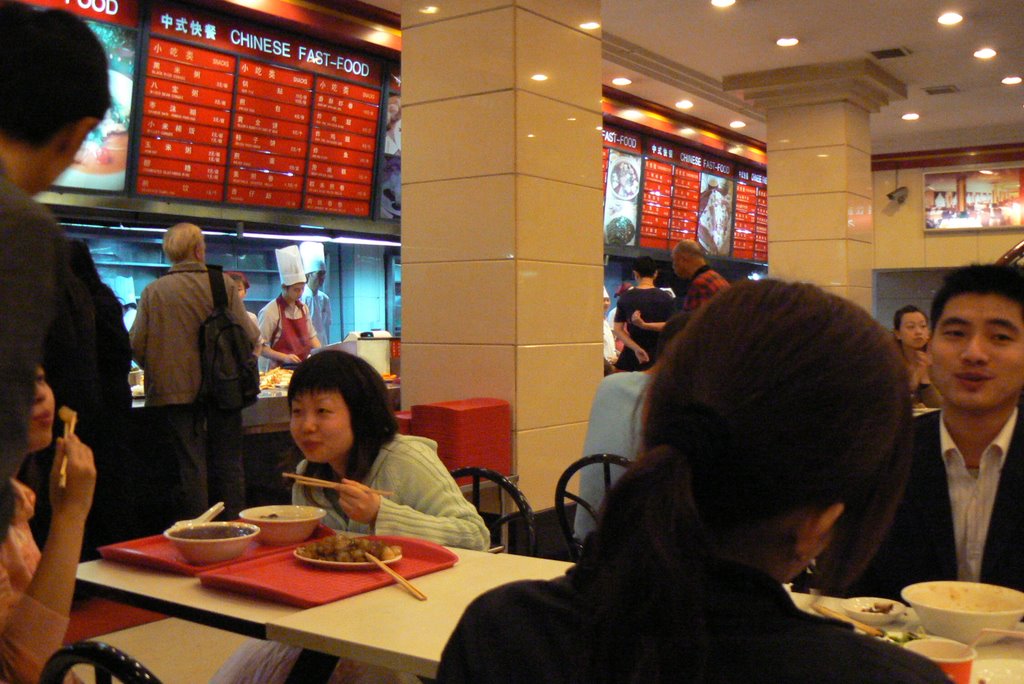
I very rarely come across new tastes or food in Shanghai, maybe the biggest exception is the Sichuanese ma flavor, it numbs your mouth like Novocain. By contrast, half the food in Xi'an looked like nothing I had seen before! Not in an exotic way, though - there was a lot of mutton and wheat dishes. This restaurant I went to was fun, maybe something like a higher-quality and spectacularly busy cafeteria - you pointed at what looked tasty, and they handed it over. Not the greatest food in the world, but passable, and a relaxed atmosphere counts for a lot:


Unlike Shanghai, where for the most part the sidewalks are narrow, crowded, and full of obstacles in your path, walking on the wide sidewalks of Xi'an was very easy and fun, and even at its most crowded you didn't feel pushed. Unfortunately I didn't get a good photo of this, but here are some street vendors, set up on the sidewalks just a little off the main drag, again with the bell tower in the background:


Everything you would expect from a fairly wealthy city was here: night clubs, malls, five star hotels, and elite clothing brands. In the back of my mind I couldn't get past the miles and miles of poverty we had driven through, to get to this city center. Just one of many examples of these small upscale stores is a local cafe chain selling fancy pastries: the name was something like "American Bakery."


I should also mention that the city walls are still extant, surrounding the city center. They're very beautiful, from what I understand Xi'an is almost finished restoring the entire wall, so you can walk along the top for the whole circumference. Very cool, by contrast in most Chinese cities the walls have long been torn down, with perhaps small fragments of the city walls still remaining. There were also various districts of older buildings, many of which are partly or largely supported by the tourist industry:


I didn't have as much time as I'd have liked, and I really regret not being able to have a look at the Muslim Quarter or the Silk Road Museum. Also, I'm stealing a lot of the photographs for this update from my father, I hope he's a good sport about it and doesn't take me to court!

Tuesday, January 02, 2007

Some American Retailers ; a Statement of Purpose

Very quickly I'd like to talk about two slices of the American big-box lifestyle making it over to China. With the further de-regulation of the Chinese market, I suppose, a couple of American retailers recently put up stake in Shanghai. The first was entirely welcome:


You can see it's an outlet of Best Buy, actually the world's largest branch of the electronics chain. I was looking forward to the opening, a few days after Christmas, because buying electronics in Shanghai is a huge bother. The normal way to do it is to go to one of Xujiahui's large electronics bazaars, with lots of very small stalls, each holding one or two different brands of goods. Instead of just freely looking at products, you have to enter a bargaining stance. And to get the best deal, you have to price-compare, at dozens of different places, all along with the feeling that nobody's cutting a foreigner a break.

Unfortunately the prices at Best Buy, if better than Shanghai's other electronics chain stores, generally don't match up to these smaller dealers. Furthermore, the return policy is only two weeks, and only when things are broken - and I got a whole lot of guff when trying to return something with bad software, seemingly out of a general disbelief that a foreigner can install software properly. It's still much larger than anything else in Shanghai, and a good place to browse, but not what I had hoped for.

The other recent chain store opened a few weeks before Christmas: Toys 'R Us. The storefront, in the upscale Lujiazui area, is actually pretty small, but I decided to go in and have a look. The insides are much larger than the storefront would indicate, although truth be told I'm not really in the market for toys. It was still fun to look around. Given the prices and the American branding, I thought there would be a lot of foreigners, but it was all Chinese families browsing the aisles.


If you look above, you see the Autobots sign. I was surprised because I thought Transformers had faded away since I was a kid. Actually the section was pretty large, and while there were some differences, they were still massively overpriced, just the way I remember! They had a large model of Optimus Prime, and while I considered fulfilling childhood ambitions and buying the toy, I quickly nixed the idea.


Not to say these are the only foreign companies doing business in China - the mall with the Toys 'R Us is operated by a Thai company, Citibank's Asian headquarters is a few minute's walk from there, McDonald's and Starbuck's are well established around Shanghai, and Motorola and Nokia phones are dangling from everybody's necklaces (no, really). But both these stores enter a retail niche that's now dominated by local mom & pop operations, and I'm guessing these store openings are a Harbinger of what's more to come.

Oh, and I've had a flurry of updates over the past couple of weeks. Expect the pace to continue; I have a three-month backlog of pictures and topics that I'd like to put online. But even when I make my way through the stack, I'm hoping to make this blog a two or three times a week affair. The scope will be changed, I'll try to have both lighter updates, and to get into more investigative looks at Shanghai. Definitely I think this blog will get better and better.

By far the best blog I've come across (and in that way, a recent inspiration for this blog) is Boston, 1775. Have a look-see!